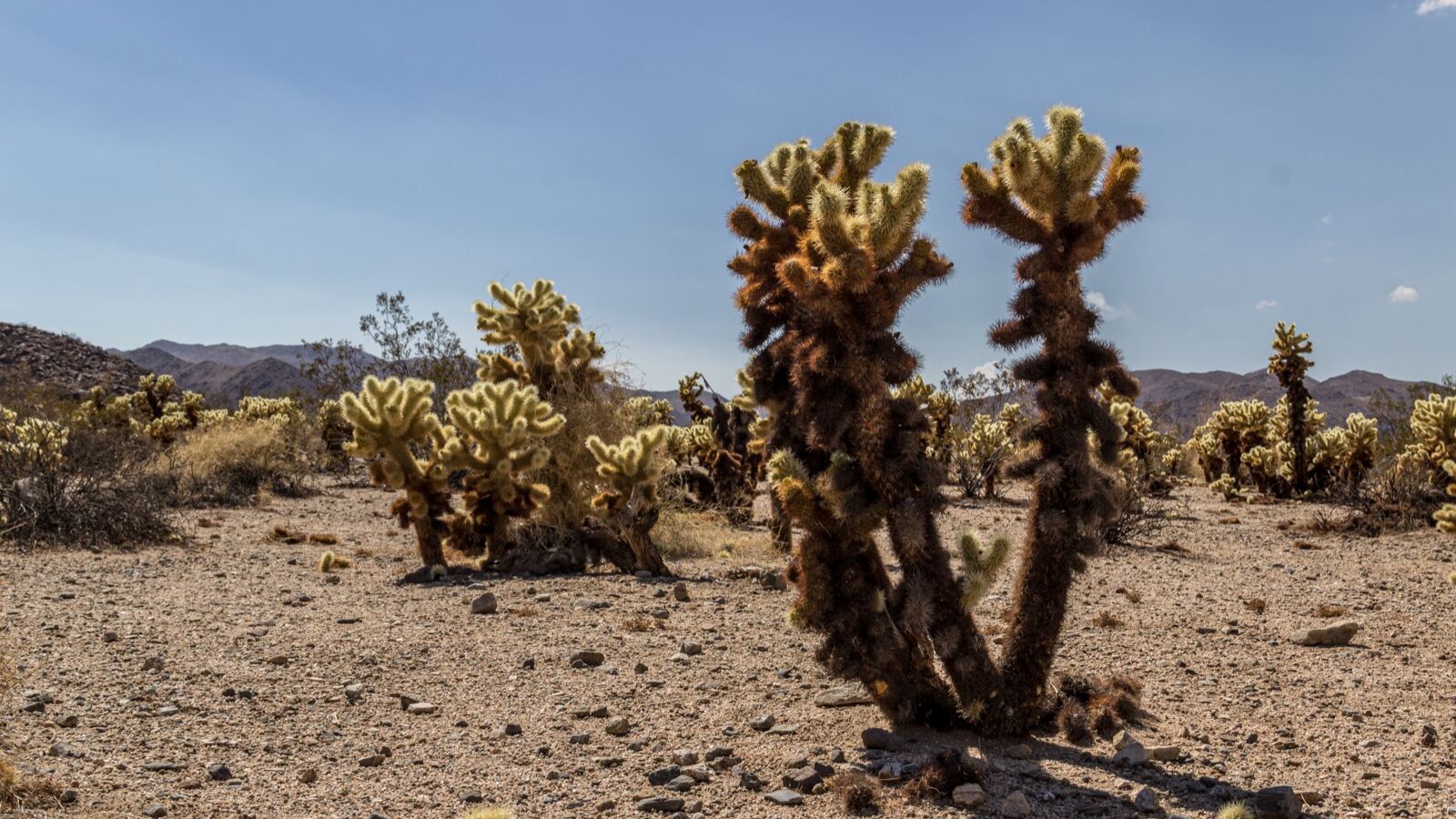
What they are
Yucca, the yuccas — stiff, spiky, evergreen rosette plants of the deserts and dry grasslands of the Americas, ranging from low clumps to the tree-sized Joshua tree (Yucca brevifolia) of the Mojave Desert, the largest and most famous of them.
Like the dragon tree, palms, and agaves, yuccas are monocots — relatives of the lilies and asparagus — not true woody trees. The tree yuccas grow tree-sized and branch into their strange, shaggy, arm-waving forms, but they have no true wood or growth rings, thickening instead through an unusual secondary growth peculiar to some monocots. The Joshua tree, with its up-thrown branching arms tipped with spiky rosettes, is the signature plant of the Mojave and gave its name to the American national park.
One tree, one moth
The yuccas are the textbook example of an obligate pollination mutualism — two species so completely dependent on each other that neither can reproduce without the other. It is one of the most celebrated relationships in all of ecology.
Yuccas are pollinated only by yucca moths (Tegeticula and relatives), and the yucca moths breed only in yuccas. The partnership is astonishingly specific:
- A female yucca moth gathers pollen from one flower, rolls it into a ball, flies to another flower, and deliberately packs the pollen onto the stigma — actively pollinating it, a behaviour seen almost nowhere else in nature.
- She then lays her eggs in that flower's ovary. The pollinated flower develops seeds, and the moth's larvae eat some of those seeds as they grow — but only some, leaving enough for the plant.
So the moth guarantees the yucca's pollination, and the yucca feeds the moth's young, and each has evolved to take just enough and no more. Remarkably, the yucca can even selectively abort flowers in which a moth has laid too many eggs, policing the bargain. Neither species can survive without the other — no yucca moths, no yucca seed; no yuccas, no moths. It is the clearest illustration of coevolution and of how deeply a tree can be tied to a single insect, in the manner of the fig and its wasp. See pollinator habitat and native bees.
Climate change and the Joshua tree
That exquisite partnership is also a vulnerability, and the Joshua tree has become a symbol of the threat climate change poses to tightly-linked species.
As the Mojave warms and dries, the conditions the Joshua tree needs are shifting — the trees depend on winter cold to flower and on occasional wet years to establish seedlings, and their suitable range is projected to shrink drastically, potentially disappearing from much of the national park named for them. But the tree cannot simply migrate to cooler ground, because it can only move as fast as its seeds are dispersed, and its Ice Age long-distance disperser (the giant ground sloth) is extinct, leaving only rodents that move seeds a few metres. And even if the tree could shift, its moth would have to shift with it, at the same rate, or the whole reproductive partnership breaks. A mutualism this tight means two species must track a changing climate in perfect step — a much harder ask than one. The Joshua tree is now a focus of assisted-migration debate and conservation concern for exactly this reason.
Uses
Yuccas have long served desert peoples. The roots and leaf bases of some yuccas are rich in saponins and were used as soap and shampoo ("soapweed," "amole"). The tough leaf fibres were made into cordage, sandals, baskets, and mats — yucca fibre was a staple material of the desert Southwest. The flowers, fruit, and flower stalks of several species are edible, roasted or boiled, and the banana yucca and Spanish bayonet were food plants. The dramatic spikes of creamy flowers are also simply beautiful, and yuccas are widely grown as bold ornamentals.
Growing them
Full sun, heat, and above all sharp drainage — yuccas want dry, poor, sandy or gravelly soil and rot in wet ground; most are very drought-hardy and many are surprisingly cold-hardy, so hardy yuccas are grown far beyond the desert as architectural garden plants. The Joshua tree itself needs desert conditions and is slow and difficult outside them.
Grow lean and dry; overwatering and rich soil are the main killers. Propagated from seed (the smaller yuccas readily, the Joshua tree slowly and, in cultivation, without its moth, so seed is scarce), and from offsets and cuttings. See propagation and drought-tolerant species.
See also
- Dragon Tree another tree-forming desert monocot
- Palms the fellow monocots that reach tree size
- Butterflies and Moths the yucca moth and coevolution
- Climate Adaptation the threat to the Joshua tree and its moth
- Pollinator Habitat the tightest of pollination partnerships
- Osage Orange another plant stranded by the loss of its Ice Age disperser
- Banyan and Strangler Figs
- Quiver Tree
- Grass Tree
- Coevolution