What it is
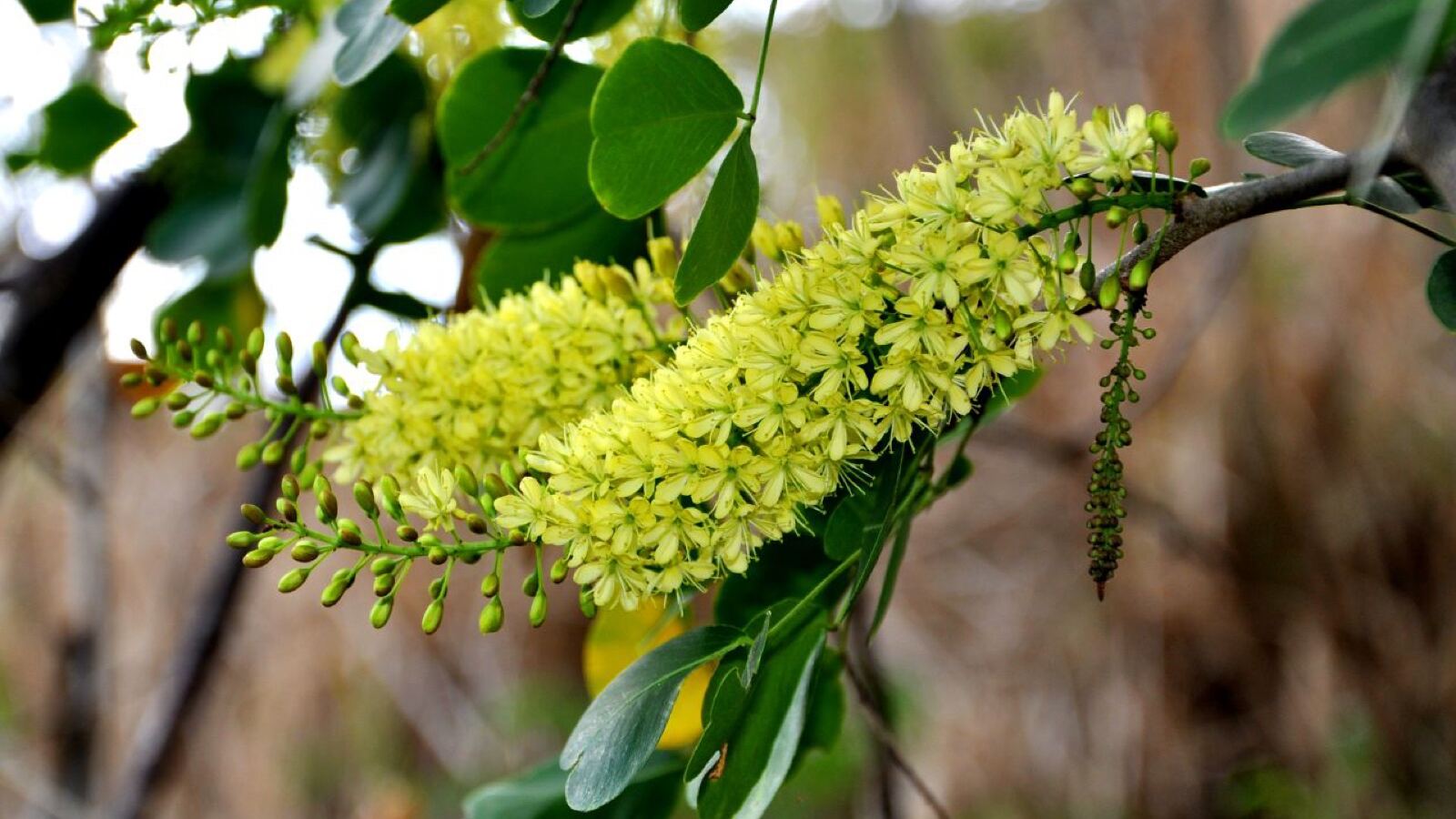
Haematoxylum campechianum, the logwood or campeche tree — a small, thorny, crooked leguminous tree of Central America and the Caribbean, kin to the tamarind and the other pea-family trees, whose dense, dark-red heartwood is the source of one of the most important natural dyes in history.
The genus name means "bloodwood," and the heartwood, boiled, yields a colouring that — depending on the mordant used — dyes wool, silk, cotton, leather, and paper deep black, blue, purple, or grey. Before synthetic dyes, a good, cheap, permanent black was hard to obtain, and logwood supplied it.
Worth a war
Logwood black was so valuable that the tree shaped the history of a whole region. From the seventeenth century, European demand for the dye drove the cutting of wild logwood in the forests of the Yucatán and Central America, and control of the "logwood coast" was fought over bitterly.
British "Baymen" — many of them former buccaneers and pirates — settled the swampy coasts to cut and export logwood, in defiance of Spanish claims, and the logwood trade was the origin of the British presence that eventually became British Honduras, now Belize (whose flag still shows a mahogany tree, the timber that later succeeded logwood). Logwood was, for a time, one of the most valuable commodities crossing the Atlantic, and skirmishes, treaties, and settlements turned on the right to cut it — a scrubby dye tree at the centre of imperial rivalry, the same story of a tree's product driving conquest and trade as quinine and the spice trees. See historical ecology and restoration economics.
The stain in every laboratory
Logwood's most enduring use is one almost no one sees, yet nearly everyone has benefited from. The active dye compound in logwood is haematoxylin, and haematoxylin is the single most widely used stain in biology and medicine.
Almost every slide of human or animal tissue examined under a microscope — every biopsy, every pathology sample, every histology class — is stained with haematoxylin and eosin ("H&E"): the haematoxylin (from logwood) colours the cell nuclei blue-purple, the eosin colours the rest pink, and the contrast reveals the structure of the tissue. This has been the standard stain for well over a century, so a Central American dye tree is, quietly, the reason pathologists can see cancer cells and students can see the architecture of a cell. Logwood is still grown and harvested specifically to supply haematoxylin for this purpose — a remarkable afterlife for the pirates' dye, and one of the clearest cases of a tree's chemistry underpinning modern medicine. See tree diseases for the wider theme of trees and human health.
Growing it
Tropical to warm-subtropical and frost-tender, logwood is a tough, thorny, drought-hardy small tree that thrives on poor, wet, and even seasonally-flooded ground as well as dry sites — it is undemanding and adaptable, wanting mainly warmth and full sun. As a legume it fixes nitrogen and tolerates poor soil.
It is slow-growing (the valuable dark heartwood takes years to form), long-lived, and grown from seed; it bears fragrant yellow flowers that are an excellent bee and honey plant, so in its range it is valued as a honey tree as well as a dye tree. It has naturalised and can be weedy in some places. A modest, thorny tree with an outsized place in history and in the laboratory. See propagation.
See also
- Brazilwood the red-dye tree that gave a country its name
- Tamarind and Carob its legume-family relatives
- Quinine Tree another tree whose product drove empire and medicine
- Osage Orange another tree grown partly for a yellow dye
- Historical Ecology logwood and the founding of Belize
- Restoration Economics a dye tree at the centre of imperial trade
- Genipap