What they are
Fouquieria, a small genus of bizarre desert plants of the American Southwest and Mexico, of which two are especially strange:
- the ocotillo (Fouquieria splendens) of the Sonoran and Chihuahuan deserts — a great spray of long, thorny, wand-like stems rising from a central base like a spiky fountain or an upturned broom;
- the boojum tree (Fouquieria columnaris, once Idria) of Baja California — a tall, tapering, mostly-leafless column, thickest at the base and narrowing to a point, often bending and curling, that looks less like a real plant than something from a storybook.
Indeed the boojum owes its English name to exactly that impression: an early explorer, reminded of the impossible creature in Lewis Carroll's nonsense poem The Hunting of the Snark, named it the "boojum," and the name stuck.
Leaves only when it rains
Both plants share the desert trick that defines them: they carry leaves only when there is water, and drop them the moment it dries.
The ocotillo spends most of the year as a bundle of bare, grey, thorny sticks — apparently dead. But within days of a good rain, the whole plant flushes with small green leaves, turning the spiny wands soft green almost overnight; and when the soil dries again, it drops those leaves and returns to bare thorns. A single ocotillo may leaf out and shed several times in a year, each time it rains, growing and photosynthesising in the brief wet windows and shutting down completely in between — an extreme, opportunistic version of the drought-deciduous strategy, wringing growth from every rain and wasting nothing on leaves in the dry. Between leafings, like the palo verde, it can photosynthesise a little through its green-tinged bark. The boojum does the same, leafing along its strange column after rain.
This makes them superb indicators of desert rhythm — a green ocotillo means it has rained recently — and models of survival in a land where water comes rarely and must be seized instantly. See drought-tolerant species.
Flowers, uses, and fences
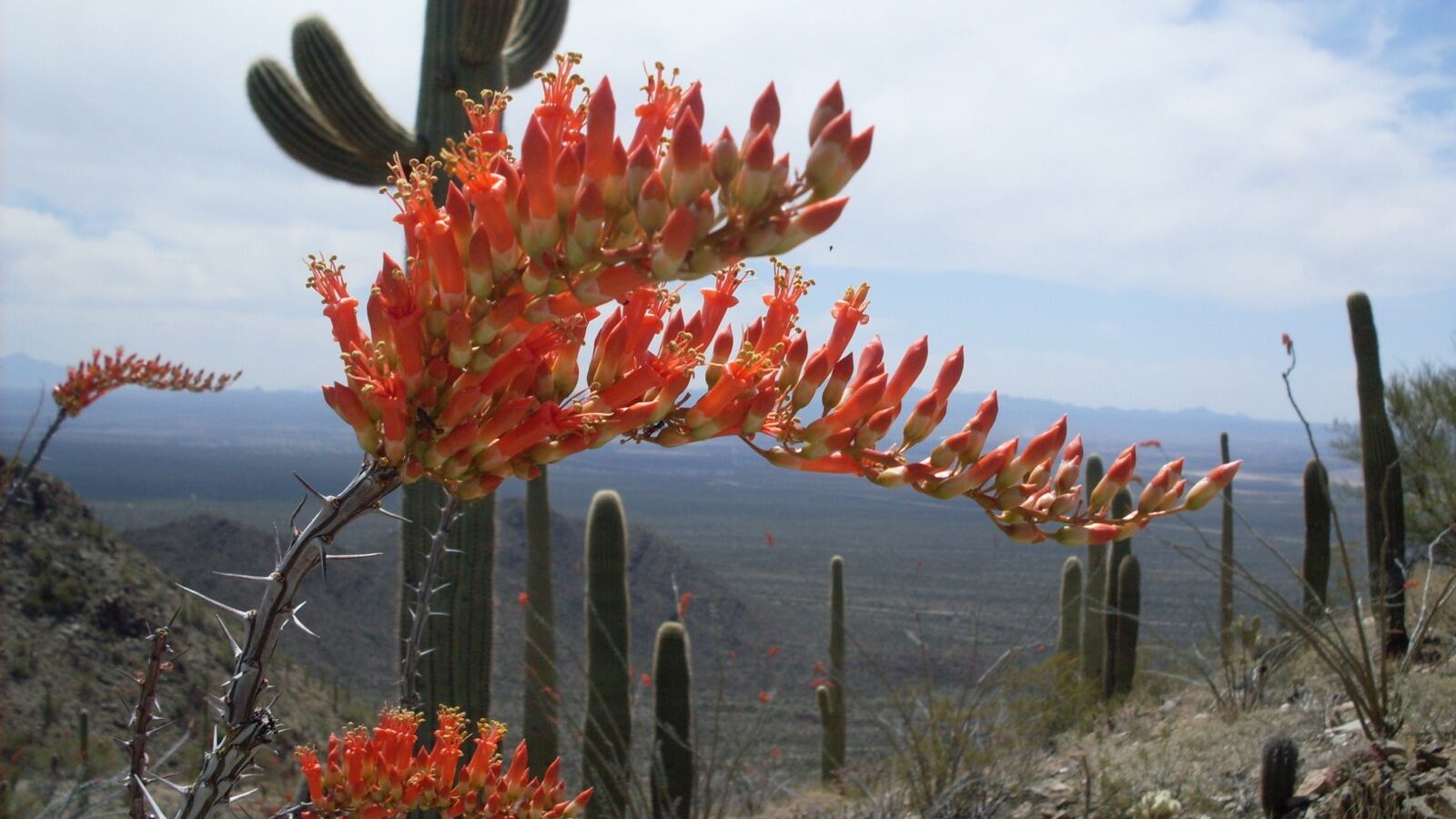
At the tip of each ocotillo wand, in spring, blazes a cluster of brilliant tubular red-orange flowers, rich in nectar and a vital food source for hummingbirds migrating north through the desert, as well as for carpenter bees and orioles — making the leafless-looking ocotillo a keystone nectar plant at exactly the season the hummingbirds need it.
The ocotillo has a long human use too: because its cut wands root readily and keep growing, they were, and are, planted in rows to make a living fence — a thorny, stock-proof, occasionally-flowering barrier — one of the classic desert living fences, in the spirit of the gliricidia and coral tree fences of the tropics. The wands were also used for walls, ramadas, and roofing. The boojum, growing only in a remote corner of Baja and on one patch of the mainland, has little practical use but is a treasured botanical curiosity and a symbol of the Baja desert.
Growing them
Strictly desert plants: ocotillo and boojum want intense sun, heat, and extremely sharp drainage on poor, rocky, sandy soil, and above all they must be kept dry — they rot almost instantly in wet, humid, or cold conditions or in ordinary watered garden soil, which is the main way they are killed in cultivation.
The ocotillo is grown as a dramatic architectural plant in desert (xeriscape) gardens across the Southwest, established either from seed or from rooted cut wands (which, planted in the dry and watered only sparingly until rooted, grow into a living fence or specimen). The boojum is a slow, precious collector's plant. Both demand desert conditions and near-neglect: lean, dry, sunny, and sharply drained. See propagation and dryland restoration.
See also
- Palo Verde another desert plant that photosynthesises through its bark
- Dragon Tree and Quiver Tree more strange desert forms
- Joshua Tree and Yuccas the fellow oddities of the American desert
- Pollinator Habitat the ocotillo's role feeding migrating hummingbirds
- Drought-Tolerant Species leafing out only when it rains
- Leucaena and Gliricidia other living-fence plants