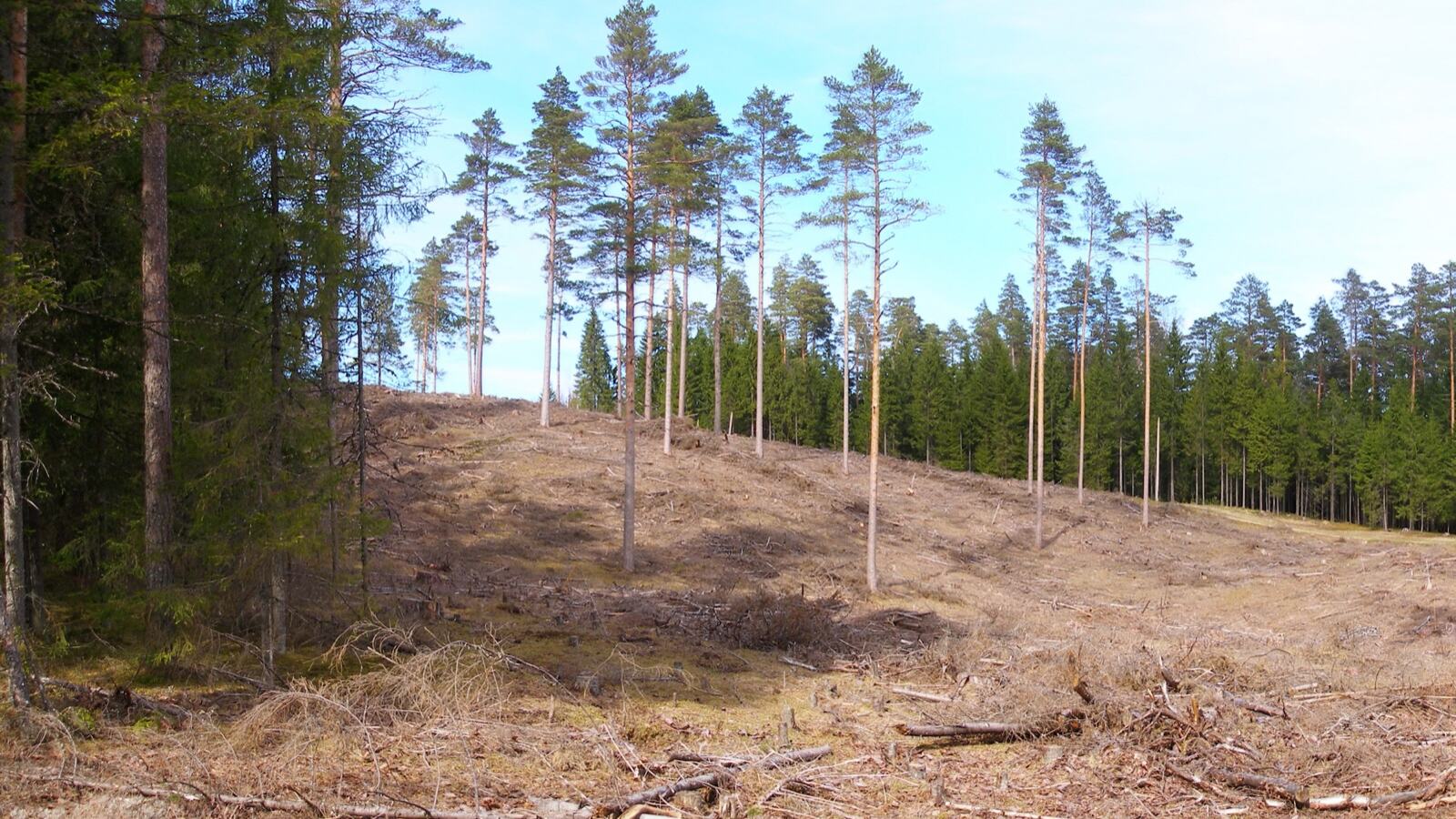
What they are
Cone-bearing, mostly evergreen, mostly needle-leaved, and much older than flowering plants. Conifers were the dominant trees on earth for something like 150 million years before broadleaves displaced them from the fertile middle ground.
They kept the edges. Conifers now hold the cold north, the high mountains, the thin acid soils, and the fire-prone dry forests. Roughly a third of global forest cover, and the overwhelming majority of the world's construction timber.
Where broadleaves win on rich soil in a mild climate, conifers win everywhere the conditions are hard.
Why they persist where nothing else does
Needles are a drought and cold strategy. Small surface area, thick waxy cuticle, sunken stomata. Little water lost, little tissue to lose to frost. A needle is a leaf built to survive rather than to maximise photosynthesis.
Evergreen means no rebuild. Broadleaves spend an enormous amount of energy building a canopy every spring. A conifer keeps needles for three to seven years and can photosynthesise on any mild day in winter. On short growing seasons that is decisive.
Conical form sheds snow. Flexible downward-angled branches let snow slide rather than break the crown.
Resin is chemical defence. Pressurised resin floods wounds, traps bark beetles, and is antimicrobial. It is also why conifer forests burn the way they do.
The genera worth knowing
Pinus, the pines. The largest and most adaptable genus. Needles in bundles of two, three, or five. Scots pine across Eurasia, lodgepole and ponderosa in North America, Aleppo and stone pine around the Mediterranean. Many are fire-adapted with serotinous cones that only open in heat. Several produce edible seed, covered in nut pines.
Picea, the spruces. Single sharp four-sided needles on woody pegs, hanging cones. Sitka, Norway, white spruce. Shallow-rooted, fast, tolerant of cold and wet, and consequently the backbone of northern plantation forestry. Windthrow is their weakness.
Abies, the firs. Flat soft needles with two white bands beneath, cones standing upright and disintegrating on the tree. More shade-tolerant than spruce, generally slower, better on sheltered mountain sites.
Larix, the larches. Deciduous conifers. Needles in rosettes, dropped every autumn. Fast, light-demanding, and they enrich rather than acidify because the litter breaks down quickly. Badly hit by Phytophthora ramorum in Europe, see tree diseases.
Pseudotsuga, Douglas fir. Not a true fir. Distinctive three-pointed bracts poking from the cones. One of the great timber trees, capable of 60 m plus and several centuries.
Taxus, the yews. Slow, extraordinarily long-lived, shade-tolerant, and the only major conifer that resprouts freely from old wood. Fleshy red arils rather than cones, and every other part highly toxic. Churchyard yews of 1,000 to 2,000 years are common in Britain.
Juniperus, the junipers. From ground-hugging shrubs to desert trees. Berry-like cones. Enormously drought tolerant, a keystone across dryland regions, and a serious wildlife resource.
Thuja, Chamaecyparis, Cupressus. Scale-leaved cedars and cypresses. Rot-resistant timber, and the source of most of the hedging conifers people later regret.
Cedrus, the true cedars. Atlas, Lebanon, deodar. Needles in whorled clusters, level plate-like branching, and among the most architectural trees available.
What they do to soil
This is where conifers earn their reputation, and it is half deserved.
Needle litter is high in lignin, resins, and phenolics, low in nitrogen and calcium. It breaks down slowly. Under a dense evergreen conifer stand the litter layer builds into a thick acidic mat, the soil acidifies, and in extreme cases you get podzolisation: iron and organic matter leached down into a distinct hardpan.
The soil biology shifts with it. Fungal networks dominate over bacterial, and earthworm populations fall. The soil food web does not stop, it changes character.
Some of this is the tree and some is the management. A dense even-aged spruce plantation with a closed canopy and no light reaching the floor produces the dead brown carpet people picture. An open pine wood with a broken canopy carries bilberry, heather, lichens, and a rich ground flora.
Larch, being deciduous with rapidly cycling litter, barely does it at all.
If you are working acid ground, work with it rather than against it. Blueberry and acid shrubs is the productive answer, and soil testing will tell you where you actually are.
Plantation is not forest
The reason conifers are unpopular in some countries is that most people have only ever seen the worst version: a single species, one age class, planted in rows at high density on ground that was previously moorland or broadleaf woodland, clearfelled on a 40-year rotation.
That structure has almost no ecological value, and it is a management decision rather than a property of conifers. A natural Caledonian pinewood, a mixed montane fir forest, and a Mediterranean pine woodland are all conifer systems with high biodiversity.
The difference is structure and time: mixed ages, gaps, standing deadwood, an intact ground layer, and species mixture. See structural diversity and woodland management.
Continuous cover forestry, working a stand through selective thinning rather than clearfell, gets timber out of conifers while keeping a functioning forest. It is slower and it produces better wood.
One thing they cannot do
Conifers do not coppice. Cut almost any of them at the base and they die. Yew is the notable exception, and redwood the other.
This is a fundamental split in how you manage broadleaf and conifer woodland. The whole tradition of hazel coppice, willow pollarding, and hedgerow laying has no conifer equivalent. A conifer is a one-shot crop unless managed for continuous cover.
Fire
Many conifer systems are fire systems, not fire victims. Serotinous cones need heat to open. Thick-barked pines survive ground fire that removes competition and clears the litter layer. Fire suppression in these forests builds fuel loads until the fire that eventually comes is catastrophic rather than restorative.
Working with that rather than against it is covered in fire management.
Using them well
As nurse trees, fast conifers shelter slower broadleaves on exposed ground and can be thinned out later.
As windbreaks, evergreen structure works in winter when a deciduous shelterbelt is bare, which is exactly when the wind matters.
As habitat, mature open conifer woodland supports crossbills, pine martens, red squirrels, and a specialised invertebrate fauna that broadleaf woodland does not.
As timber, they are unmatched for speed to a usable structural product.
Plant them where the site actually suits them: acid, thin, cold, exposed, or steep. Do not plant them on deep fertile ground that would grow oak, and do not plant them on peat, where the carbon cost of drainage exceeds anything the trees will ever sequester.
See also
- Nut Pines the edible-seed conifers in detail
- Structural Diversity what separates plantation from forest
- Woodland Management thinning and continuous cover
- Tree Diseases larch dieback and conifer pathogens
- Fire Management conifers as fire-adapted systems
- Blueberry and Acid Shrubs making use of acid ground
- Peter Wohlleben
- Yew
- Juniper
- Scots Pine
- Spruces
- Douglas Fir
- Larch
- Silver Fir
- Redwoods
- Cedars
- Cypresses and Thujas
- Monkey Puzzle
- Sweetgum
- Ginkgo
- Hemlock
- Podocarps
- Bristlecone Pine
- Pines
- China Fir
- Golden Larch