What they are
Abies, the true firs, around 50 species across the cold and montane northern hemisphere.
Three features identify the genus:
Needles are flat and soft, with two white stomatal bands on the underside, and they leave a smooth round scar when pulled off. That is the reliable separation from spruce, whose four-sided needles sit on woody pegs and leave the twig rough.
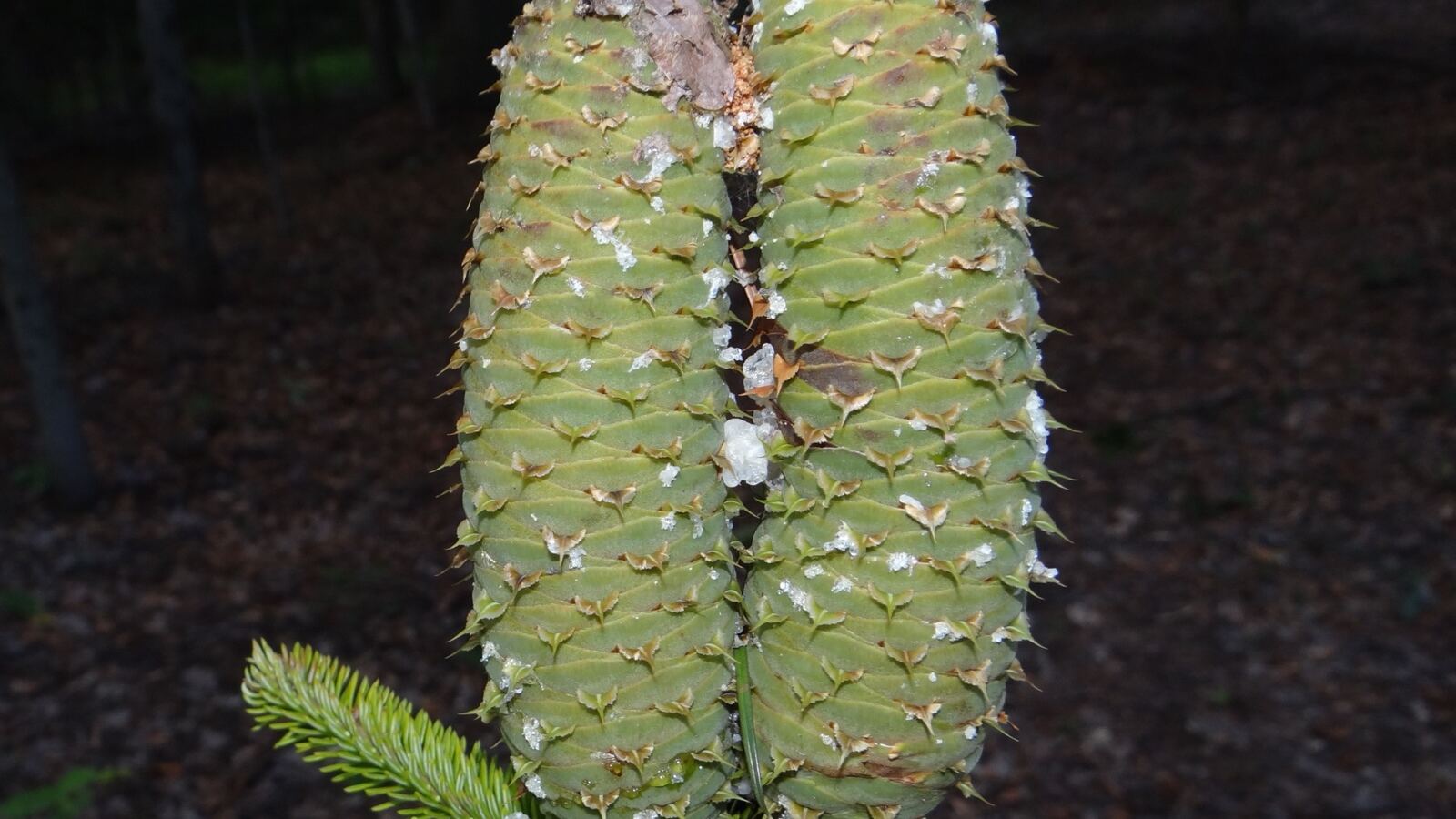
Cones stand upright on the branch like candles.
Cones disintegrate on the tree, shedding scales and seed and leaving a bare central spike standing. You essentially never find a whole fir cone on the ground, which is a useful field check.
Abies alba is the European silver fir; A. grandis, A. procera, and A. amabilis are the Pacific North American species; A. nordmanniana is the Caucasian fir that took over the Christmas tree market.
The shade-tolerant one
Most conifers are light-demanding. Scots pine and larch cannot regenerate under their own canopy at all.
Silver fir can. Seedlings persist and grow slowly in deep shade, sometimes for decades, waiting for a gap — and then respond rapidly when one opens.
That single trait makes fir the conifer of continuous-cover forestry. A stand can be managed by selective felling, with natural regeneration coming up beneath the canopy, with no clearfell ever required. The classic central European Plenterwald — a permanently irregular mixed forest of silver fir, beech, and spruce, managed by single-tree selection for centuries — depends on fir's shade tolerance to work.
It is the opposite management model from the even-aged plantation described in spruces, and it produces a forest with continuous canopy, mixed ages, and standing deadwood. See woodland management and structural diversity.
The trade-off is patience. Fir is slow to start, and a stand managed this way yields steadily rather than in one harvest.
What went wrong for European silver fir
A. alba declined markedly across central Europe during the twentieth century, and the reasons stack up in an instructive way.
Air pollution. Silver fir is unusually sensitive to sulphur dioxide, and the acid-rain decades of the mid-twentieth century hit it harder than spruce or pine. Its recovery since emissions controls is one of the clearer ecological benefits of clean-air legislation.
Deer. Fir seedlings are highly palatable, and high deer densities remove regeneration selectively — browsing the fir and leaving the spruce. Over decades that converts mixed fir-beech-spruce forest into spruce forest without a single tree being felled. See deer and rabbits.
Forestry preference for faster-yielding spruce.
The result is that a shade-tolerant, deep-rooted, drought-resistant, windfirm species was replaced across large areas by a shallow-rooted, drought-vulnerable one — and the consequences of that substitution are now visible in the bark beetle collapse described in spruces.
Restoring silver fir into those forests is now a standard climate-adaptation measure. See climate adaptation.
Christmas trees
Nordmann fir dominates the European Christmas tree market for one reason: needle retention.
Cut Norway spruce drops its needles within a couple of weeks indoors. Nordmann fir holds them for the whole season, because the needles are attached more securely and lose water more slowly.
It is also soft rather than spiky, which matters when decorating, and it has a good symmetrical form.
The trade-off is cost and time — Nordmann grows more slowly, taking around 10 to 12 years to reach 1.8 m against 8 to 10 for spruce.
Most Nordmann fir seed still comes from a small number of stands in Georgia, harvested by climbers, which makes it a supply chain worth knowing about.
Timber and other uses
Fir timber is pale, light, soft, odourless, and non-resinous — it has no resin canals, unlike pine and spruce.
Not durable outdoors. Used for construction, packaging, pulp, and interior joinery. Historically valued for food containers and butter tubs precisely because it does not taint.
Silver fir was the great mast timber of European navies before Scots pine took over, and grand fir and noble fir produce good structural timber in the Pacific Northwest.
Canada balsam, from A. balsamea, is a clear resin used historically as an optical cement and a mounting medium for microscope slides.
Fir foliage is intensely aromatic and is the source of several essential oils, and noble fir foliage is grown commercially for wreaths and greenery.
Growing them
Cool, moist, and sheltered. Firs are montane and northern trees. They want reliable moisture, high humidity, and shelter from drying wind, and they suffer in hot dry summers and in exposed lowland sites.
Deep well-drained soil, and they dislike waterlogging, shallow chalk, and drought.
Late spring frost damages the flushing shoots, so avoid frost pockets.
Slow to establish and then steady. Long-lived, commonly 300 to 500 years.
Plant small stock, protect from browsing — this matters more for fir than for most conifers — and be patient. See tree planting and site protection.
Like nearly all conifers, fir will not resprout from old wood. See conifers.
Wildlife
In its native range, silver fir forest supports capercaillie, three-toed woodpecker, and a range of species dependent on old montane forest with deadwood.
Old firs develop cavities and heart rot readily, which makes them valuable for hole-nesting birds and bats. See dead wood habitat and bats.
The seed is taken by crossbills, nutcrackers, and squirrels.
See also
- Conifers the wider group and the identification keys
- Spruces the species most easily confused with it, and its replacement
- Douglas Fir the other windfirm continuous-cover conifer
- Woodland Management selection forestry and why fir enables it
- Deer and Rabbits selective browsing that removes fir from a mixture
- Climate Adaptation restoring fir into failing spruce forest
- Succession
- Firs