What it is
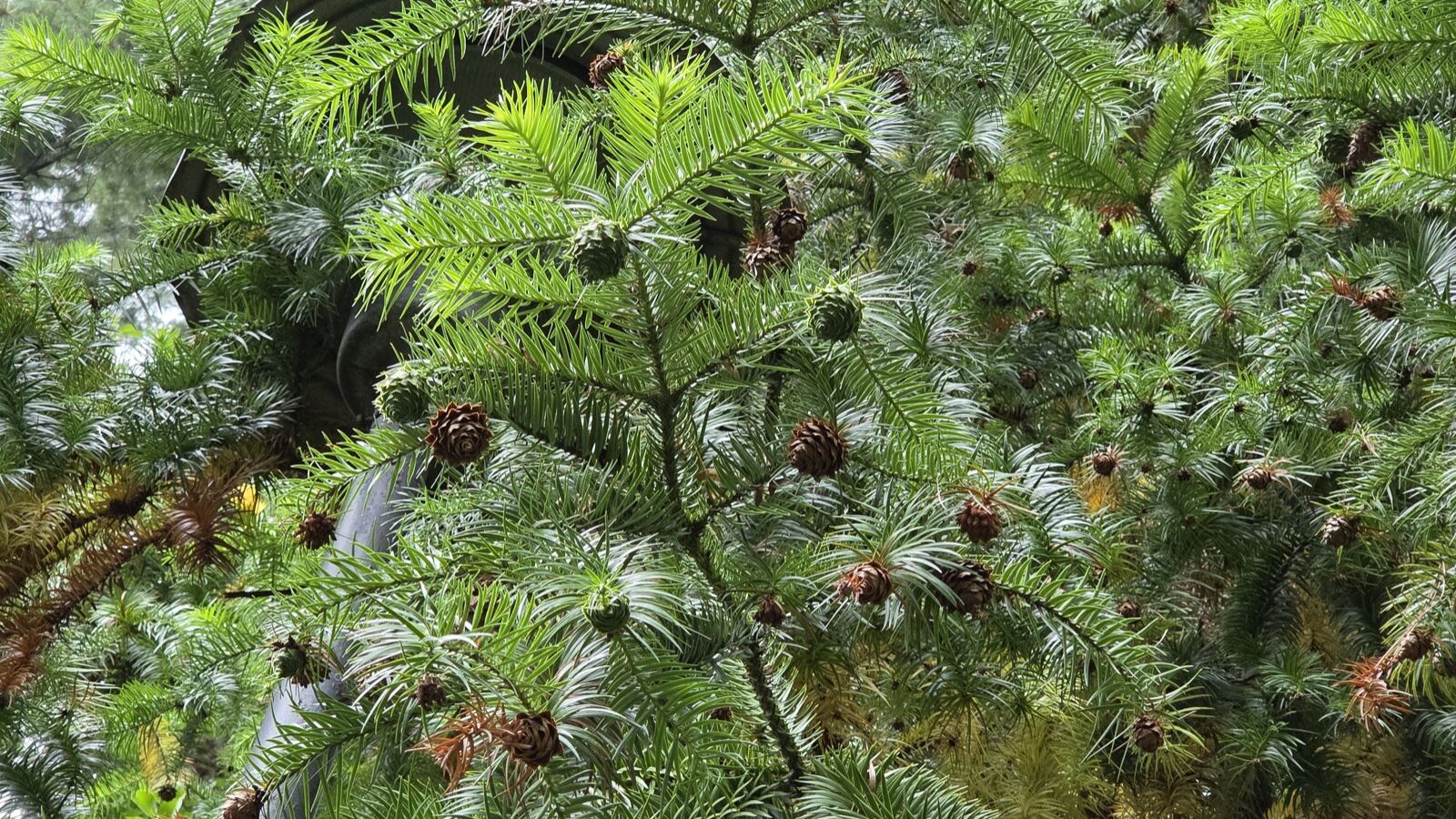
Cunninghamia lanceolata, the china fir or shan — a large evergreen conifer of China and mainland Southeast Asia, and one of the most important timber trees of China, planted there on an enormous scale for millennia.
Despite the name it is not a fir (the true firs are pines-family conifers); china fir belongs to the cypress family, Cupressaceae, a relative of the redwoods, cryptomeria, and cypresses. It is easily recognised by its foliage: broad, flat, stiff, sharply-pointed, glossy needles, up to several centimetres long, arranged in spirals around the shoots — quite unlike the fine needles of most conifers, and rather fierce to handle.
The conifer that coppices
China fir has a botanical trick that sets it apart from nearly all other conifers and shapes the whole way it is grown: it resprouts vigorously from the cut stump.
Almost all conifers, once felled, are dead — cut a pine or spruce to the ground and it will not regrow (the coast redwood is a rare exception). But china fir behaves like a broadleaf: a cut stump throws up a ring of new shoots, so the tree can be coppiced — harvested and allowed to regrow from the same rootstock again and again — which is extraordinary in a conifer and hugely convenient for a timber crop. This lets a china fir plantation be cut and regrown repeatedly without replanting, and it is one of the reasons the tree has been such a mainstay of Chinese forestry. See reforestation techniques.
The timber
China fir wood is the reason for all this cultivation. It is soft, light, straight-grained, easily worked, fragrant, and — importantly — naturally rot- and insect-resistant and durable, with the same self-preserving quality as cedar and cryptomeria.
That durability and pleasant scent made it a prized timber across China for construction (beams, pillars, and boards), boat-building, bridges, furniture, and — famously — coffins, for which its rot resistance and fragrance were especially valued. It is one of the fastest-growing and most productive of Chinese timber conifers, and, being coppiceable, one of the most convenient, so it has been planted for centuries and remains a major plantation species in southern China. It is also grown as an ornamental (including an attractive blue-grey form) worldwide, though its size and prickly foliage suit it to larger gardens. See restoration economics and woodland management.
Growing it
China fir wants a warm-temperate to subtropical, moist, humid climate and deep, moist, well-drained, acidic soil — the mild, wet conditions of southern China — and it dislikes drought, exposure, cold drying winds, and alkaline soil. Given moisture and shelter it is fast and vigorous.
It grows into a tall, conical tree with drooping branchlets, and it is grown from seed, from cuttings, and — uniquely among common conifers — by coppice regrowth from the stumps of felled trees, which is central to its use as a repeatedly-harvested timber crop. The prickly, spiralling foliage and the fibrous reddish-brown bark make it distinctive year-round. See propagation.
See also
- Cryptomeria the Japanese counterpart, another Cupressaceae timber conifer
- Redwoods the family relative that also resprouts from the stump
- Cypresses and Thujas more of the cypress family
- Firs the true firs it is named for but unrelated to
- Coppice Rotation the coppicing that china fir uniquely allows among conifers
- Conifers the wider group