What it is
Prunus avium, the wild cherry or gean, native across Europe and western Asia and the wild ancestor of every sweet cherry in cultivation. A stone fruit, and one of the larger members of the genus at 25 to 30 m.
Its close relative P. padus, bird cherry, is a smaller northern and upland tree with long drooping flower racemes rather than clusters, and small bitter black fruit. Both are covered here.
The bark is unmistakable: glossy, reddish-brown, banded with horizontal lenticel lines, and peeling in papery strips on older trees.
Blossom, and what it feeds
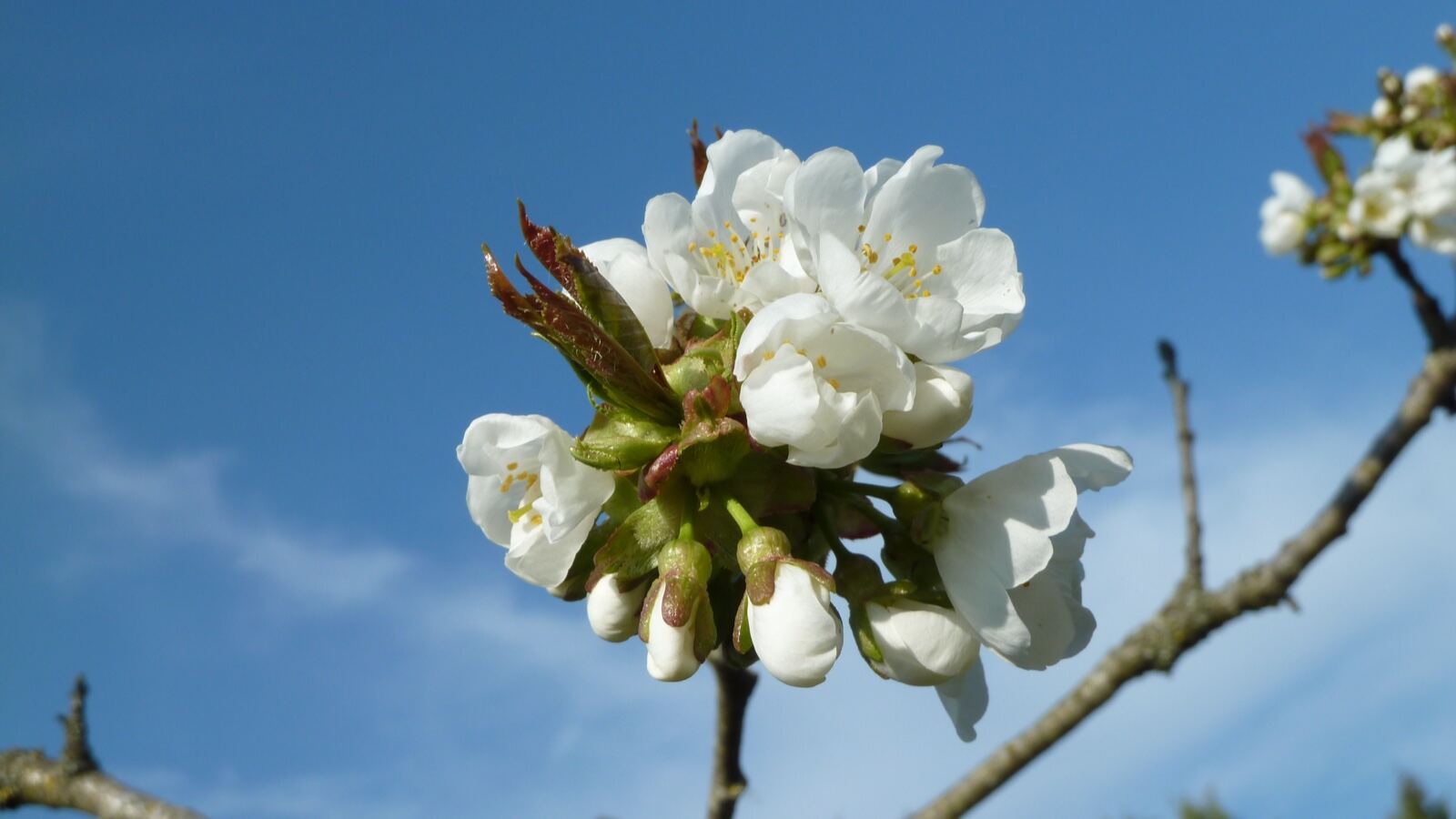
Wild cherry flowers in mid-spring, in dense white clusters, often before the leaves are fully out. A mature tree in flower is one of the more spectacular sights in temperate woodland.
That timing matters. Cherry blossom arrives after blackthorn and around hawthorn, in the window when queen bumblebees are provisioning nests and solitary bees are emerging in numbers. See native bees and pollinator habitat.
The leaves also carry extrafloral nectaries — small glands at the base of the leaf blade, visible as two reddish bumps on the stalk. These secrete nectar outside the flowers and attract ants, which in turn deter herbivores. It is a defence mechanism you can see with a hand lens, and a neat illustration of the indirect defences discussed in acacia.
The timber
Cherry is one of the most valuable broadleaf timbers in Europe, and the main reason wild cherry is planted commercially.
The heartwood is a warm pinkish-brown that darkens to a deep reddish tone with light and age. It is fine-grained, stable once dry, works and turns cleanly, and takes a superb polish.
Used for high-quality furniture, cabinetmaking, veneer, musical instruments, and turnery. American black cherry, P. serotina, fills the same role in North America and is a major commercial hardwood.
To grow it for timber you need a straight, clear stem of 4 to 6 m, which means formative pruning from an early age — and cherry must be pruned in summer, never winter, because of silver leaf and bacterial canker. See pruning basics, stone fruit, and tree diseases.
Cherry is a common component of alley cropping systems for exactly this reason: a high-value timber crop on a several-decade horizon, with arable between the rows meanwhile.
Suckering
Wild cherry suckers freely from its roots, sometimes vigorously, and a single tree becomes a clonal group over time.
That is useful in woodland, where it regenerates readily and fills gaps, and it is a genuine nuisance in a garden or a lawn, where suckers come up metres from the trunk and keep coming.
Consider it before planting near mown grass, borders, or drains. Grafted ornamental cherries on non-suckering rootstocks avoid the problem.
The habit does make cherry good for stabilising banks and for rapid cover in restoration planting. See erosion control.
Wildlife
Wild cherry is a strong wildlife tree across the whole year.
Blossom for pollinators, as above.
Fruit in mid to late summer, taken heavily by blackbirds, thrushes, starlings, and mammals. Sweet cherries from a wild tree are small and variable — some trees produce genuinely good fruit, most are sharp — and you will rarely get any, because the birds are faster. The species name avium means of the birds. See seed-dispersing birds.
Foliage supports a wide range of moth larvae. See caterpillars.
Bird cherry in particular hosts the bird-cherry ermine moth, whose larvae can defoliate an entire tree in early summer and wrap it in dense white webbing. It looks catastrophic and the tree almost always refoliates and recovers.
Growing it
Light-demanding. Wild cherry needs full sun and will not persist under a closed canopy. It behaves as a gap and edge species, colonising openings and then being overtopped. See edge effects and pioneer species.
Fertile, well-drained soil, ideally slightly alkaline. It dislikes waterlogging and thin dry sand.
Fast when young, then slowing. Not especially long-lived for a large tree — 60 to 100 years is typical, well short of oak or lime.
Protect from browsing when young; deer and rabbits both take it readily. See deer and rabbits and site protection.
Susceptible to bacterial canker and silver leaf, both entering through wounds, which returns to the summer-pruning rule.
Bird cherry is hardier, more shade-tolerant, tolerates wetter ground, and is a good choice for northern, upland, and riparian planting. See riparian buffers.
In mixed woodland
Wild cherry is a useful component rather than a backbone. It adds spring blossom, summer fruit, autumn colour, and a high-value timber option to a mixture dominated by oak, beech, or ash.
Plant it in groups in gaps and along edges rather than scattered through shade, and thin around it to keep its crown in light. See woodland management and structural diversity.
See also
- Stone Fruit the cultivated relatives and the pruning rule
- Hawthorn the other spring-flowering hedgerow tree
- Blackthorn the earlier flowering cousin
- Alley Cropping cherry as a timber row crop
- Tree Diseases silver leaf and bacterial canker
- Seed-Dispersing Birds why the fruit disappears