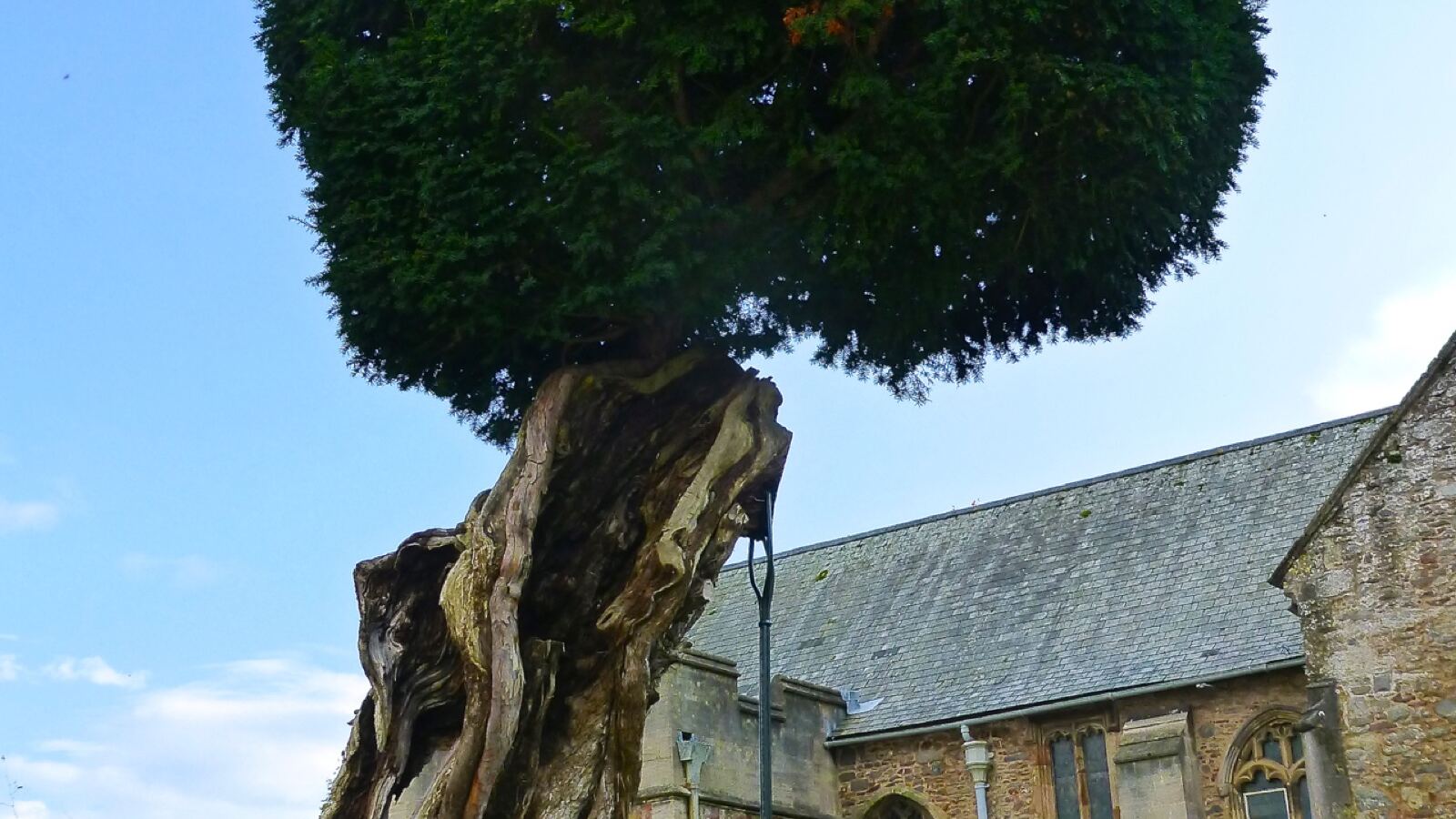
What it is
Taxus baccata in Europe, T. brevifolia in the Pacific Northwest, T. cuspidata in Japan, and a handful more. A conifer, though an unusual one — it bears no cone.
Instead the seed sits in a fleshy scarlet aril, an open-ended cup that looks like a berry. Birds eat the aril, pass the seed intact, and disperse it. See seed-dispersing birds.
Yews are dioecious: separate male and female trees, so only the females carry arils.
Dark, dense, slow, and extraordinarily long-lived.
How old is an old yew
Yew is almost certainly the longest-lived tree in Europe, and dating one is genuinely difficult.
The heartwood rots out from the centre as the tree ages, so there are no rings to count. A yew of great age is typically a hollow shell — sometimes several separate fragments of living trunk around an empty middle, held together by little more than habit.
Then it does something stranger. A yew can send an aerial root down through the hollow interior into the ground, which thickens into a new stem inside the old one. The tree effectively regenerates itself from within, indefinitely.
Estimates for the oldest British yews run from 1,500 to 3,000 years and beyond, with the Fortingall Yew in Perthshire and the Llangernyw Yew in Wales among the candidates. The uncertainty is large and the arguments are long-running, but a substantial number of churchyard yews clearly predate their churches.
That is the likely explanation for the churchyard association: the sites were sacred before Christianity arrived, and the churches were built beside trees that were already ancient.
Every part is toxic except one
Yew contains taxine alkaloids in the foliage, bark, and seed. They are cardiotoxic, act quickly, and there is no reliable antidote. Yew poisoning kills livestock regularly, and horses and cattle are highly susceptible.
Clippings are more dangerous than the living tree, because wilted foliage is more palatable and animals eat it readily. Never dump yew hedge trimmings where stock can reach them, and never over a boundary fence.
The single exception is the aril, the red flesh, which is not toxic. The seed inside it is, and it is swallowed whole and passed intact by birds. Children should still be kept away from the whole plant.
For all that, yew gave modern medicine one of its more important cancer drugs. Paclitaxel was isolated from Pacific yew bark in the 1960s and became a major chemotherapy agent. Harvesting bark killed the tree and the wild population could not sustain it, so production moved to semi-synthesis from renewable clippings of European yew and to plant cell culture — a case where a toxic tree turned out to be worth a great deal for exactly that reason.
The conifer that resprouts
Yew breaks the rule that defines conifer management.
Nearly every conifer dies if cut into old wood — see conifers — which is why the coppice and hedging traditions built around hazel, willow, and hornbeam have no conifer equivalent.
Yew is the exception. It resprouts freely from old wood, from the trunk, and from the base. An overgrown yew hedge cut back hard into bare timber will regenerate, though it takes several years and is best done one side at a time.
That, plus its density and its tolerance of deep shade, is why yew became the hedging and topiary plant of formal European gardens. Nothing else clips to such a fine, dark, solid surface and recovers from a mistake.
Clip once or twice a year in late summer. Growth is slow — 15 to 25 cm a year — which is the price of the density.
The longbow
Yew was a strategic military material for centuries. The English longbow was made from a stave cut across the boundary between heartwood and sapwood: the dense heartwood resists compression on the inner face, the elastic sapwood resists tension on the outer, and the natural junction gives a composite bow from a single piece of timber.
Demand was enormous and largely stripped continental Europe of good bow staves by the sixteenth century, with imports mandated by statute and supplies exhausted across Iberia and central Europe.
The timber is otherwise beautiful — orange-brown, dense, fine, and durable — and is used for furniture, veneers, and turning.
Growing conditions
Yew is remarkably adaptable and there is one absolute requirement.
Drainage. Yew will not tolerate waterlogged ground and dies in it. This is the main cause of failure.
Beyond that it accepts chalk and limestone happily, acid soils, deep shade, heavy shade under other trees, exposure, pollution, and hard clipping. It grows on cliff faces and in the shade of beech woods on the chalk downs.
It is slow, which is the real cost. A yew hedge is a decade's commitment and a specimen is a century's.
Plant in autumn or spring, keep watered through the first two summers, and mulch. See tree planting.
In woodland
Pure yew woods are rare and remarkable — Kingley Vale in Sussex is the classic example, a dark, silent, almost floorless wood where the canopy admits nearly nothing.
Under a mature yew almost nothing grows, which makes it a poor choice where ground flora matters. It is an excellent evergreen shelter and screening tree, valuable winter cover for birds, and its dense structure supports nesting.
Old yews are exceptional habitat, hollow and rot-rich. See dead wood habitat.
Deer will browse yew and are not much affected by it. Protect young plants. See deer and rabbits and site protection.
See also
- Conifers and why yew is the exception to the rule
- Hedgerow Care clipping and renovating yew
- Dead Wood Habitat what an ancient hollow yew supports
- Seed-Dispersing Birds how the arils move
- Lichens and Mosses continuity on very old trees
- Tree Planting establishing a slow tree
- Redwoods
- Ginkgo
- Osage Orange
- Lychee and Longan
- Box and Privet
- Podocarps
- Plum-Yews