What it is
Araucaria araucana, from the volcanic slopes of the Andes in southern Chile and adjacent Argentina.
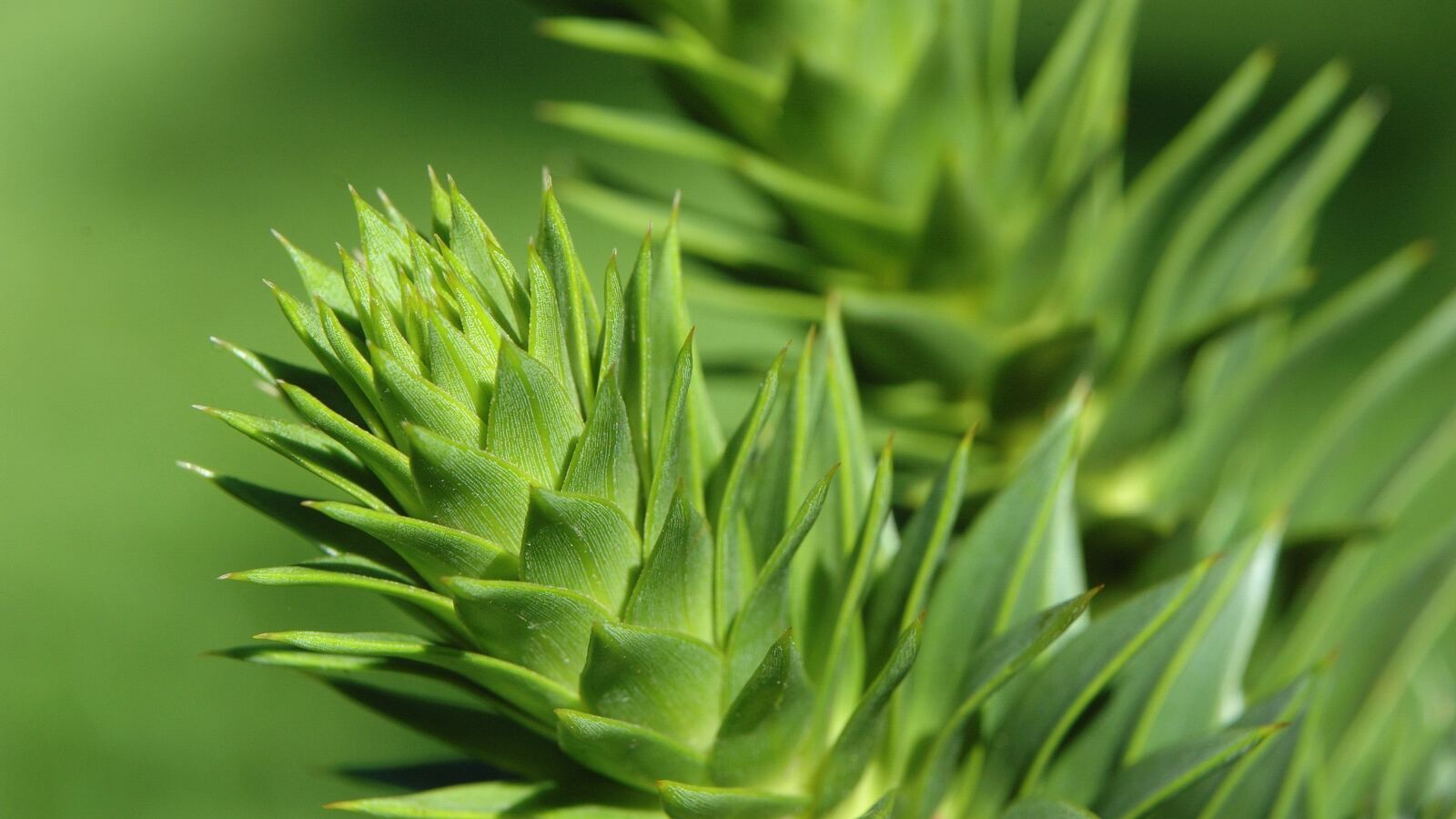
Unmistakable. Stiff, leathery, triangular leaves with sharp points, overlapping in dense spirals so that entire branches are armoured, arranged in regular whorls around a straight trunk. Mature trees lose the lower branches and develop an umbrella crown on a bare column.
The English name comes from a nineteenth-century remark that climbing it would puzzle a monkey — which it would, and there are no monkeys in Chile.
A survivor from before flowering plants
The Araucariaceae are ancient. The family was widespread across both hemispheres in the Jurassic and Cretaceous, and was a dominant forest type when dinosaurs were the principal herbivores.
The armoured leaves are usually interpreted as a defence against very large browsing animals, and the whole architecture — inaccessible foliage on a bare trunk — reads as a response to pressure that no longer exists.
The family retreated to the southern hemisphere after the Cretaceous and survives as scattered relicts: monkey puzzle and Paraná pine in South America, Norfolk Island pine, bunya pine, kauri in New Zealand, and a cluster of species in New Caledonia.
The Wollemi pine, Wollemia nobilis, is in the same family and was known only from fossils until a small stand was found in a canyon near Sydney in 1994. Fewer than a hundred wild adults exist, and cultivation for sale was adopted deliberately as a conservation strategy.
The nuts
Monkey puzzle produces large edible seeds — piñones — and they are a genuine food crop, not a curiosity.
The cones are enormous, up to 20 cm across, and shatter on the tree when ripe, dropping 200 or more seeds each. A mature female can produce several thousand.
Each seed is 3 to 4 cm, starchy, and comparable to a chestnut when boiled or roasted.
For the Pehuenche people — whose name means people of the pehuén, the monkey puzzle — these were the staple food, and the tree is central to their culture and land rights. Harvest is communal and seasonal, and the groves are managed as a commons.
Compare nut pines and chestnut: a small group of trees worldwide that provided staple carbohydrate without annual cultivation, and whose loss reshaped the societies that depended on them.
Trees are dioecious — separate male and female — so a crop needs both, and they take 30 to 40 years to begin producing.
Endangered at home
A. araucana is assessed as Endangered.
The causes are the familiar stack: logging until protection in 1990; conversion of forest to plantation and pasture; livestock grazing preventing regeneration; and, increasingly, fire.
The 2015 and 2017 fires in Chile burned through araucaria forest at intensities the species is not adapted to survive. Mature trees have thick fire-resistant bark and normally tolerate ground fire, but crown fires driven by drought and by adjacent flammable plantations kill them outright. See fire management.
A poorly understood dieback affecting mature trees across Chilean populations since around 2015 adds to it.
There is a hard irony here: it is a common ornamental in British and Irish suburbs while being endangered in its own habitat. As with horse chestnut, abundance in cultivation from a narrow founder stock does nothing for the wild population. See minimum viable populations and seed banking.
The Victorian garden tree
Introduced to Britain in 1795 by Archibald Menzies, who reportedly pocketed seeds served as dessert at a dinner in Chile and germinated them aboard ship.
It became a Victorian status symbol — exotic, architectural, and expensive — and was planted in front gardens, cemeteries, and estates across Britain and Ireland. Many of those trees are now full-sized and considerably larger than the gardens that hold them.
That is the practical warning. A monkey puzzle reaches 30 to 40 m over a century or two, drops branches with vicious spines onto lawns and paths, and is impossible to prune into a smaller shape — like nearly all conifers it does not resprout from old wood. See conifers.
Plant it where it can reach full size, or not at all.
Growing it
Cool, moist, oceanic climate. It does well in western Britain, Ireland, the Pacific Northwest, and New Zealand, and poorly in hot dry continental conditions.
Free-draining but moisture-retentive soil, slightly acid. It dislikes waterlogging, drought, and shallow chalk.
Full sun and shelter from cold drying wind when young, particularly from east winds, which scorch the foliage.
Hardy to about minus 20 C once established. Slow — 20 to 30 cm a year — and very long-lived, with wild trees over 1,000 years.
Grow from seed, which must be sown fresh, as it loses viability quickly and does not store. Cuttings only root from vertical leading shoots; a cutting from a side branch grows permanently sideways, which is a peculiarity of the family.
Handle the foliage with gloves. The leaf tips are genuinely sharp.
Timber
Straight-grained, pale, and strong, and it was logged heavily for construction and joinery in Chile and Argentina before protection.
Paraná pine, A. angustifolia, the Brazilian relative, was a major export timber and is now also endangered, with its Atlantic forest habitat reduced to a small fraction.
Trade in wild-sourced araucaria timber is now restricted, and any monkey puzzle timber should be assumed problematic unless clearly plantation-grown.
See also
- Conifers the wider group and the no-resprouting rule
- Nut Pines the other conifer staple-seed crop
- Fire Management crown fire in a fire-tolerant species
- Minimum Viable Populations common in gardens, endangered in the wild
- Seed Banking conserving recalcitrant seed that will not store
- Horse Chestnut the same abundance-versus-conservation paradox
- Ginkgo
- Southern Beech
- Kauri
- Umbrella Pine