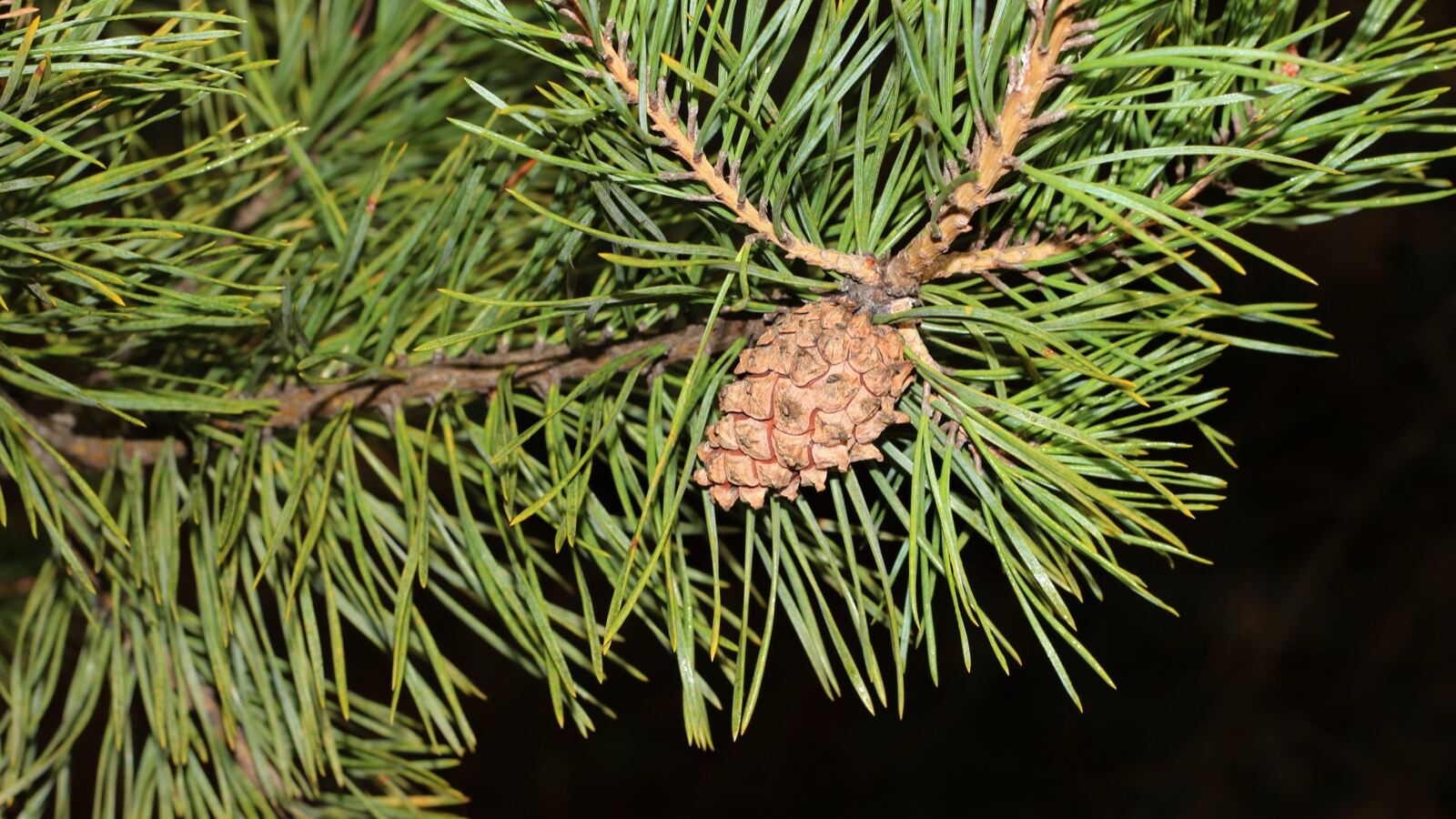
The defining conifer
Pinus, the pines — over a hundred species of evergreen conifers spread across the northern hemisphere from the Arctic treeline to the tropical mountains — are, by almost any measure, the most important trees in the world: the leading source of construction timber and paper pulp, a mainstay of reforestation, and the dominant tree of vast tracts of the planet.
Individual pines appear throughout this encyclopedia — the Scots pine, the stone and nut pines, the ancient bristlecone — but the genus as a whole is worth understanding, because its features and its habits recur across all of them.
How to know a pine
A pine is easy to recognise once you know the one key feature: its needles grow in bundles.
Where a fir or spruce carries its needles singly along the twig, a pine holds its long needles in small bundles (fascicles) of two, three, or five, each bundle wrapped at the base in a papery sheath. The number of needles per bundle is one of the first things used to identify a pine, and it splits the genus roughly into two great groups:
- "Hard" or yellow pines — usually two or three stiff needles per bundle, denser resinous wood (Scots pine, the southern yellow pines, lodgepole);
- "Soft" or white pines — usually five slender needles per bundle, softer, lighter wood (the white pines, sugar pine, the nut and stone pines).
The other universal pine feature is the cone — the woody, scaled seed cone that gives the family its popular name — which holds the winged seeds between its scales and opens to release them to the wind.
Wood, pulp, and resin
Pines are the workhorses of world forestry, for three products.
Timber. Pine ("deal" or "softwood") is the standard construction and joinery timber of the temperate world — straight, strong for its weight, easily worked, and fast-grown — and pines are the most widely planted timber trees on Earth, in enormous plantations from the southern United States to Scandinavia to the vast exotic pine forests of the southern hemisphere (radiata pine in New Zealand and Chile, planted far from its tiny Californian home).
Pulp. Their long fibres make pines a leading source of wood pulp for paper.
Resin. Pines exude sticky resin to seal wounds, and tapping that resin gives "naval stores" — turpentine and rosin — historically vital for waterproofing wooden ships (hence the name), and still used in varnishes, adhesives, inks, soaps, and countless products; rosin is what violinists rub on their bows and gymnasts on their hands. See restoration economics.
Pines also feed people and wildlife with their seeds — the pine nuts of several species — and provide shelter, and their fast growth and toughness make them mainstays of reforestation, shelterbelts, and the greening of poor and eroded land, though planting them as dense single-species monocultures brings the usual risks.
Pines and fire
Many pines have a deep and defining relationship with fire, and it shapes whole landscapes.
Pines are typically light-demanding pioneers that colonise open, burnt, and poor ground, and a great many are fire-adapted in remarkable ways. Some, like the lodgepole and jack pines, are serotinous — their cones are sealed shut with resin and open only when the heat of a fire melts it, showering seed onto the freshly-cleared, ash-fertilised ground, the same fire-triggered seeding as the banksia. Others, like the longleaf pine of the American Southeast, have thick, fire-resistant bark and grow in open, fire-maintained pine savannas that depend on regular ground fires to keep out competing hardwoods — ecosystems, rich in their own specialised wildlife, that decline when fire is suppressed. Understanding pines means understanding fire, and much of their management is really the management of fire. See pioneer species and succession.
Growing them
Pines are, as a group, tough, sun-loving, and undemanding — most want full sun and good drainage and tolerate poor, dry, sandy, and acidic soils where little else grows, which is exactly why they are so useful for difficult sites and so successful as pioneers. They dislike shade, waterlogging, and (many of them) rich or alkaline soil.
They range from ground-hugging dwarfs to forest giants, and there is a pine for almost every temperate and mountain situation; the dwarf and mountain pines are among the most useful of garden conifers. Pines are grown from seed (some needing cold or fire treatment), and — because, like all conifers, they cannot be grown from cuttings easily — special forms are grafted. See propagation and nursery stock.
See also
- Conifers the wider group pines belong to
- Scots Pine the archetypal European pine
- Nut Pines the pines grown for edible seed
- Bristlecone Pine the oldest pines, and the oldest trees
- Fire Management the fire ecology that shapes pine forests
- Firs and Spruces the other great conifers, and how they differ
- Longleaf Pine