What it is
Fagus sylvatica in Europe, Fagus grandifolia in eastern North America, plus a dozen more across the temperate northern hemisphere.
Smooth grey bark that stays smooth for centuries, oval leaves with a wavy margin and silky hairs when young, and triangular nuts held in a bristly husk. Capable of 40 m and 300 years, more when pollarded.
Beech is the great competitor of temperate forest. Where soil and climate suit it, it wins, and it wins by removing the light.
Deep shade is the strategy
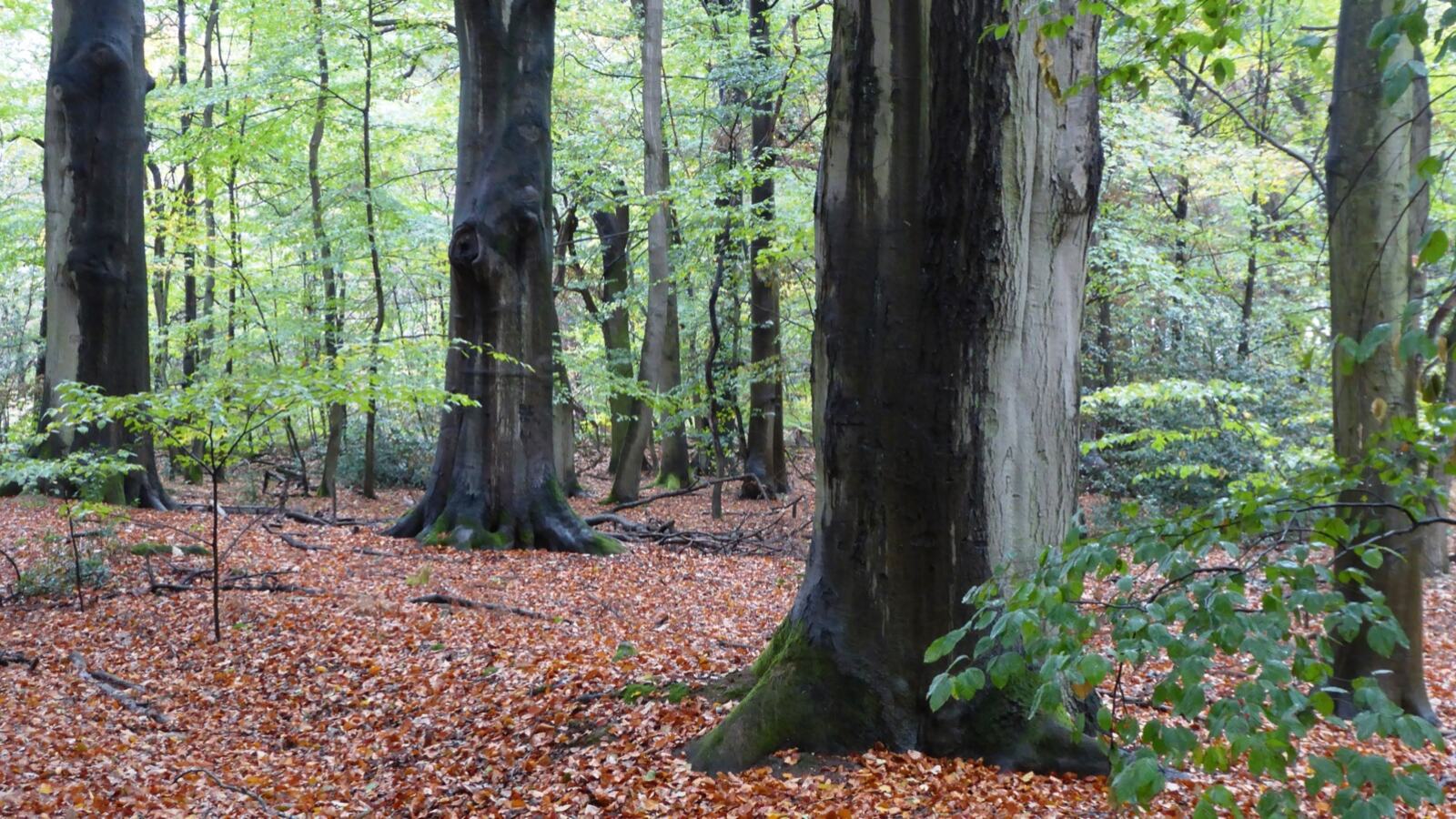
Beech leaves are arranged in flat overlapping layers that intercept almost everything. Light transmission to the floor under a closed beech canopy can fall below 2 percent, which is less than nearly any other temperate broadleaf.
The result is the beech woodland floor: bare, brown, deep in slowly rotting leaf litter, with almost no ground flora except a brief spring window before the canopy closes. Bluebells, wood anemone, and wild garlic exploit that window and then disappear.
It is not a poor habitat, but it is a specialised one, and it looks empty compared with oak. The leaf litter itself is slow to break down and acidifies the surface, which reinforces the effect.
Beech seedlings, unusually, are shade-tolerant. So beech regenerates under its own canopy while light-demanding species cannot. Given enough time without disturbance, beech replaces almost everything else on suitable ground. Only structural diversity maintained by gaps, grazing, or management prevents it.
Where it fails
The weakness is the root system: shallow, spreading, and concentrated in the top 40 to 60 cm.
That makes beech badly drought-vulnerable and prone to windthrow. The 2018 and 2022 European droughts caused widespread beech dieback and mortality across Germany and central Europe, and beech is now regarded as one of the temperate species most exposed to warming.
It also demands drainage. Beech will not tolerate waterlogging, which is why it dominates chalk downland and free-draining slopes and disappears on heavy wet clay, where oak and alder take over.
So the picture is a strong competitor with a narrow tolerance: excellent on well-drained ground in a reliable climate, and among the first to go when either changes. See climate adaptation.
Hedges that keep their leaves
Beech is marcescent when clipped: cut hedges hold their dead coppery leaves through winter and drop them only as new growth pushes in spring.
That makes it one of the best deciduous hedging plants available, giving winter screening no other deciduous species matches. Hornbeam does the same and tolerates wetter ground, which is the usual substitution on heavy soil.
The trick only works on clipped plants. A free-standing mature beech drops its leaves normally, since marcescence is a juvenile trait that regular cutting maintains.
For hedge establishment and cutting cycles, see hedgerow care.
Mast years
Beech produces nuts irregularly, with heavy mast years every 5 to 10 years and little in between.
The synchrony is a predator-satiation strategy: flood the market so seed predators cannot take everything, then starve them in intervening years so populations cannot build. Mast years drive population cycles in mice, voles, and the predators that eat them, and are followed by pulses of regeneration.
Beech nuts are edible and were traditionally used for oil and for finishing pigs, though they contain fagin and are mildly toxic in quantity. Squirrels, jays, badgers, and deer all depend heavily on them.
Mast timing is one of the phenological signals shifting most clearly under warming, which makes it useful for monitoring.
Wood and use
Pale, dense, hard, straight-grained, and even-textured. It steams and bends superbly, which made it the chair-making timber of the Chilterns and the standard for bentwood furniture.
Not durable outdoors, so it is an indoor timber: furniture, flooring, tool handles, kitchenware, and the traditional choice for anything shaped by turning. Excellent firewood with high calorific value.
Beech coppices reluctantly compared with hazel or willow, but it pollards well, and ancient beech pollards in wood pasture are among the most valuable habitat trees in Europe, riddled with rot holes and supporting enormous invertebrate assemblages. See dead wood habitat and coppice rotation.
Planting and management
Plant on free-draining ground, ideally with shelter, since beech establishes poorly in exposure and full sun. It is naturally an understorey species in youth and does best planted under a nurse canopy of birch or pine that is thinned out later.
Grey squirrels are the serious problem in Britain, stripping bark from pole-stage beech and ruining timber potential across whole stands. Protection or population control determines whether a beech plantation is worth establishing.
Do not plant it as a monoculture. Its drought exposure, its shallow rooting, and the shade it casts all argue for mixture. See woodland management and tree diseases.
See also
- Native Oaks the other pillar of temperate forest
- Conifers the usual nurse and mixture partner
- Hedgerow Care managing beech hedges
- Structural Diversity why beech dominance is a problem
- Dead Wood Habitat ancient pollards
- Climate Adaptation a species under pressure
- Peter Wohlleben
- Hornbeam
- Silver Fir
- Succession
- Southern Beech
- Yellowwood
- Dipterocarps