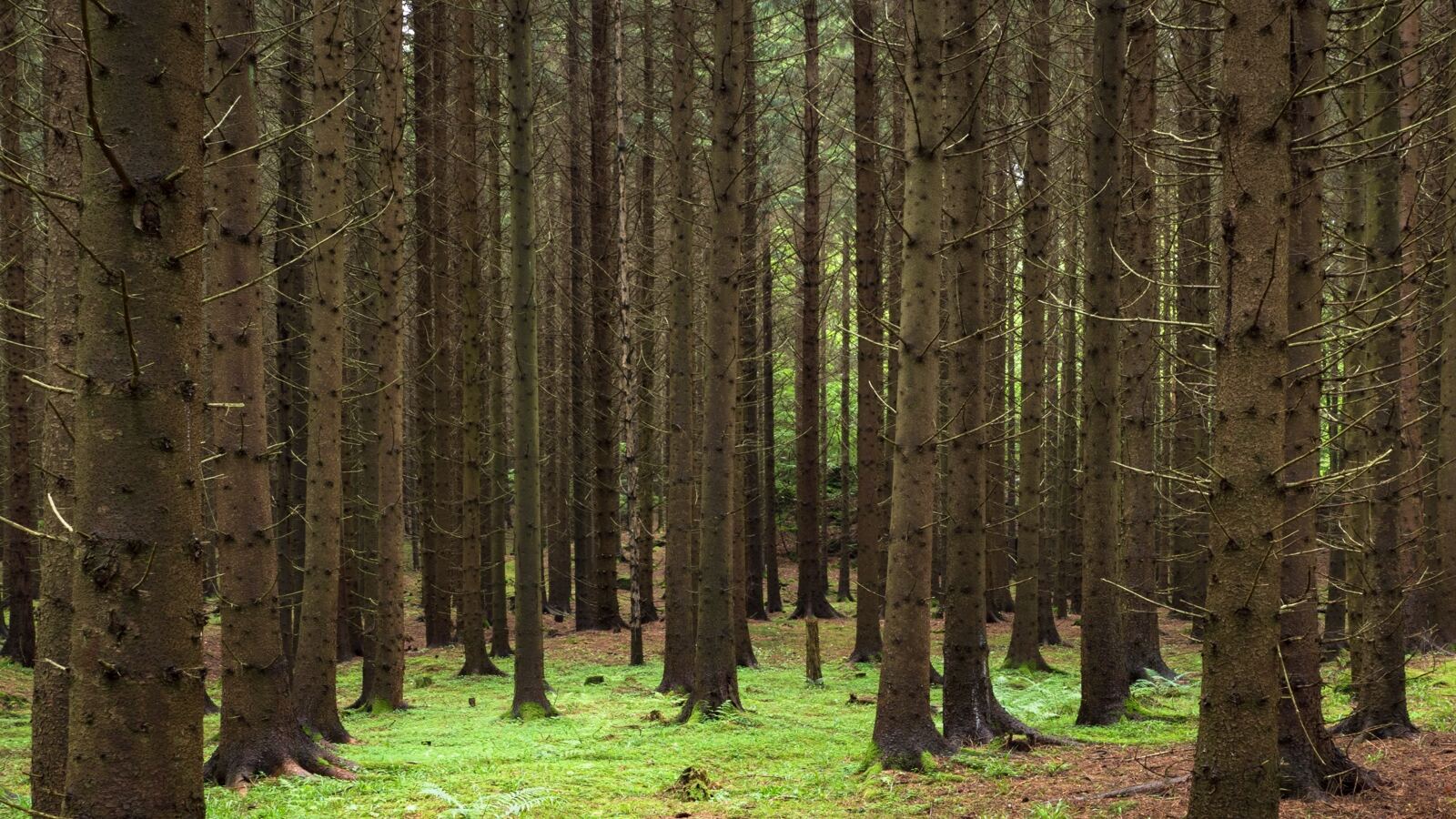
What they are
Picea, around 35 species across the cold northern hemisphere.
Identify by the needles: single, sharp, four-sided in cross-section so they roll between the fingers, and attached to small woody pegs that stay on the twig after the needle drops, leaving the shoot rough to the touch. Cones hang downward and fall whole.
That peg detail is the quickest field separation from firs, whose needles are flat, soft, and leave a smooth circular scar.
Norway spruce, P. abies, is the European native — the traditional Christmas tree and the timber of violins.
Sitka spruce, P. sitchensis, is from the Pacific coast of North America and is now the dominant plantation conifer in Britain and Ireland.
Why plantations chose them
Sitka spruce in particular does something no native British tree does: it produces large volumes of usable timber, fast, on cold wet acid upland ground that grows almost nothing else.
Yields of 12 to 24 cubic metres per hectare per year on sites where oak would take three centuries to reach millable size. Rotations of 35 to 45 years.
It also tolerates exposure, high rainfall, and peaty soils, which describes most of the British uplands.
The result is that Sitka accounts for a very large share of British forestry, and the argument about upland conifer plantations is largely an argument about this one species.
The case against, made fairly
The criticism of spruce plantations is mostly justified and mostly about management rather than the tree.
Even-aged monoculture. Planted at high density, all one species, all one age, clearfelled together. That structure supports very little: no gaps, no understorey, no deadwood, no ground flora under a closed canopy. See structural diversity.
Planted on the wrong ground. Large areas were established on deep peat in the twentieth century, which required drainage. Drained peat oxidises and emits carbon, often exceeding anything the trees accumulate — so the plantation is a net emitter. This is the clearest case where planting trees is worse for carbon than not planting them, and it is set out in peatland restoration and carbon accounting.
Acidification of already acid soils and of watercourses, worsened historically by pollution deposition.
Windthrow, below.
Clearfell, which removes everything at once and restarts the cycle.
None of that is inherent to spruce. Mixed-species, mixed-age spruce managed under continuous cover with retained deadwood is a functioning forest. The plantations were designed for volume and got volume.
Windthrow
Spruce roots are shallow and plate-like, spreading wide rather than deep, especially on wet or compacted ground where a hardpan stops downward growth.
A dense even-aged stand is mutually supporting, so the trees stand while the block is intact. Thin it, or open an edge, and the newly exposed trees have no individual stability and go over in the first serious gale — often the whole block, like dominoes.
This is why upland spruce is frequently left unthinned and clearfelled: once a stand passes a critical height, thinning it is a gamble. It is also why continuous-cover management is harder with spruce than with deep-rooted species.
Windthrow risk rises with height, wetness, exposure, and any operation that opens the canopy. See storm damage recovery, and note the caution about timber under tension in tool care and safety.
Drought and bark beetle
Norway spruce across central Europe is in serious trouble, and it is worth understanding as a compound failure.
Shallow roots make spruce badly drought-exposed. The 2018 to 2020 droughts left enormous areas of German, Czech, and Austrian spruce water-stressed.
Stressed spruce cannot produce enough resin to defend against European spruce bark beetle, Ips typographus, whose populations then exploded on the weakened trees and on the windthrown timber left after storms.
The result has been the loss of very large areas of spruce forest and a collapse in timber prices from the salvage glut. Much of it was spruce planted outside its natural range — on lowland sites where it was never well adapted, chosen because it grew fast.
It is a direct illustration of the argument in climate adaptation: a species selected for yield under past conditions, planted uniformly, failing all at once. See also tree diseases.
The timber
Spruce is the standard European softwood, sold as whitewood.
Pale, light, strong for its weight, straight-grained, and not durable outdoors without treatment. Used for construction timber, framing, pallets, packaging, paper pulp, and plywood.
Its outstanding use is acoustic. Slow-grown spruce with fine even rings has an exceptional stiffness-to-weight ratio, which is why it is the soundboard of essentially every violin, guitar, and piano. The timber Stradivari used came from the Val di Fiemme, and the same forests still supply instrument makers.
Sitka is also the traditional timber for aircraft spars and gliders for the same strength-to-weight reason.
Growing them
Cold, wet, and acid suits them. Norway spruce prefers deep moist soils; Sitka tolerates exposure and high rainfall better than almost any timber conifer.
Both dislike drought, alkaline soil, and heat — which is why the lowland European plantings have failed.
They will not resprout from old wood. A hedge or specimen cut back hard does not recover. See conifers.
For Christmas trees, Norway spruce drops its needles quickly indoors; Nordmann fir, a true fir, holds them far better, which is why it took most of the market.
If planting spruce at any scale, the useful lessons are: not on peat, not as a pure block, not on drought-prone lowland ground, and thin early or not at all. Mixtures with Douglas fir, larch, Scots pine, and broadleaves reduce every one of the risks above. See woodland management.
See also
- Conifers the wider group and the plantation-versus-forest distinction
- Scots Pine the deeper-rooted native alternative
- Peatland Restoration why spruce on peat is a carbon loss
- Climate Adaptation drought and the bark beetle collapse
- Structural Diversity what a monoculture cannot support
- Storm Damage Recovery dealing with windthrow
- Hemlock
- Firs