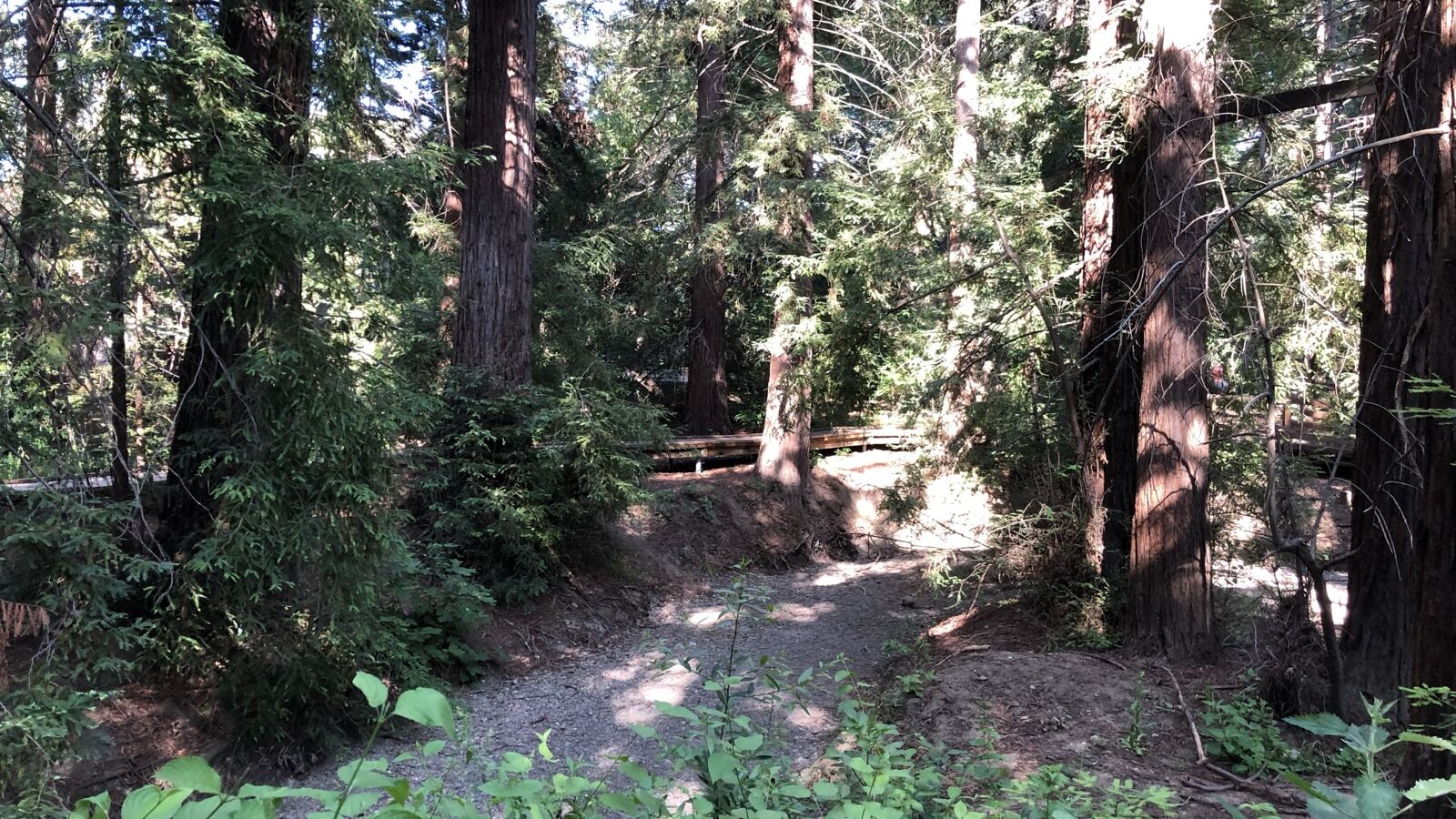
Three trees, often confused
Coast redwood, Sequoia sempervirens. The tallest tree on earth. A narrow coastal strip of northern California and southern Oregon. Hyperion, the tallest known, is over 115 m.
Giant sequoia, Sequoiadendron giganteum. The largest tree by volume. Confined to about 75 scattered groves on the western slope of the Sierra Nevada. General Sherman is around 84 m tall but 11 m in diameter at the base and roughly 1,500 cubic metres of trunk.
Dawn redwood, Metasequoia glyptostroboides. Deciduous, from a small area of central China, and known only as a fossil until living trees were found in the 1940s — one of the great botanical discoveries of the century. Now widely planted worldwide.
All three are relicts. The family was widespread across the northern hemisphere before the Miocene and has been reduced to these fragments.
Fog, and how coast redwood drinks it
Coast redwood is confined to a narrow band within reach of Pacific fog, and the reason is water physics.
Lifting water 100 m against gravity is at the limit of what a tree's vascular system can do, and the topmost foliage lives in permanent water stress.
Redwoods solve it by taking water in through the leaves. Summer fog condenses on the needles, and a substantial share of the tree's water — commonly estimated at a quarter to a half in the dry season — is absorbed directly through the foliage rather than drawn up from the roots.
The canopy also strips fog from the air and drips it to the ground, so a redwood forest generates a large part of its own summer rainfall. Fog drip beneath the trees can exceed measured rainfall by several times.
That makes the forest's water supply partly self-maintaining, and it makes the trees vulnerable to changes in coastal fog frequency — a genuine climate concern for the species. The same mechanism is exploited artificially in fog nets.
Bark that will not burn
Both Californian redwoods have thick, fibrous, deeply furrowed bark — up to 60 cm on an old giant sequoia — that is low in resin and high in tannin, and is a genuinely effective fire barrier.
Giant sequoia goes further: it is fire-dependent.
Its cones are serotinous, sealed with resin and held closed on the tree for up to 20 years. Heat from a fire opens them, releasing seed onto a freshly burnt seedbed of bare mineral ash — exactly the conditions the seedlings need, with competing vegetation removed and the litter layer gone.
So a century of fire suppression in the Sierra Nevada did two things at once: it stopped giant sequoia regenerating, and it allowed enormous fuel loads of white fir and litter to build in the groves.
The consequence has been severe. The fires of 2020 and 2021 killed a substantial share of all large giant sequoias in existence — trees that had survived every previous fire for two thousand years — because the fires burned hotter and higher than any in their history.
Prescribed burning is now standard management in the groves, and the whole case is set out in fire management.
The conifer that resprouts
Coast redwood breaks the rule stated in conifers.
Cut a coast redwood and it resprouts vigorously from the stump and from dormant buds in a woody basal burl. Rings of young trees around the stump of a felled giant — fairy rings — are clones of the original, and a redwood grove may be substantially one organism.
It also sprouts along the trunk, and fallen trees root where they lie.
That makes it, with yew, one of the very few conifers that can be coppiced, and it is why redwood forest recovers from logging in a way most conifer forest does not.
Giant sequoia does not resprout, and regenerates only from seed.
The timber
Redwood heartwood is light, straight-grained, dimensionally stable, and exceptionally durable — very high in tannins, resistant to rot and insects without treatment.
Used for exterior cladding, decking, shingles, greenhouses, water tanks, and outdoor furniture. It was logged intensively from the mid-nineteenth century, and roughly 95 percent of the original old-growth coast redwood forest was cut.
Giant sequoia timber is brittle and splits badly on felling — huge trees frequently shattered on impact — so it was largely worthless commercially, which is a bleakly ironic reason many groves survived.
Most redwood on the market now is second-growth, and old-growth timber is effectively unavailable.
Growing them
All three are widely planted outside their native ranges and grow well in cool, moist temperate climates.
Coast redwood wants high humidity, reliable moisture, shelter, and mild winters. It grows very fast in western Britain, Ireland, New Zealand, and the Pacific Northwest, and poorly in dry continental conditions. Hardy to about minus 15 C.
Giant sequoia is hardier and more drought-tolerant, tolerates colder winters, and makes an enormous specimen tree. Widely planted in Victorian estates and avenues across Europe.
Dawn redwood is deciduous, fast, tolerates wet ground and clay far better than the others, and is much smaller — 20 to 35 m. The best of the three for a normal site, and it turns a good foxy-brown in autumn.
All three need space and time and are entirely unsuitable for small gardens, whatever the label says. A giant sequoia planted 5 m from a house is a problem for someone in eighty years.
Plant small, keep watered through establishment, and shelter from wind. See tree planting.
Carbon and old growth
Redwood forest stores more carbon per hectare than any other forest type measured — the coast redwood stands of northern California hold roughly two to three times the above-ground biomass of tropical rainforest.
That is a function of enormous individual trees and very long accumulation times, and it is not recoverable on any planning horizon once cut. A second-growth stand is a fraction of the store.
It is the strongest available illustration of the point in carbon accounting: protecting existing old growth is worth far more than planting, and the two are not interchangeable.
See also
- Conifers the wider group, and the resprouting exception
- Fire Management serotiny and the consequences of suppression
- Fog Nets harvesting fog, as the canopy does
- Carbon Accounting why old growth cannot be replanted
- Yew the other conifer that resprouts
- Douglas Fir the forest partner in the Pacific Northwest
- Swamp Cypress and Dawn Redwood
- Kauri
- Bristlecone Pine
- Cryptomeria