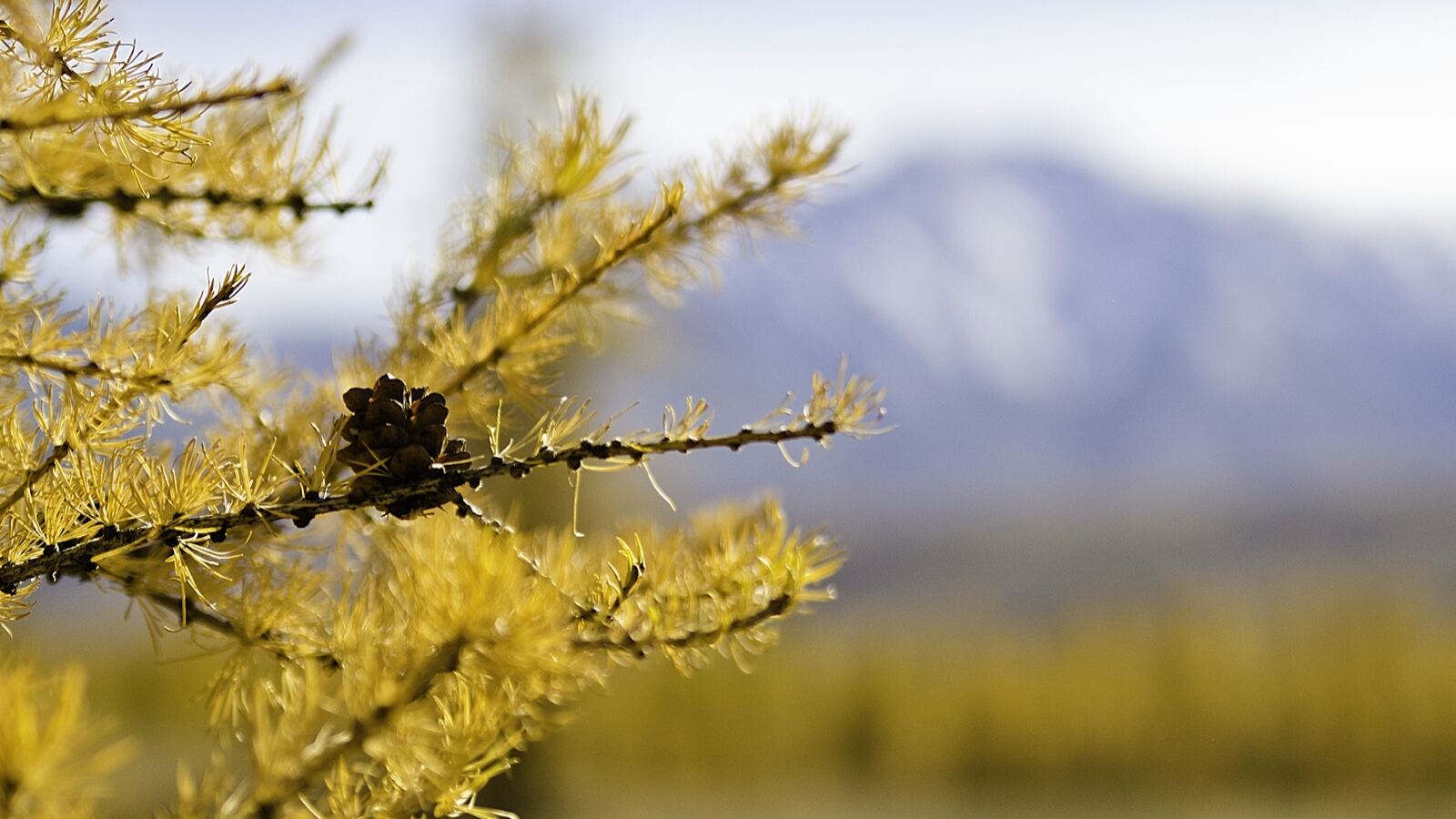
The conifer that is deciduous
Larix, around 10 species across the cold northern hemisphere, and the best-known exception to the rule that conifers are evergreen.
Larch drops every needle in autumn, turning a clear gold first, and stands bare through winter. It leafs out in spring in a soft, extremely bright green that is one of the more conspicuous events in a mixed woodland.
The needles are borne in rosettes of 20 to 40 on short woody spurs along the twig, with single needles on the current year's growth. Cones are small, upright, and persist on the tree for years after shedding seed.
Being deciduous is a cold-climate strategy: shedding needles avoids winter desiccation and snow load, which is why larch dominates enormous areas of Siberian taiga where evergreen conifers cannot survive. Larix gmelinii forests are the largest single forest type on earth by area.
Litter that improves the soil
This is the ecologically important point, and it separates larch from the rest of the group.
Most conifer litter is high in lignin and phenolics, low in nitrogen and calcium, and breaks down slowly into an acidifying mat — the mechanism described in conifers that produces podzolised soils and a bare forest floor.
Larch litter does not behave that way. It is soft, decomposes rapidly, and cycles nutrients quickly, so it builds rather than degrades soil structure.
Combined with a genuinely light canopy — thin in summer, absent in winter — that means larch woodland has a real ground flora. Bilberry, grasses, herbs, and bryophytes persist under it, and spring flowers get a full light season before the needles emerge.
That makes larch by far the best conifer for mixing with broadleaves and the usual first choice where a conifer nurse crop is wanted without wrecking the site. See nurse trees and structural diversity.
The timber
Larch is the most durable common European softwood.
The heartwood is resinous, dense for a conifer, and naturally rot-resistant — good enough for external cladding, decking, fencing, boat planking, and posts without preservative treatment. It weathers to a silver-grey and is widely used as untreated timber cladding for exactly that reason.
Historically it went into ship hulls, pit props, and stakes. Siberian larch is denser and more durable still, and is traded specifically for external use.
It is strong, works reasonably, and splits if nailed near an end without pre-drilling. It contains a lot of resin, which makes it spit in a fire.
Rotations are short by conifer standards, and it grows fast when young.
Phytophthora ramorum
Larch in Britain and Ireland has been hit hard by an epidemic, and it is worth understanding because it inverts an expectation.
Phytophthora ramorum is an oomycete — a water mould, not a true fungus — that arrived in Europe and North America through the ornamental plant trade. In California it causes sudden oak death, which is where the common name comes from.
In Britain the main victim has turned out not to be oak but Japanese larch, L. kaempferi, which proved unexpectedly susceptible after the pathogen was found on it in 2009. Larch produces enormous quantities of spores, so infected plantations became engines of spread.
The response has been very large-scale sanitation felling across Wales, south-west England, Scotland, and Ireland — statutory plant health notices requiring clearance of infected and neighbouring stands, running to tens of thousands of hectares.
The knock-on effects were significant: timber gluts, disrupted rotations, and the felling of larch that had been planted specifically as the ecologically better conifer choice.
It is a clear case of the argument in tree diseases: the plant trade is the vector, monoculture is the amplifier, and mixture is the only durable insurance.
The species
European larch, L. decidua, native to the Alps and Carpathians. Best form and timber quality, susceptible to larch canker on unsuitable sites.
Japanese larch, L. kaempferi, faster, more tolerant of exposure and poor ground, more resistant to canker — and the main P. ramorum host.
Hybrid larch, L. × marschlinsii, a cross of the two, combining vigour with canker resistance. Widely planted.
Tamarack, L. laricina, the North American species, tolerates waterlogged and peaty ground better than any of them.
Siberian and Dahurian larch, L. sibirica and L. gmelinii, the taiga species, extraordinarily cold-hardy — surviving below minus 60 C.
Growing it
Light-demanding, and absolutely so. Larch will not tolerate shade at any stage, and it must be kept in full light or it dies out. This limits it in continuous-cover systems, where it needs large gaps.
Free-draining soil. It dislikes waterlogging and heavy compacted ground, though tamarack is the exception.
Cold-hardy and wind-firm, with a deeper root system than spruce.
Fast when young, then slowing. Reaches 30 to 45 m.
Prone to larch canker, worse on frost-prone valley bottoms and unsuitable provenances, and to larch adelgid.
Plant small, protect from browsing, and thin early and often to keep the crowns in light. See tree planting and woodland management.
As with all conifers except yew, it will not resprout from old wood.
See also
- Conifers the wider group and the litter question
- Douglas Fir the usual mixture partner
- Spruces the plantation conifer larch is often preferred over
- Tree Diseases the Phytophthora epidemic in context
- Nurse Trees larch as a light nurse for broadleaves
- Structural Diversity why the light canopy matters
- Swamp Cypress and Dawn Redwood
- Golden Larch