What they are
Sorbus, in the rose family. Rowan or mountain ash is S. aucuparia, with pinnate leaves resembling ash but unrelated to it. Whitebeams have simple oval leaves, densely white-felted beneath, so the tree flashes silver as wind turns the foliage. Wild service tree, S. torminalis, has maple-like lobed leaves.
All are small to medium trees, rarely above 15 m, with flat clusters of white flowers in spring and heavy crops of berries in late summer.
They are the trees of thin soil, high ground, and rocky places, growing where larger species cannot.
Rowan and altitude
Rowan grows higher up mountains than almost any other tree in Europe, persisting on crags and boulder fields well above the treeline of oak and beech. In Scotland it is often the last tree, clinging to gullies and rock ledges where deer cannot reach it.
That last detail is important. In heavily browsed uplands, rowan survives mainly in inaccessible places, and its distribution maps browsing pressure as much as climate. A hillside with rowan only on cliff ledges is telling you something about deer numbers. See deer and rabbits and site protection.
Rowan is also a genuine pioneer: tolerant of exposure, poor thin acid soil, and cold, and dispersed widely by birds. It appears readily on abandoned ground, in rock crevices, and even epiphytically in the forks of other trees. See pioneer species.
That makes it valuable in upland restoration, both as a nurse for slower species and as a component of montane scrub, a habitat that has been almost eliminated across Britain and is now a restoration priority.
The berries
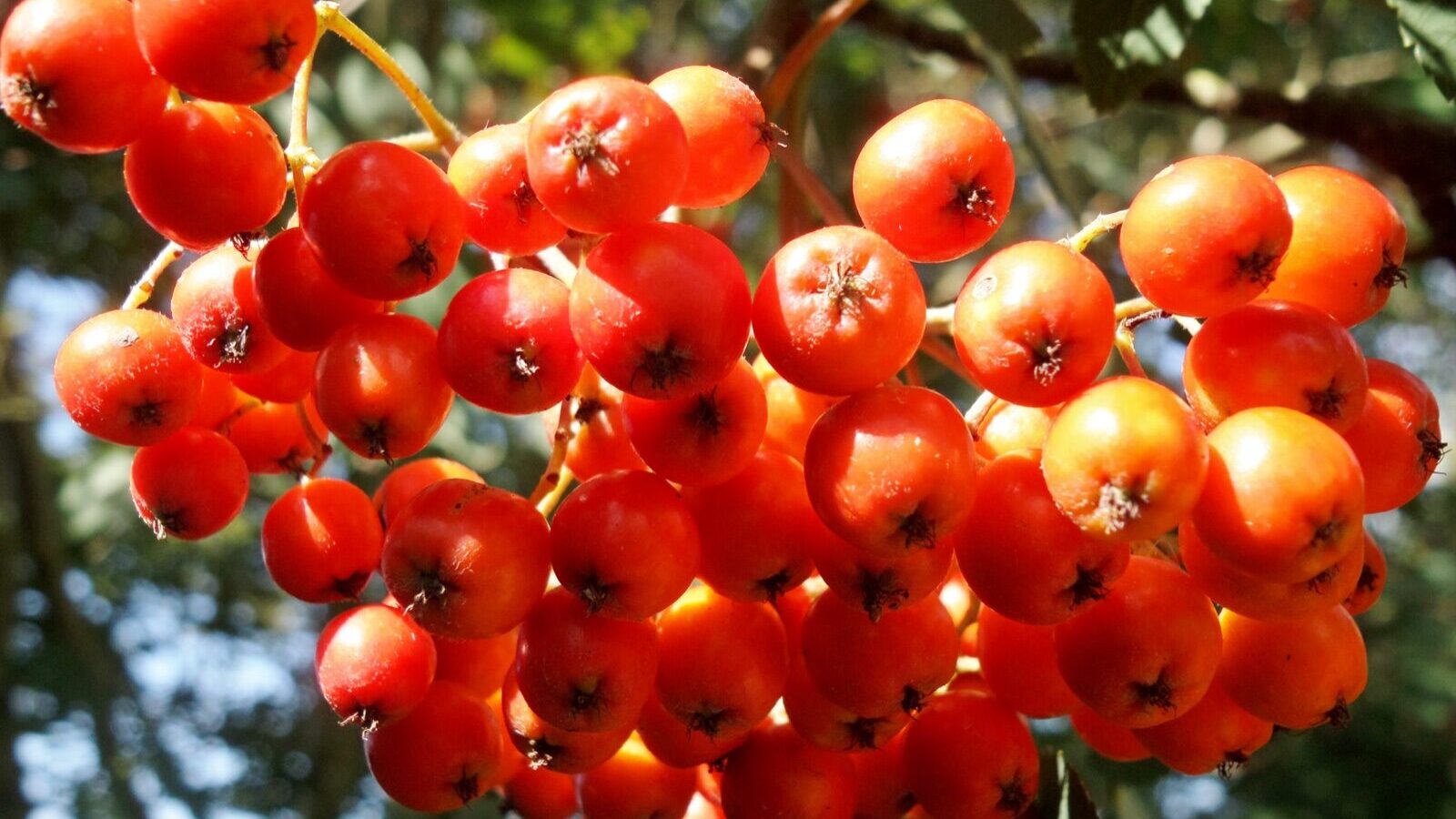
Rowan produces very heavy crops of scarlet berries in late summer, and they are a major food resource at exactly the point when migrating and wintering thrushes need it.
Fieldfares and redwings arriving from Scandinavia strip rowans in days. Blackbirds, mistle thrushes, and waxwings all depend on them, and waxwing irruptions into Britain are driven largely by rowan and related berry crop failures further north.
The seeds pass through birds and are deposited elsewhere, which is precisely how rowan reaches its improbable growing sites. See seed-dispersing birds.
Rowan berries are edible for people only after cooking, which breaks down the parasorbic acid, and rowan jelly is a traditional accompaniment to game. Raw berries in quantity cause stomach upset.
Whitebeam and wild service berries are also bird food, and service berries were historically eaten by people once bletted, softened by frost or storage. The wild service tree gave its name to a great many English pubs called the Chequers, from the fruit.
The strange genetics
Sorbus is one of the more remarkable genera in European botany because much of it reproduces without sex.
Many whitebeams are apomictic: they set viable seed from unfertilised ovules, producing offspring genetically identical to the parent. Combined with occasional hybridisation between species, this generates populations of stable clonal microspecies, each confined to a very small area.
The result is a large number of extremely localised endemic Sorbus species, several restricted to a single gorge, cliff, or island, sometimes numbering only a few dozen individual trees. Britain alone has dozens of endemic whitebeams, many critically rare.
For anyone working on rare plant conservation this makes Sorbus disproportionately important, and it is a good practical illustration of minimum viable populations and the value of seed banking.
Uses
Rowan wood is tough, fine-grained, and elastic, historically used for tool handles, bows, and small turned work.
Wild service and whitebeam timber is hard, dense, and pale, valued for precision work: rulers, musical instrument parts, and machine cogs before metal replaced them.
Rowan carries substantial folklore across northern Europe as a protective tree, planted beside doors and gates to guard against harm, which is why old rowans stand next to so many upland farmhouses and churchyards.
Planting them
Easy, useful, and under-planted.
Rowan tolerates exposure, cold, acid soil, and poor drainage, and it establishes readily. It is one of the best choices for difficult upland and northern sites, and a good small garden tree with three seasons of interest.
Whitebeam handles chalk and limestone well, and is notably tolerant of urban pollution and coastal salt wind, which makes it a good street tree at modest size. See urban forestry.
For wildlife planting, both belong in any mix intended to feed birds through autumn and winter, alongside hawthorn, elderberry, and the shrubs in wildlife shrubs.
Protect from browsing when young, or in most upland situations you will simply be feeding deer. Rowan is highly palatable and is usually the first thing eaten.
Susceptible to fireblight in the rose family, so avoid planting near pears and apples in areas where fireblight is active. See tree diseases.
See also
- Hawthorn the other great berry tree
- Seed-Dispersing Birds how rowan travels
- Wildlife Shrubs the autumn berry supply
- Pioneer Species rowan as a coloniser
- Minimum Viable Populations the rare endemics
- Site Protection browsing as the limiting factor
- Scots Pine
- Serviceberry
- Guelder Rose and Viburnum