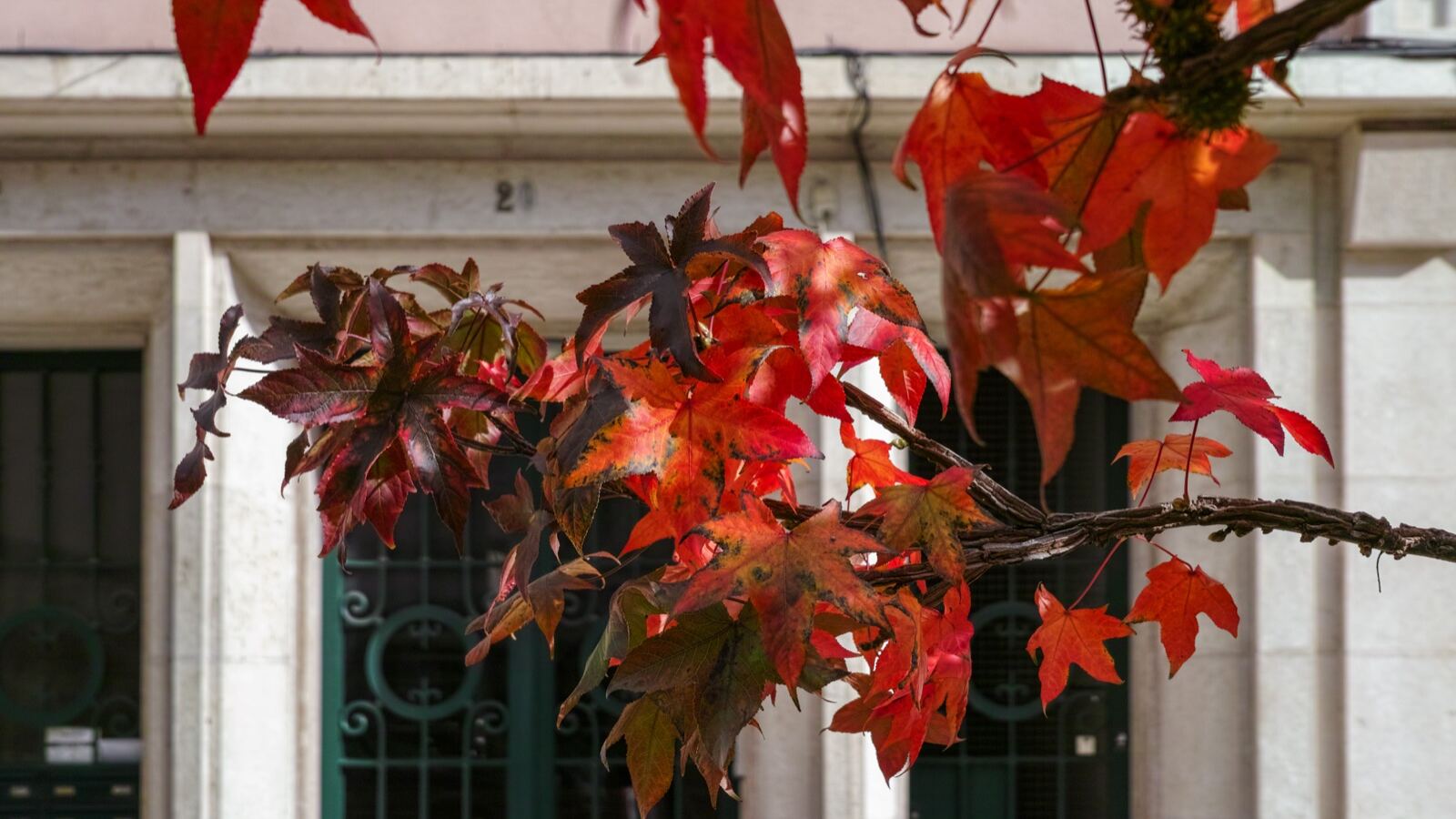
What it is
Liquidambar styraciflua, from eastern North America, with relatives in Turkey (L. orientalis) and East Asia — another of the eastern-Asia–eastern-North-America disjunct pairs, like tulip tree and magnolia.
Two features identify it. The leaves are star-shaped, five to seven pointed lobes, glossy, and often mistaken for a maple's — but sweetgum leaves are arranged alternately on the twig, where maple leaves are opposite, which settles it instantly. And the seed capsules are hard, round, spiky balls that hang through winter and litter the ground beneath.
Autumn colour
Sweetgum is among the finest autumn-colour trees of the temperate world, and its display is unusually long and varied.
A single tree can carry yellow, orange, scarlet, crimson, and deep purple at once, and different trees colour differently, so a stand is a patchwork. The colour holds for weeks, later than most, and named cultivars are selected for reliable intense colouring — a real consideration, since seedlings vary and some colour poorly.
It rivals the maples and tupelo for autumn display, and it is planted worldwide as an ornamental for that reason.
Storax
The name Liquidambar means liquid amber, and it refers to the fragrant resin the tree exudes from wounds in its bark.
This resin, storax or styrax, has a long history: a fixative and fragrance in perfumery, an incense, a flavouring, a traditional medicine, and a component of some balms and salves. The oriental sweetgum of Turkey is tapped commercially for it. Chewing the hardened resin as a gum is the origin of the common name, and Native Americans and later settlers used it that way.
It places sweetgum among the resin- and balm-yielding trees, alongside the conifers and the storax of the unrelated Styrax trees.
The spiky balls
The seed capsules — gumballs, in American usage — are the tree's chief liability and the reason it is sometimes disliked as much as loved.
They are hard, woody, spiky, roughly 3 cm across, and they drop in quantity through autumn and winter, littering lawns and paths, rolling underfoot, jamming mowers, and being genuinely painful to step on barefoot. On a lawn or a path they are a real nuisance.
For that reason fruitless cultivars have been selected and are widely planted where the litter matters, giving the foliage and colour without the balls. There are also chemical fruit-suppression treatments, mostly used on municipal trees.
Left in a wilder setting the capsules are less of a problem, and the seeds feed finches, chickadees, and squirrels through winter. See seed-dispersing birds.
Growing it
Deep, moist, fertile, slightly acid soil. Sweetgum is a bottomland and floodplain tree in the wild, tolerant of wet ground and even periodic flooding, and it dislikes shallow chalk and drought. On alkaline soil it becomes chlorotic. See soil pH.
Full sun for the best colour.
Fast when young, reaching 20 to 35 m with a neat conical then rounded crown, and long-lived.
It develops distinctive corky wings on the twigs and young branches, a good winter identification feature shared with some elms and maples.
It transplants somewhat poorly because of a coarse root system, so plant small. See tree planting.
Largely free of serious pests and diseases, which with its colour and toughness makes it a good large ornamental and a useful component of a diverse tree planting — provided the seed-ball litter is acceptable, or a fruitless form is used. See urban forestry.
See also
- Maples the tree its leaves are mistaken for, and how to tell them apart
- Tupelo the other great American autumn tree of wet ground
- Tulip Tree the disjunct-distribution relative
- Conifers the other major resin-yielding trees
- Urban Forestry and the seed-ball litter question
- Soil pH why it yellows on chalk
- Witch Hazel
- Sumac and Smoke Tree
- Sourwood