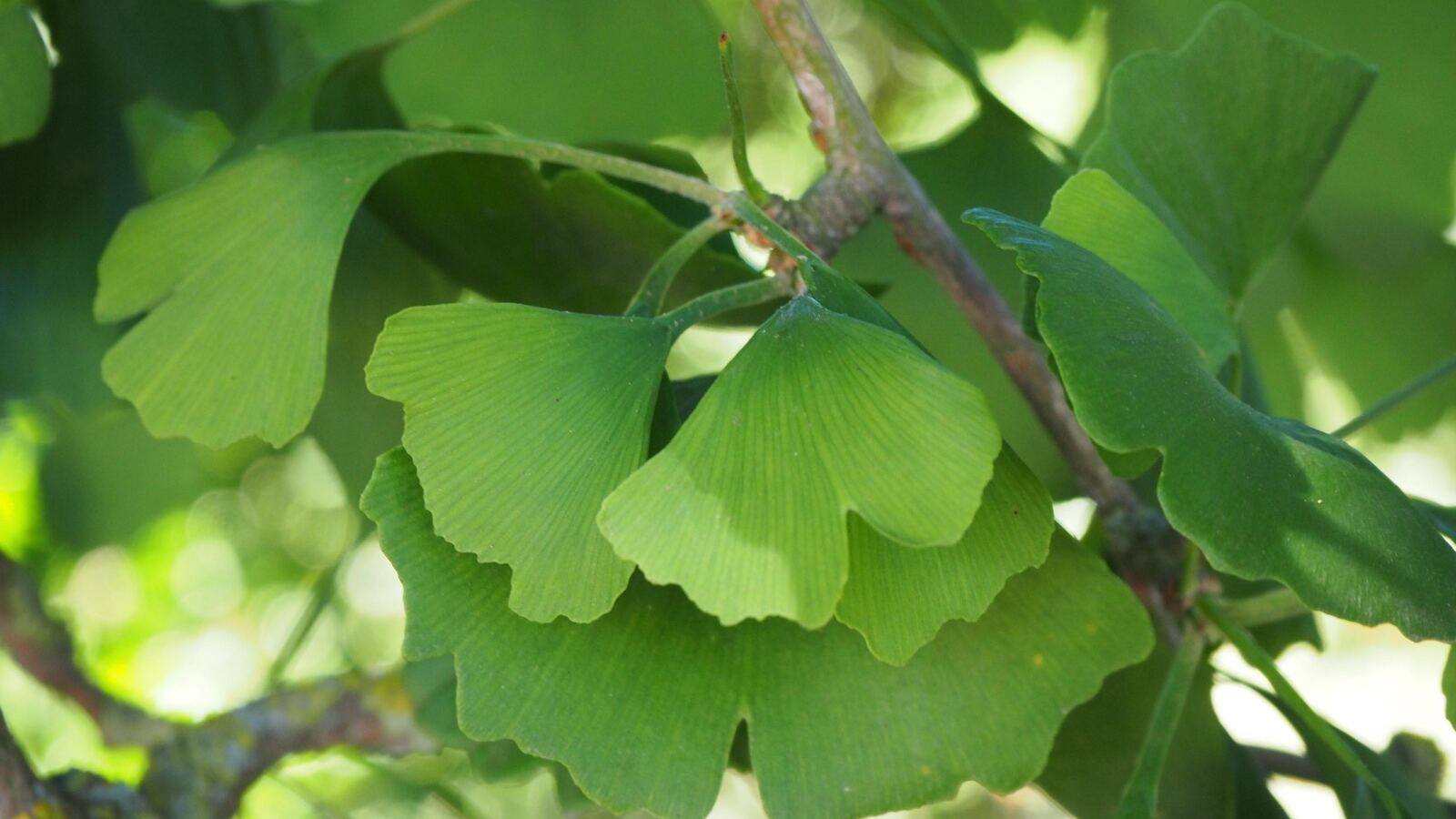
What it is
Ginkgo biloba, and it is genuinely alone — the sole surviving species of its genus, family, order, and division. Every other ginkgo that ever lived is extinct.
It is a gymnosperm, related to the conifers and cycads far more than to any flowering tree, but it is none of those — it sits in its own branch of the plant kingdom, a lineage that split off before the dinosaurs.
Fossils essentially identical to the living tree date back over 200 million years, to before the age of dinosaurs, which is why it is the classic living fossil — a term Darwin coined, with the ginkgo in mind. Its distinctive fan-shaped, notched leaves, with veins that fork and radiate without a central midrib, appear unchanged in rock across that entire span.
Saved from extinction
Ginkgo very nearly did not survive. It declined to near-extinction and by historical times may have persisted in the wild only in a small area of China, if at all — whether any truly wild population remains is uncertain.
It survived because it was cultivated in temple gardens across China, Korea, and Japan, planted for its beauty, its longevity, and its sacred associations, for well over a thousand years. Monks and gardeners kept alive a tree the wild had almost lost — one of the clearest cases of a species preserved by human cultivation, in the mould of the monkey puzzle and the Wollemi pine. See seed banking and minimum viable populations.
Its resilience was demonstrated starkly at Hiroshima, where several ginkgos close to the 1945 atomic blast survived, resprouted from their bases, and still live — among the hibaku jumoku, the survivor trees, and a symbol of endurance.
The toughest street tree
That deep-time resilience translates into extraordinary practical toughness, and it has made ginkgo one of the most reliable urban trees in the world.
It tolerates pollution, poor and compacted soil, drought, road salt, heat, and confined roots better than almost any other tree, and it is remarkably free of pests and diseases — its ancient chemistry seems to deter most modern insects and pathogens. It is essentially immune to the fungal and insect problems that afflict other street trees, which for a municipal planting is a major advantage.
It gives clean, brilliant, uniform golden autumn colour, often dropping its leaves in a single day in a striking carpet, and it has a neat, upright, manageable form.
For all these reasons it is planted heavily in cities worldwide, and it is a strong recommendation in the urban forestry diversity argument, being about as unrelated to every other street tree as a tree can be.
The smell problem
There is one large caveat, and it governs how ginkgo is planted.
Ginkgo is dioecious — separate male and female trees — and the female produces fleshy seed coats that, when they fall and rot, smell overpoweringly of rancid butter or vomit, from butyric acid. A female ginkgo dropping fruit on a pavement is genuinely offensive.
So street and amenity ginkgos are almost always male clones, grafted or propagated vegetatively to guarantee the sex, avoiding the fruit entirely. Sexing is impossible from a seedling until it matures, which is why named male cultivars are used.
The seed inside, however — ginkgo nut, ginnan — is a valued food in East Asian cooking once the foul outer coat is removed, roasted or in soups and celebration dishes. It is eaten in moderation, as larger quantities contain a mild toxin. So the female's offensive fruit conceals a delicacy, and where the nut is wanted, females are grown deliberately.
Growing it
Undemanding once established: full sun, almost any well-drained soil, wide pH tolerance, and great tolerance of urban stress. It dislikes only deep shade and waterlogging.
Slow to establish and then steady, reaching 20 to 35 m, and extraordinarily long-lived — cultivated ginkgos of over 1,000, even 2,000, years survive in East Asia, on the scale of the yew.
Plant a named male for amenity use to avoid the fruit. Grows easily from seed, which must be sown fresh, and grafted for guaranteed-male clones. See grafting and propagation.
Ginkgo leaf extract is one of the most widely sold herbal supplements, promoted for memory and circulation; the evidence is weak and mixed, another case of health claims outrunning the data, as with turmeric and tea.
Ginkgo is a tree to plant for the very long term, for its toughness, its clean gold autumn, and the quiet remarkableness of growing a plant that has looked essentially the same since before flowers existed. See perennials first.
See also
- Conifers its nearest, distant, gymnosperm relatives
- Urban Forestry ginkgo as the ultimate tough street tree
- Monkey Puzzle another ancient lineage saved by cultivation
- Yew the comparable extreme-longevity tree
- Minimum Viable Populations a species preserved from near-extinction
- Seed Banking conservation by cultivation
- Swamp Cypress and Dawn Redwood
- Cycads
- Franklinia
- Umbrella Pine
- Golden Larch