What it is
A woodland is not a crop. It is a 200-year project you inherited halfway through.
Management means deciding, in any given decade, which trees stay, which come out, and which patch you do not touch at all. Get the cycle right and the wood pays for itself in timber, firewood, and habitat while building structure you will never live to see mature.
The mistake most owners make is treating a wood like a garden. Annual tidying. Quick wins. A woodland answers on a slower clock.
The thinning cycle
A stocked broadleaf wood in temperate climate runs on a 15 to 25 year thinning rotation. Conifer plantations come in tighter, 8 to 12 years. The principle is the same: remove around 30 percent of standing canopy per cycle, favour the stems you want to keep, and walk away for another decade and a half.
Mark before you cut. Walk the compartment in winter when the structure is visible, ribbon the keepers in one colour and the removals in another. Keepers are straight, vigorous, well-spaced, ideally of the species you want dominant in 80 years. Removals are crooked, suppressed, diseased, or simply too close to a better neighbour.
Favour by subtraction. You almost never plant your way to a better wood. You cut your way there. Take out the sycamore crowding your oak, not the other way round. Drop the spruce shading out the hazel coppice you want to bring back.
Thirty percent canopy removal lets light to the floor without shocking the system. Push past 40 percent and you invite bramble, bracken, and wind damage. Stay under 20 percent and the suppressed stems below get no chance to respond.
Deadwood is not waste
Aim for 10 percent of standing volume as deadwood, split between standing snags and fallen logs.
In a typical broadleaf wood that means leaving 30 to 50 cubic metres per hectare of dead and decaying timber on the floor and standing. Snags taller than 4 metres host woodpeckers, owls, bats, and beetles. Fallen logs over 40 cm diameter become saproxylic habitat for decades.
When you thin, do not extract everything. Ring-bark one stem in twenty and leave it standing. Drop another and leave it where it falls. The whole dead wood habitat entry covers the detail.
A tidy woodland floor is a poor one. Beetles, fungi, and the birds that feed on them all measure their fortune in rotting timber.
Rides and glades
Cut light back into the wood deliberately.
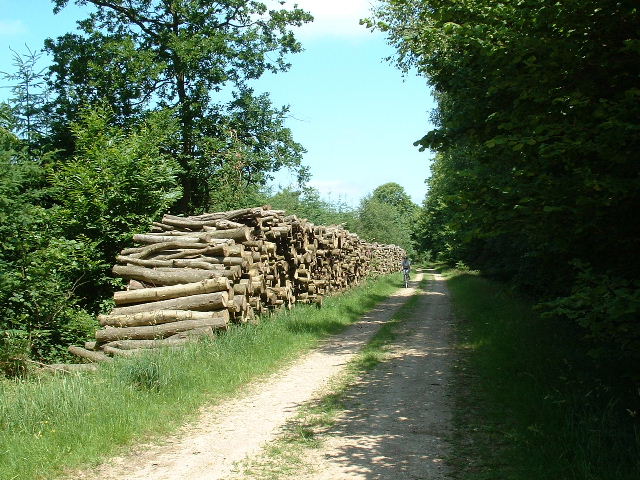
A ride is a permanent path through the canopy, 1.5 to 2 tree-heights wide. So in a 20 m wood, that is 30 to 40 m of cleared width. Mow or graze the centre annually to keep grass and herbs. Coppice the shrub margins on a 5 to 7 year rotation. The graded edge from open sward to scrub to canopy is where butterflies feed, slow-worms bask, and bluebells flower in the broadest sweep.
A glade is a permanent opening within the wood, 0.1 to 0.5 hectares. Same logic, no through-route. Cut every 10 years to suppress tree regeneration. Leave the brash piled along the shaded edge for rock and log piles habitat.
Target around 5 to 10 percent of total woodland area as open ride and glade. Pearl-bordered fritillaries, silver-washed fritillaries, and woodland flora will track you back within three or four seasons.
Selective versus group felling
Two methods, two outcomes.
Selective (single-stem) felling takes individual trees from across the compartment. Gaps are small, 0.05 to 0.1 hectare. The canopy closes again quickly. Shade-tolerant species like beech, holly, and yew regenerate. This is the engine of continuous-cover forestry: the wood is always a wood, never a clearing.
Group felling takes a patch of 0.1 to 0.5 hectare at a time. The bigger gap lets light-demanding oak, birch, and cherry establish from seed or planting. You end up with a mosaic of even-aged groups across the compartment, each at a different stage.
Choose by the species you want. Beech and hornbeam wood: selective. Oak and birch wood: groups. Mixed objective: do both in different compartments and read what comes back.
Clear-felling, the standard even-aged plantation approach, has its place in conifer crops grown for timber on short rotation. It has almost no place in broadleaf woodland managed for the long haul.
Ancient woodland: when not to manage
Some fragments are too old to improve.
Ancient woodland in the UK means continuous tree cover since 1600. Equivalent old-growth fragments exist worldwide and they are all rare. Indicators tell you what you have walked into: bluebell (Hyacinthoides non-scripta), dog's mercury (Mercurialis perennis), wood anemone (Anemone nemorosa), yellow archangel, ramsons, herb-paris. Find three in good cover and treat the patch as ancient until proven otherwise.
The rule is minimum intervention.
No thinning of native canopy. Remove invasives (rhododendron, Himalayan balsam) by hand. Keep deer pressure down. Fence the boundary if grazing pressure is heavy from outside. Otherwise leave it alone for the next 30 years.
Soil seed banks in ancient woodland are the genuine article. You cannot recreate them. A single deep harrow and 400 years of memory is gone in an afternoon.
For reading what your wood is telling you, see site reading and historical ecology.
The long view
Write a 50-year plan, compartment by compartment.
Year 0 to 10: first thinning, ride network cut, deadwood quota established. Year 10 to 25: second thinning, regeneration assessed, deer fence reviewed. Year 25 to 50: third thinning, oldest stems left to senesce in place.
You will not finish it. Whoever takes the wood after you finishes it. Write the plan anyway. The next steward needs to know what you were trying to do, and so do you in 15 years when the trees look nothing like what you remember.
See Richard St. Barbe Baker for the long view at its purest.
See also
- Coppice Rotation
- Dead Wood Habitat
- Historical Ecology
- Hedgerow Care
- Storm Damage Recovery
- Conifers
- Peter Wohlleben
- Wild Cherry
- Douglas Fir
- Silver Fir
- Wood Decay Fungi
- Southern Beech
- Mahogany
- Hemlock
- Kauri
- Rosewood and Sandalwood
- Cedar of Lebanon
- Quebracho