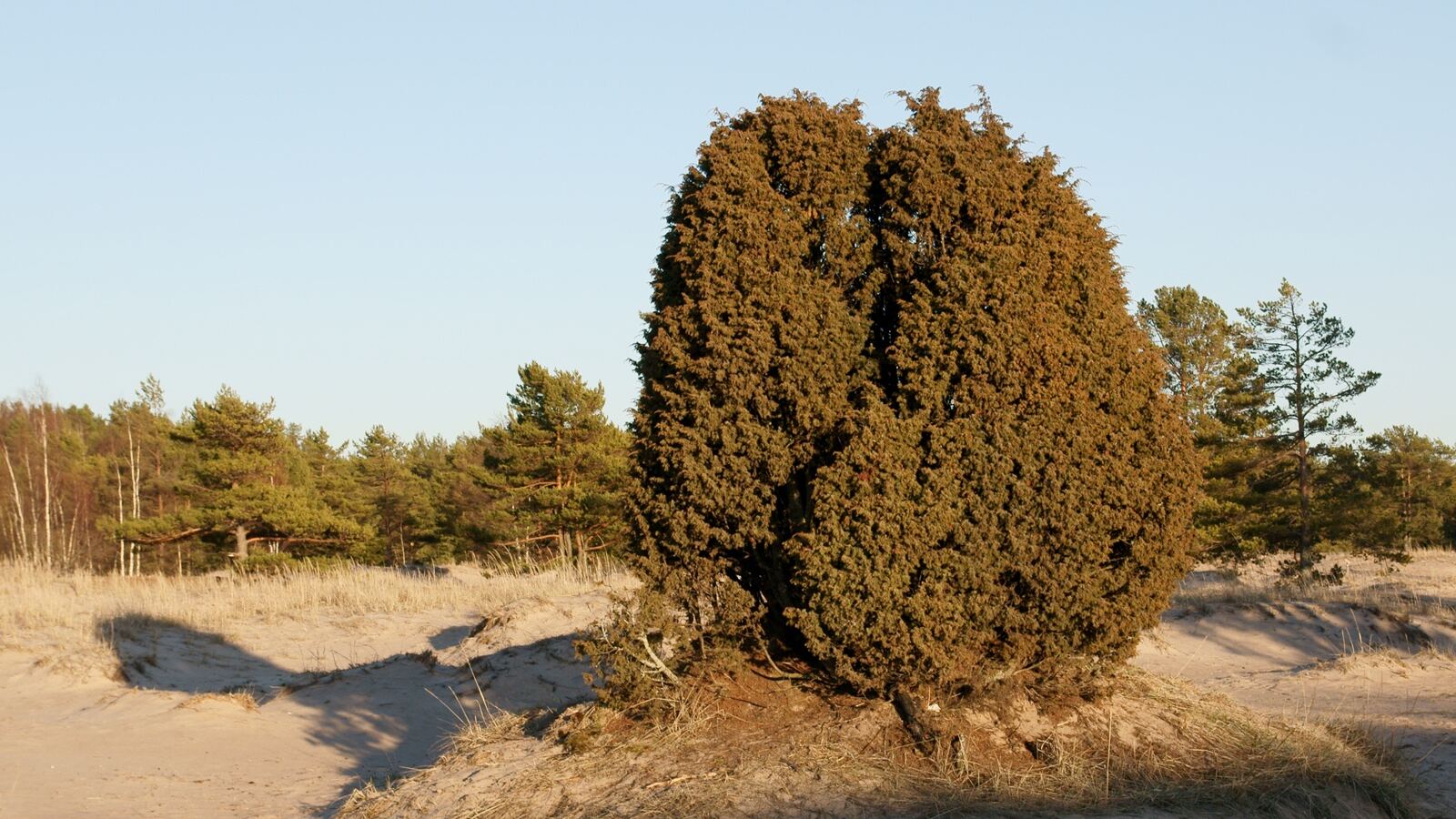
What it is
Juniperus, around 60 species, and collectively the most widely distributed conifer genus on earth — from arctic tundra to the deserts of Mexico, from sea-level dunes to 4,500 m in the Himalaya.
Form varies enormously: ground-hugging mats a few centimetres high, dense shrubs, and desert trees several hundred years old.
J. communis is the widest-ranging woody plant in the world, circumpolar across Europe, Asia, and North America.
The berry is a cone
Junipers are conifers, so what looks like a berry is a fleshy cone with the scales fused into a soft, resinous, wax-bloomed sphere.
They take two to three years to ripen, so a mature bush carries green first-year cones and blue-black ripe ones simultaneously.
Like yew, most junipers are dioecious — separate male and female plants — so only females bear cones, and only with a male nearby.
Birds eat the cones and disperse the seed. See seed-dispersing birds.
Gin
Juniper is the defining botanical of gin — legally so, since a spirit cannot be called gin unless juniper is the predominant flavour.
The name descends through Dutch jenever from the Latin juniperus. The flavour compounds are terpenes, chiefly alpha-pinene, myrcene, and limonene, and their balance varies with species, region, and season.
Most gin juniper is still wild-harvested, largely from Mediterranean and eastern European populations, which makes the supply chain unusually dependent on wild plant populations for a mass-market product.
Juniper is also used to smoke foods in Scandinavia, to flavour game and sauerkraut, and as a traditional medicinal.
Not all junipers are edible. J. sabina, savin, is toxic and was historically used as an abortifacient with frequently fatal results. Use only confirmed J. communis.
Dryland cover
Across arid and semi-arid regions, junipers are keystone woody cover where little else survives.
They tolerate drought, thin stony soil, extreme cold, extreme heat, exposure, and grazing better than almost any other tree. Deep roots reach water far below the surface, and the dense low canopy shelters seedlings of other species — a genuine nurse plant in hostile country. See nurse trees and drought-tolerant species.
Piñon-juniper woodland across the American southwest is a major vegetation type, providing food and cover for a large fauna, and juniper woodlands in East Africa, the Himalaya, and the Mediterranean fill similar roles.
That same toughness makes juniper an encroachment problem in some rangelands, where fire suppression has let it spread into grassland and lower the water table. See fire management and grassland restoration.
Why British juniper is failing
J. communis is one of only three conifers native to Britain, alongside Scots pine and yew, and it is in serious decline. The problem is not adult mortality but failed regeneration, and it is a useful case study in how a species can be functionally lost while the plants are still standing.
Several factors compound:
Grazing. Rabbits, deer, and sheep eat seedlings. Juniper needs the right amount of grazing — enough to keep competing vegetation open, not enough to remove the seedlings. That window is narrow and is missed in both directions. See deer and rabbits.
Ageing populations. Many British stands are almost entirely old plants with no young ones, so the population is dying of old age with nothing replacing it.
Sex ratio and isolation. Dioecious plants in small scattered stands may lack a male within range, so cones set no viable seed.
Poor seed viability, often very low even in good years, and seed that needs a long cold stratification.
Phytophthora austrocedri, a root pathogen now killing juniper in Britain, arriving through the horticultural trade like so many others. See tree diseases.
Restoration involves fencing to control grazing precisely, creating bare ground for seedlings, and in places direct sowing or planting of local provenance stock. It is slow and unglamorous, and it illustrates minimum viable populations clearly: a species can be present and still be finished.
Wildlife
Dense prickly juniper is first-rate nesting cover, and the cones feed thrushes, waxwings, and fieldfares through winter.
British juniper supports a specialised invertebrate fauna, including several moths and a gall midge found on nothing else — so losing the plant loses more than the plant.
Growing it
Full sun and sharp drainage are the two requirements, and it will not tolerate waterlogging or heavy shade.
Beyond that it accepts chalk, acid sand, drought, salt wind, and severe cold. Slow-growing and long-lived.
Propagate from cuttings, which is far more reliable than seed — juniper seed is notoriously slow and erratic, often needing 18 months and a warm-then-cold sequence to break dormancy. See propagation.
Buy from a reputable source and be aware of the Phytophthora risk in the trade. See nursery stock.
Do not cut into old bare wood. Like most conifers and unlike yew, juniper does not resprout from it, so an overgrown plant cannot be renovated by hard pruning. See conifers.
Ground-cover forms are useful on banks and dry slopes for erosion control. See erosion control.
See also
- Conifers the wider group, and the no-resprouting rule
- Yew the other native conifer, and the exception
- Drought-Tolerant Species juniper in dry country
- Minimum Viable Populations regeneration failure
- Nurse Trees juniper sheltering other seedlings
- Deer and Rabbits the grazing that stops regeneration
- Scots Pine
- Shea and Argan
- Plum-Yews
- Incense Cedar