What it is
Pseudotsuga menziesii, from the Pacific coast of North America and the Rocky Mountains.
Not a true fir, not a spruce, not a hemlock — the genus name means false hemlock, and it sits in its own group. The common name is a persistent misnomer.
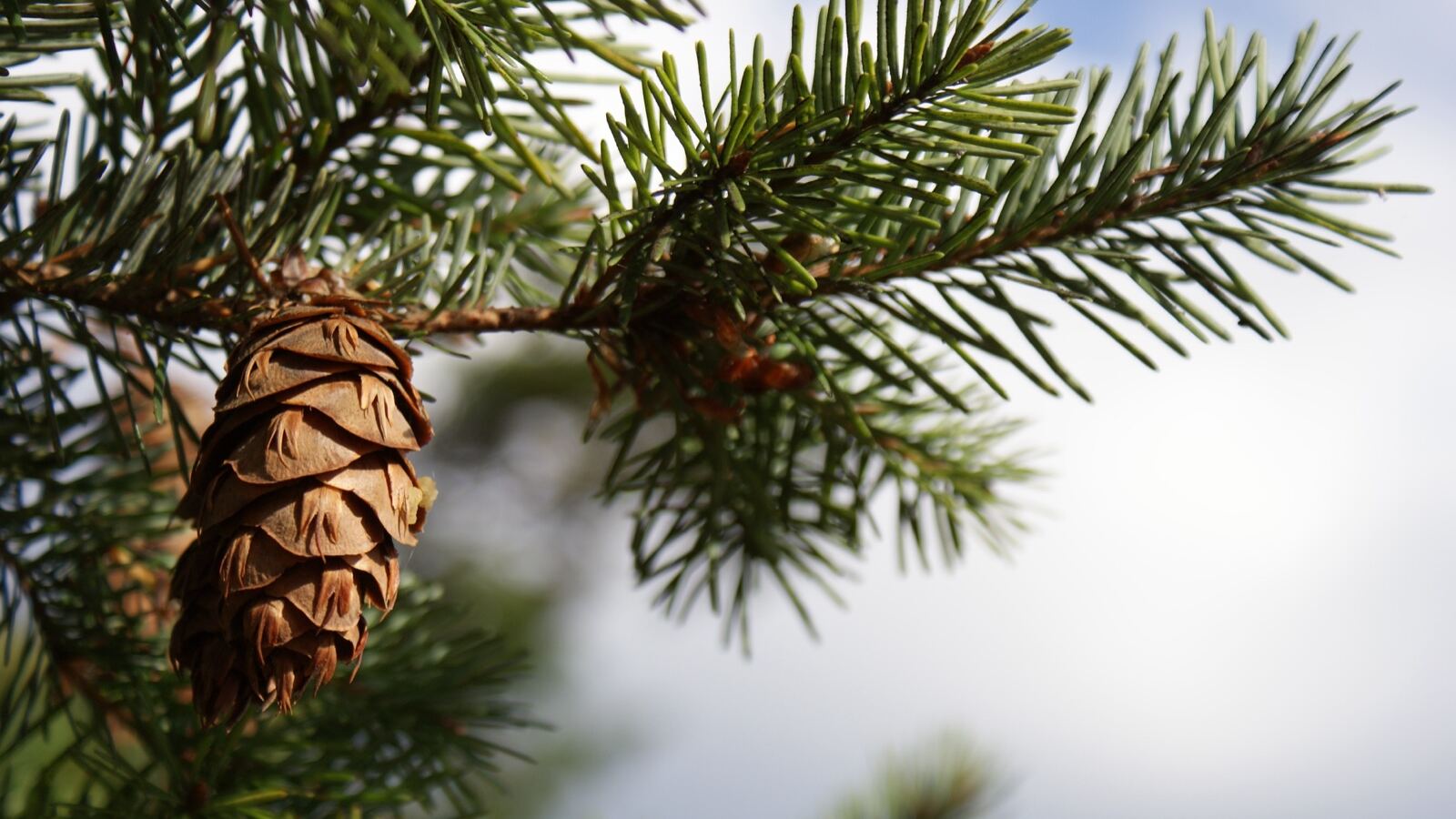
The cone settles it. Douglas fir cones hang downward and carry distinctive three-pointed bracts protruding between the scales, like the back legs and tail of a mouse diving in. Nothing else has them, and a single cone on the ground identifies the tree.
Needles are soft, flat, arranged all round the shoot, and smell of citrus and resin when crushed. Buds are sharply pointed and papery brown, unlike the blunt resinous buds of spruce.
One of the great trees
Coast Douglas fir reaches 60 to 75 m routinely and historically well over 100 m — among the tallest trees on earth, behind only the redwoods and a few eucalypts. The tallest surviving specimens are around 100 m.
It lives 500 to 1,000 years and more, and the old-growth Douglas fir forests of Oregon, Washington, and British Columbia are among the highest-biomass ecosystems ever measured — carrying more carbon per hectare than tropical rainforest, largely in enormous trunks and deep coarse woody debris.
Those forests are also where much of the modern understanding of forest ecology was developed, including the mycorrhizal network research described in mycorrhizal fungi and by Suzanne Simard, whose isotope experiments used Douglas fir and paper birch.
The timber
Douglas fir is arguably the best structural softwood in commercial use.
Strong, stiff, and stable, with an unusually high strength-to-weight ratio for a softwood. Straight-grained, available in very long clear lengths, and it holds fastenings well.
Used for structural framing, glulam beams, laminated veneer, plywood — it was the original plywood species — flooring, joinery, and heavy construction. Its long clear lengths made it the standard for masts, bridge timbers, and mine props.
Moderately durable outdoors, better than spruce, well short of larch or black locust.
The heartwood is a warm reddish-brown with a strong grain pattern, and the timber is distinctive enough to be specified for appearance as well as strength.
Why foresters in Europe like it
Douglas fir has become the preferred alternative to spruce across much of European forestry, and the reasons are specific.
Deep rooting. Unlike spruce's shallow plate, Douglas fir puts down a substantial root system including a taproot on suitable soils. That makes it markedly more windfirm, which is what allows the next point.
It can be thinned. A stand that can be thinned without blowing over can be managed under continuous cover — selective harvesting, natural regeneration, permanent canopy — rather than clearfelled. That single difference changes the whole character of the forest. See woodland management.
Shade tolerance in youth, enough to regenerate under a partial canopy, which is what continuous cover requires.
Drought tolerance considerably better than spruce, which matters increasingly. Interior provenances from the Rockies are more drought-hardy still, though slower and less well-formed. See climate adaptation.
Fast growth with good form and long clear stems.
The result is that Douglas fir is widely recommended as a partial replacement for Norway spruce on sites where spruce is now failing.
The caveats
It is not native to Europe, and it does not support the invertebrate fauna a native conifer does. A Douglas fir plantation is better structured than a spruce one and is still a plantation. See structural diversity.
It regenerates freely in some European conditions and is treated as a potentially invasive introduction in parts of central Europe, particularly on nutrient-poor sites and in protected heath and dune habitats. Check local status. See invasive species.
It is susceptible to Swiss needle cast, a fungal disease increasing in wet conditions, and to Douglas fir needle midge. See tree diseases.
And provenance choice is unusually consequential: coastal provenances grow fast and are frost-tender when young; interior ones are hardier and slower. Getting it wrong produces a stand that is either frosted or unproductive.
Wildlife, in its own range
In the Pacific Northwest, Douglas fir forest is the habitat of the northern spotted owl, marbled murrelet, and a long list of species dependent on old growth — structural features like large limbs, cavities, and deep litter that take centuries to form and are removed by clearfelling.
The seed is a major food for crossbills, chickadees, chipmunks, and Douglas squirrels. Deer and elk browse the foliage heavily, which makes establishment a protection problem there as elsewhere. See deer and rabbits and site protection.
Growing it
Deep, moist, well-drained soil and shelter. It dislikes waterlogging, exposed windy sites when young, shallow chalk, and severe frost pockets — late spring frost damages the flushing shoots.
Plant small stock and protect from browsing. Establishment is straightforward on the right site and poor on the wrong one.
Prune for clear stems if timber is the aim, since side branches persist.
It will not resprout from old wood, like nearly all conifers. See conifers.
For mixtures, it works well with larch, Scots pine, beech, and broadleaves — and mixing is the sensible default given everything the spruce experience has demonstrated.
See also
- Conifers the wider group
- Spruces the species it is increasingly replacing
- Woodland Management continuous cover and why windfirmness matters
- Suzanne Simard the mycorrhizal research done in these forests
- Climate Adaptation provenance choice under warming
- Larch the usual mixture partner
- Hemlock
- Firs
- Incense Cedar