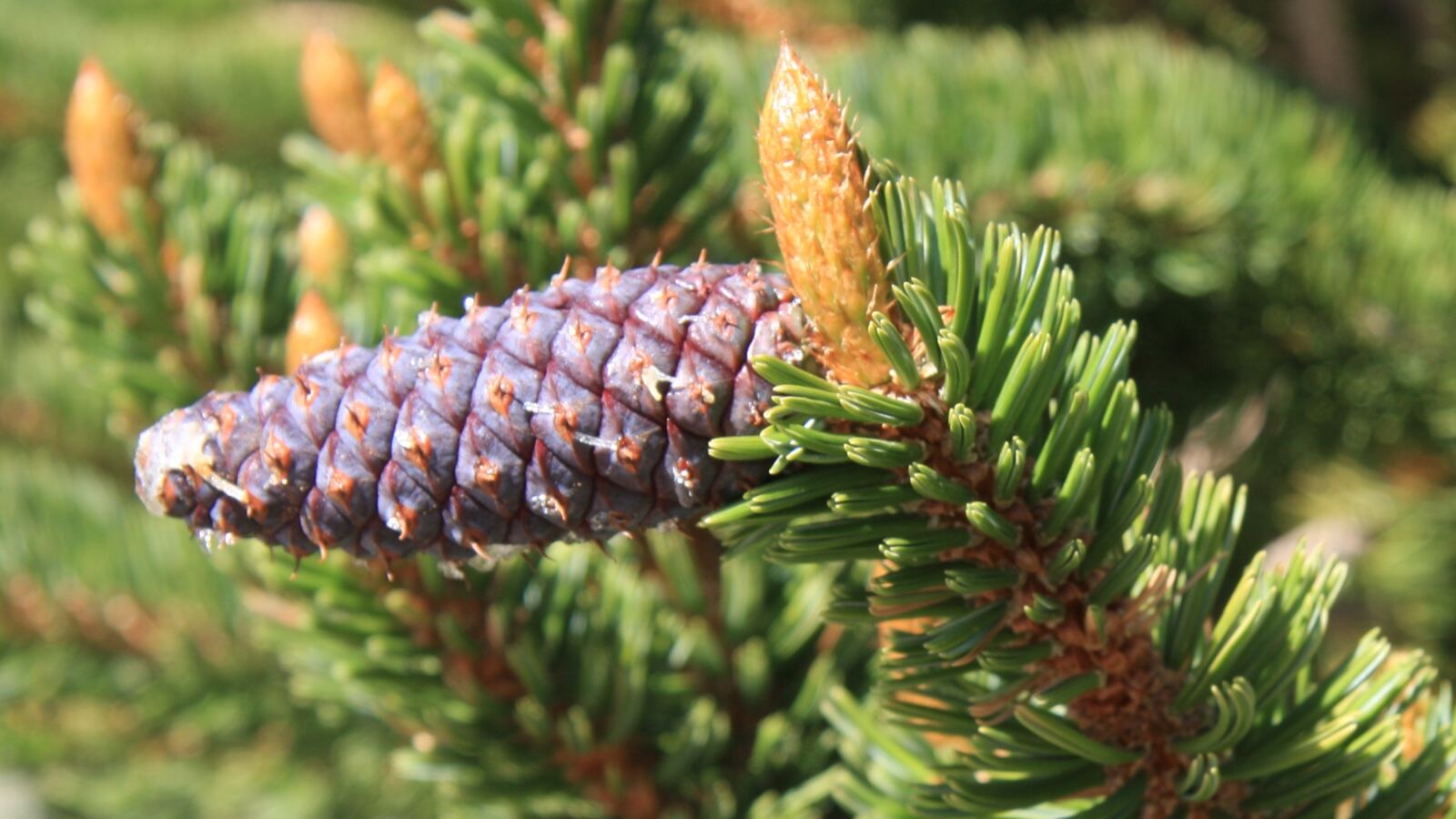
What it is
Pinus longaeva, the Great Basin bristlecone pine — a small, gnarled, weather-tortured pine of the high, dry mountains of the western United States, and the longest-lived non-clonal organism known on Earth.
The oldest documented individual, a tree in the White Mountains of California nicknamed Methuselah, is over 4,850 years old — older than the Egyptian pyramids, already ancient when Stonehenge was raised — and other bristlecones exceed it. (An even older clonal organism, like the aspen grove Pando, is a colony of connected stems; the bristlecone is a single, continuously-living individual, which makes its age all the more staggering.) These trees were seedlings before recorded history began.
Living long by living hard
The bristlecone's secret is counter-intuitive: it achieves its immense age not by growing in comfort, but by growing in some of the harshest conditions any tree endures — and growing extraordinarily slowly as a result.
The oldest bristlecones grow high on cold, arid, wind-blasted mountain slopes, often on nearly barren dolomite soils that few other plants tolerate, at the edge of the treeline. In this brutal setting they grow with almost unbelievable slowness — sometimes less than a hundredth of an inch of ring a year — and this slowness is the key to their longevity:
- The slow-grown wood is incredibly dense and resinous, which makes it highly resistant to rot, insects, and fungi.
- The harsh site means few competitors, few pests, and little risk of fire (there is not enough vegetation to carry one).
- The trees grow in a sparse, spaced-out stand, so a fire or disease cannot sweep from tree to tree.
An old bristlecone is mostly dead wood: as sections of the trunk die, a thin ribbon of living bark and cambium keeps just a few branches alive, so the tree survives as a sliver of life wrapped around a spine of ancient, weathered, sculpturally beautiful deadwood that may itself stand for thousands of years after death. The trees that grow faster and easier, lower down in kinder conditions, live far shorter lives — a profound lesson that, for a bristlecone, hardship is longevity. It is the extreme opposite of the fast-living balsa and pioneer trees. See drought-tolerant species.
Rings that date the past
The bristlecone's second great importance is scientific. Because the trees live so long and their dead wood persists for millennia, overlapping the rings of living trees with those of long-dead ones has let scientists build an unbroken, year-by-year tree-ring chronology (dendrochronology) stretching back more than 8,000 years.
This bristlecone chronology became one of the most important tools in archaeology and earth science. By comparing tree-ring dates with radiocarbon dates, scientists discovered that radiocarbon dating needed correction — and the bristlecone record provided the calibration that fixed it, reshaping the accepted dates of much of ancient prehistory. The rings also record ancient climate — drought, volcanic winters, temperature — year by year, making the bristlecones a living archive of the last several thousand years of the planet's history. A tree that has lived through it all has, in its rings, written it down.
The felling of Prometheus
The bristlecones carry one famous cautionary tragedy. In 1964, a researcher studying ice-age climate was given permission to cut down a bristlecone in Nevada for study — and only after it was felled and its rings counted was it realised that the tree, nicknamed Prometheus, was over 4,860 years old, quite possibly the oldest tree then known. It had been killed to be counted. The episode became a lasting lesson in humility and caution, and the locations of the oldest living bristlecones (including Methuselah) are now kept secret to protect them, exactly as for the Wollemi pine. See woodland management.
Growing it
Bristlecone pines are grown by specialist enthusiasts and in botanic collections, and they make characterful, slow, hardy bonsai and rock-garden conifers — but they are trees for the patient and the particular.
They want full sun, cold, and extremely sharp drainage on poor, dry, alkaline soil, and they resent rich soil, heat, humidity, wet ground, and pampering — grow one soft and fast in a comfortable garden and it will be a short-lived shadow of the ancient wild trees. Treat it mean: lean soil, full exposure, minimal water. Grown from seed. To plant a bristlecone is, in the truest sense, to plant for the millennia. See propagation and climate adaptation.
See also
- Conifers the wider group of cone-bearing trees
- Redwoods the largest trees, as the bristlecone is the oldest
- Nut Pines other pines of the dry mountain west
- Poplar and Aspen home of Pando, the oldest clonal organism
- Drought-Tolerant Species survival in the harshest sites
- Historical Ecology tree rings and the dating of the past
- Pines
- Life-History Strategies