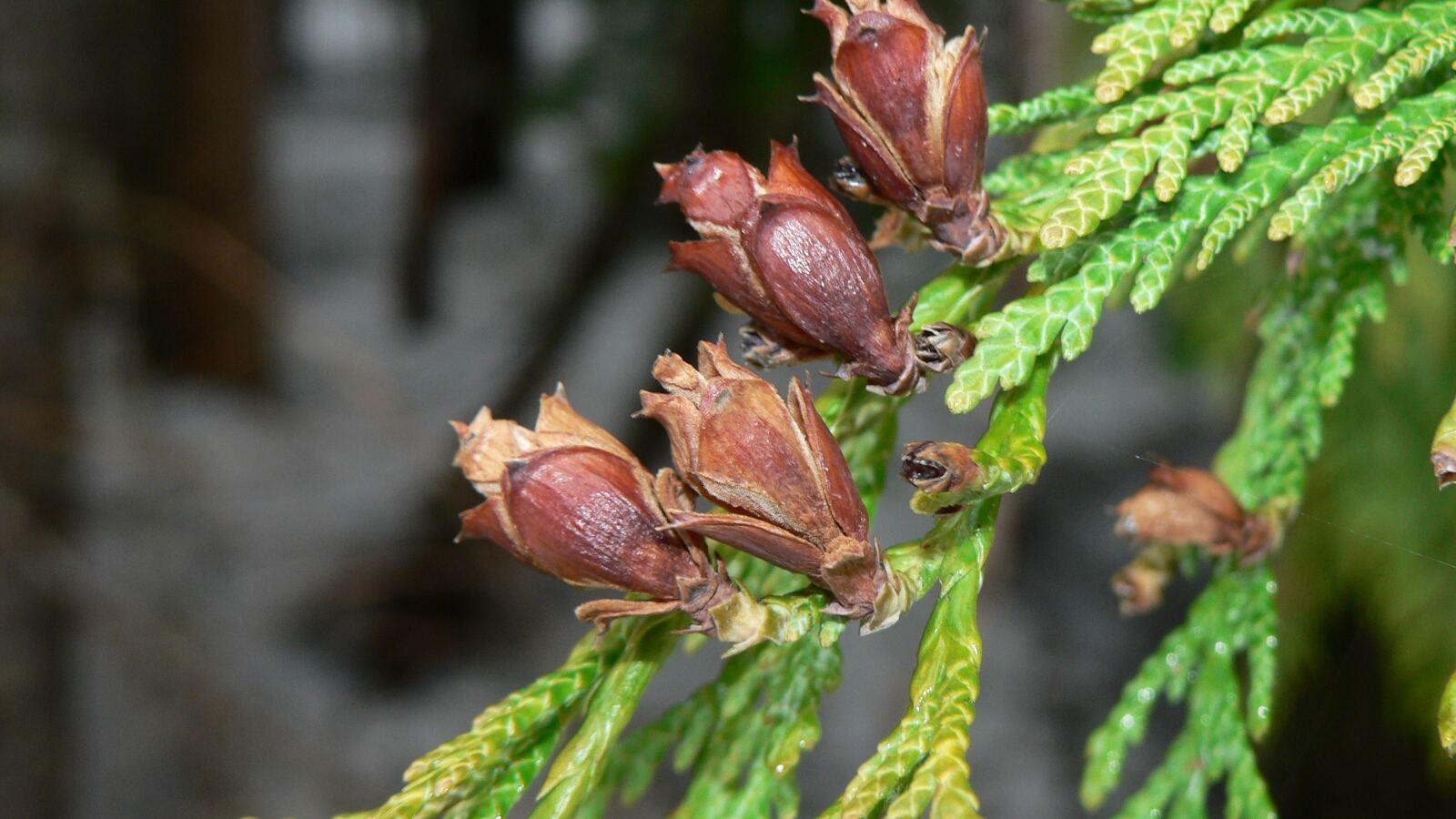
Scale leaves
A group of conifers united by having scale-like leaves pressed flat against the shoot rather than needles, producing flattened fern-like sprays.
Crush them and most are strongly aromatic — pineapple, parsley, or resin depending on species, which is a genuinely useful identification route.
The main genera:
Thuja — western red cedar (T. plicata) and northern white cedar (T. occidentalis). Not true cedars; see cedars for those. Chamaecyparis — Lawson cypress, Nootka cypress, hinoki, sawara. Cupressus — Monterey cypress, Italian cypress, and the dryland cypresses. Taxodium — swamp cypress, deciduous and covered below. × Cuprocyparis leylandii — the hybrid, covered below.
Rot-proof timber
The defining property of the group, and the reason for most of its uses.
Western red cedar heartwood is light, soft, straight-grained, dimensionally very stable, and naturally durable — high in thujaplicins, which are fungicidal.
Untreated western red cedar cladding lasts 40 to 60 years or more. It is the standard timber for shingles, shakes, weatherboarding, greenhouses, beehives, sheds, and saunas. It weathers to a silver-grey.
It is also very light, holds fastenings poorly, and dents easily — it is a cladding and joinery timber, not a structural one. Stainless or galvanised fixings are essential, since the tannins corrode ordinary steel and stain around it.
Pacific Northwest peoples used western red cedar comprehensively — for canoes, longhouses, totem poles, boxes, rope, baskets, and clothing woven from the inner bark — to the point that it is often called the tree of life. Bark was harvested in strips without killing the tree, and culturally modified trees bearing those scars are still standing.
Italian cypress, C. sempervirens, gives the dark exclamation marks of the Mediterranean landscape, and its durable timber was used for doors, chests, and ships in antiquity.
Swamp cypress, Taxodium distichum, is deciduous, tolerates permanent flooding, and produces the woody knees — pneumatophores — that project above water around its base. Its timber resists rot in wet conditions better than almost anything.
Leylandii
× Cuprocyparis leylandii is a hybrid of Monterey cypress and Nootka cypress that arose by chance in Wales in 1888.
It is the fastest-growing conifer commonly available in Britain — up to a metre a year — evergreen, dense, cheap, and easy.
Which is exactly the problem. Planted as a quick hedge, it does not stop at hedge height. Left unchecked it reaches 20 to 35 m, and by then it is shading gardens, undermining light, and drawing enormous quantities of water from the soil.
And it will not regrow from old wood. Like nearly all conifers other than yew, cutting into the brown interior leaves permanent bare patches. So an overgrown leylandii hedge cannot be reduced in width — only removed. See conifers.
The disputes became frequent enough that England and Wales legislated: Part 8 of the Anti-social Behaviour Act 2003 gives councils power to require the reduction of a high hedge of evergreens over 2 m where it affects a neighbour's reasonable enjoyment.
If you want a leylandii hedge, clip it at least twice a year from the start and never let it exceed the height you can maintain. If you want a hedge you can neglect, plant yew, hornbeam, beech, or holly instead — slower, and far less trouble in twenty years. See hedgerow care.
Shelter and coastal planting
Monterey cypress and Monterey pine are among the most salt-tolerant conifers available, and both are planted extensively as coastal shelterbelts in Britain, Ireland, New Zealand, and Australia.
The evergreen scale foliage gives dense year-round wind reduction, which is the main advantage over a deciduous shelterbelt that is bare exactly when winter storms arrive. See windbreaks.
Western red cedar is also strongly shade-tolerant, unusually for a fast conifer, so it will regenerate and grow beneath a canopy — useful in continuous-cover systems alongside silver fir and Douglas fir. See woodland management.
Problems
Phytophthora lateralis, which kills Lawson cypress and has largely ended its use in forestry and increasingly in gardens. Spread in soil and water, and another arrival through the plant trade. See tree diseases.
Cypress aphid, which causes brown dieback patches in leylandii and other cypress hedges — and since the plants cannot resprout from brown wood, the damage is permanent. See aphids.
Fire. Many Cupressus species carry volatile oils and burn readily, which makes dense cypress hedging a genuine hazard near buildings in fire-prone regions. See fire management.
Low wildlife value for most of the group as planted in Europe. A leylandii hedge supports very little, though it does provide dense nesting cover and winter roosting, which is not nothing. A mixed native hedge does far more. See hedgerow care and structural diversity.
Growing them
Most want moist, well-drained soil and shelter when young, and most dislike waterlogging — swamp cypress being the obvious exception, which thrives in standing water.
Western red cedar tolerates shade, wet, and cold. Monterey cypress tolerates salt and wind but is frost-tender. Italian cypress wants heat and sharp drainage and is a poor choice in cool damp climates.
Plant small stock, and for hedging plant at 60 to 90 cm spacing and begin clipping in the first or second year to build density from the base.
The single rule that governs the whole group: decide the final height before planting, and clip to it from the beginning, because you cannot correct it later.
See also
- Conifers the wider group and the no-resprouting rule
- Hedgerow Care choosing and maintaining a hedge
- Yew the conifer hedge that can be renovated
- Windbreaks evergreen shelter in winter
- Tree Diseases Phytophthora on Lawson cypress
- Cedars the true cedars, and the naming confusion
- Tupelo
- Swamp Cypress and Dawn Redwood
- Cryptomeria