What it is
Tsuga, the hemlocks — eastern hemlock (T. canadensis) and Carolina hemlock in eastern North America, western hemlock (T. heterophylla) and mountain hemlock in the west, and species in East Asia — a genus of graceful, soft-textured conifers of cool, moist temperate forest.
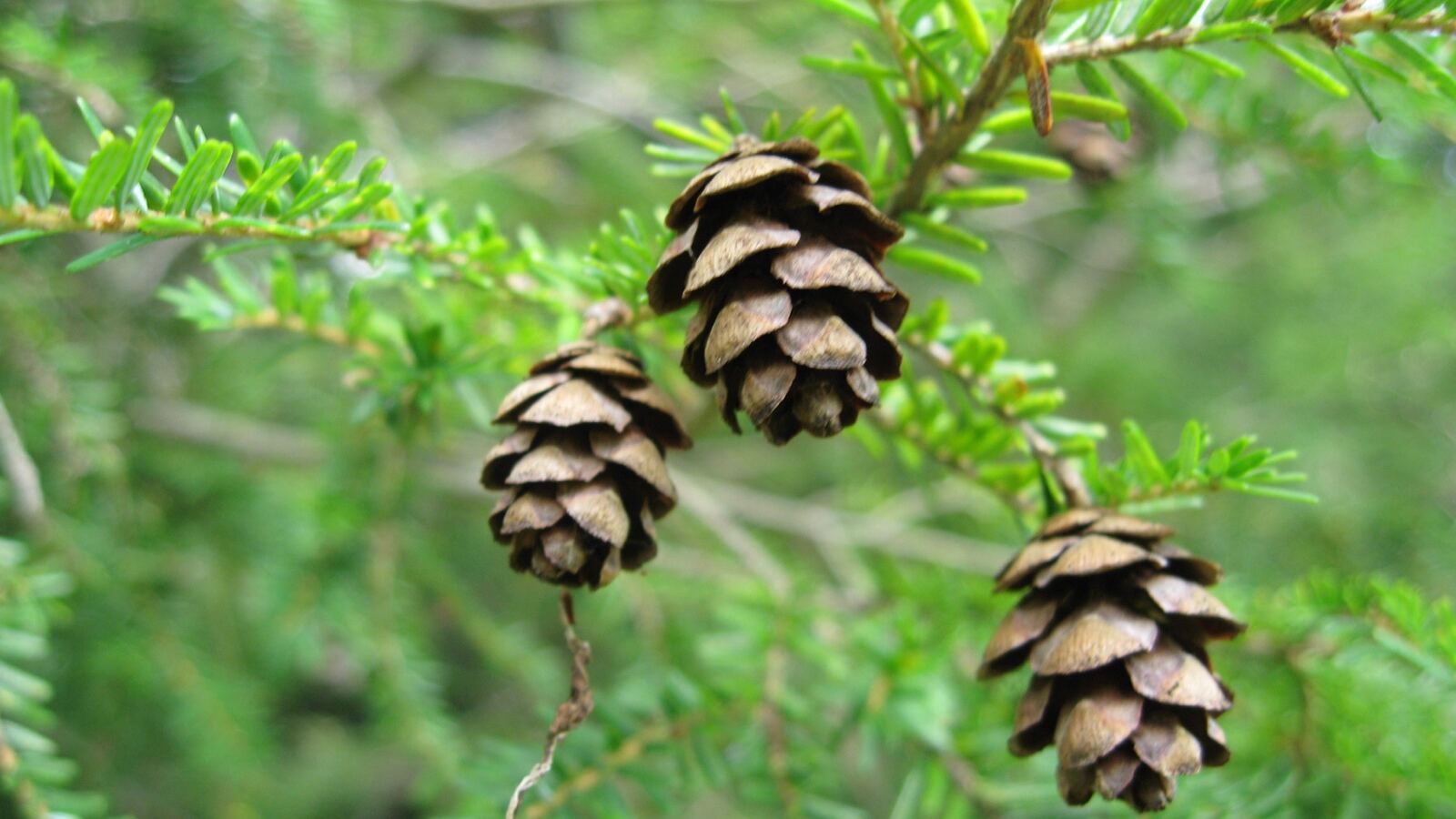
They are among the most elegant of conifers: fine, flat, short needles of two lengths, a soft feathery outline, a drooping leading shoot that nods at the treetop (a reliable field mark), and small neat cones. Western hemlock is a tall forest giant of the Pacific Northwest; eastern hemlock a slower tree of ravines and north slopes.
Not the poison
A necessary clarification, because the name causes real alarm: the hemlock tree has nothing to do with the poison hemlock that killed Socrates.
Poison hemlock (Conium maculatum) is a herbaceous plant of the carrot family, and the deadly water hemlock is another. The hemlock tree, Tsuga, is a harmless conifer — its needles were brewed into a vitamin-C-rich "hemlock tea" by Indigenous peoples and settlers. The name is said to come only from a supposed similarity in smell between the crushed foliage and the poisonous herb. The tree will not poison you; the confusion is purely one of names.
The deep-shade specialist
Hemlock's defining ecological trait is extreme shade tolerance — it is one of the most shade-tolerant of all trees, able to germinate and survive for decades as a suppressed sapling in deep forest gloom, waiting for a gap.
This makes it a classic climax species: in the succession of eastern forests, hemlock is among the trees that come to dominate old, undisturbed, shaded stands, casting such dense shade that little grows beneath. A mature hemlock grove is a distinctive habitat — dark, cool, humid, acidic underfoot, moderating temperature and shading streams — and it supports species found nowhere else, from certain warblers to the cool-water life of the streams it shades. Its role in creating deep shade and structural diversity makes hemlock a genuine keystone of the forests it dominates. See woodland management.
The woolly adelgid catastrophe
Eastern hemlock is now in the middle of an ecological disaster, and it is one of the clearest cautionary tales in modern forestry.
The hemlock woolly adelgid (Adelges tsugae), a tiny sap-sucking insect from East Asia, was introduced to the eastern United States and has spread through the eastern hemlock's range, killing trees on a vast scale. It feeds at the base of the needles — recognisable as tiny white woolly blobs on the underside of the twigs — draining the tree, which typically dies within a few years. Because eastern hemlock has no resistance and few effective controls, whole hemlock forests have collapsed, with cascading effects on the specialised species and cool streams that depended on them. It is a textbook example of an introduced pest destroying a keystone tree, in the manner of the chestnut blight and Dutch elm disease, and of why guarding against imported tree diseases and pests matters so much. Biological control (predatory beetles) and insecticide treatment of individual valued trees are the main responses, but the eastern hemlock's future is genuinely uncertain.
Uses
Western hemlock is a major timber tree of the Pacific Northwest — pale, straight-grained, and used for construction, pulp, and joinery — and one of the mainstays of the region's forestry alongside Douglas fir and spruce.
Hemlock bark was historically a leading source of tannin for the leather industry, and vast quantities of eastern hemlock were felled for bark alone in the nineteenth century, the stripped trunks often left to rot — an early episode of forest destruction that prefigured the adelgid's damage.
Growing it
Cool, moist, humid conditions and shade; hemlock dislikes heat, drought, wind, pollution, and dry soil, which limits it as an ornamental to cool, sheltered, moist gardens.
Where it is happy it makes a superb specimen or a dense, shade-tolerant hedge — it stands clipping well, an unusual virtue in a conifer, and dwarf and weeping forms are prized in gardens. Slow, long-lived, and shallow-rooted, so shelter from wind. Grown from seed. In eastern North America, weigh the adelgid threat before planting. See propagation.
See also
- Conifers hemlock among the wider group
- Douglas Fir its Pacific Northwest forest companion
- Spruces another cool-forest timber conifer
- Tree Diseases the woolly adelgid and imported pests
- Keystone Species hemlock as a habitat-defining tree
- Succession hemlock as a shade-tolerant climax tree