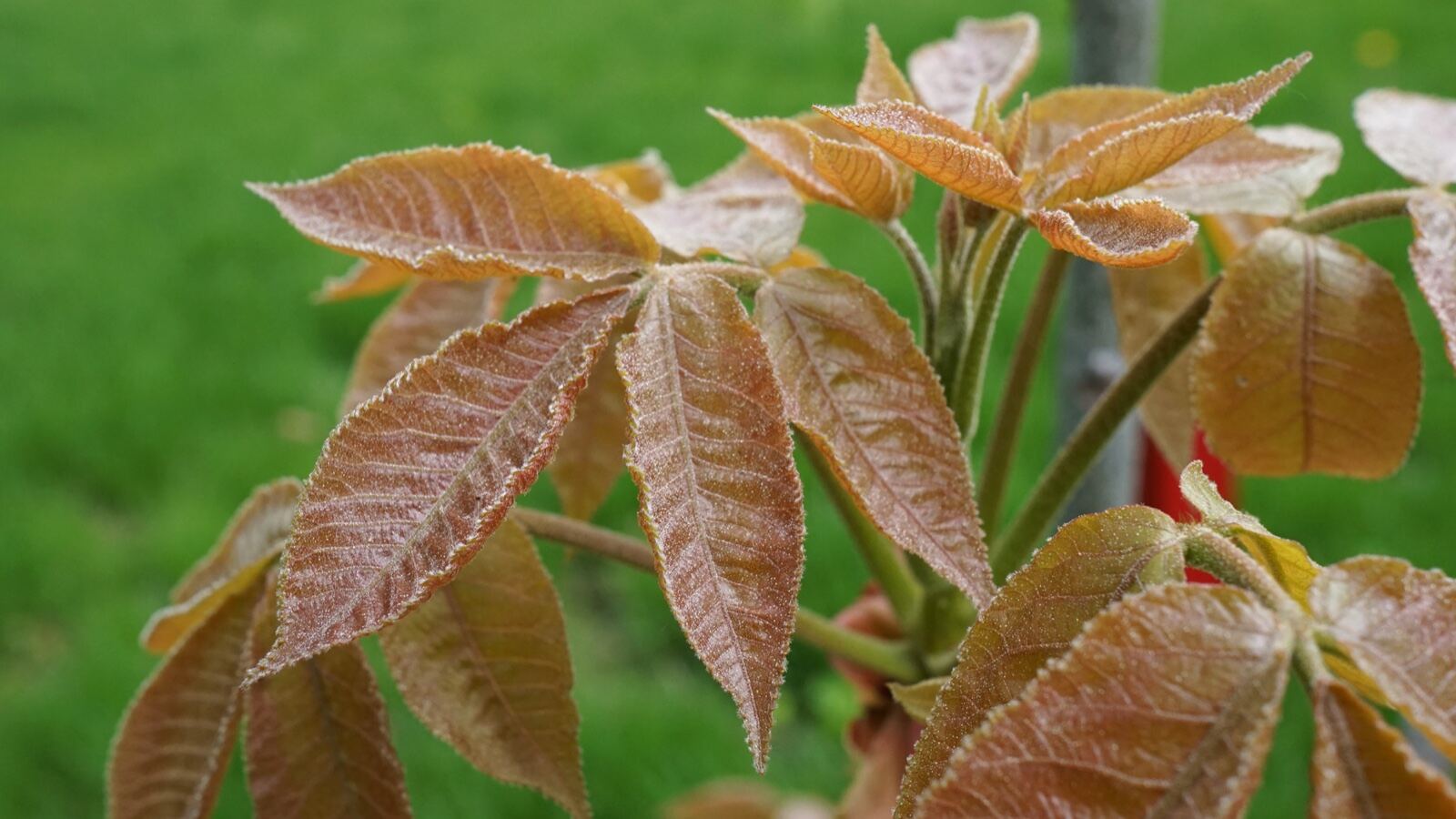
What they are
Carya, around 18 species, mostly in eastern North America with a few in East Asia. In the walnut family, alongside walnut, and sharing its pinnate leaves, husked nuts, and juglone chemistry.
Shagbark hickory, C. ovata, has bark that peels away in long loose vertical plates — unmistakable, and the reason for the name.
Shellbark, mockernut, pignut, and bitternut are the other common hickories, varying mainly in nut quality; bitternut is exactly what it sounds like.
Pecan, C. illinoinensis, is the commercial one — larger, faster, southern, and the source of the only major tree nut native to North America that became a global crop.
Wood that absorbs shock
Hickory has a combination of properties almost nothing else matches: very high hardness, stiffness, and shock resistance together with real flexibility.
That makes it the definitive timber for anything struck repeatedly — axe and hammer handles, pick handles, sledgehammers. A hickory handle bends and returns rather than shattering, which is why it survived the transition to fibreglass better than most traditional materials.
Also used for tool handles generally, ladder rungs, wheel spokes, drumsticks, skis, and the frames of early aircraft and golf club shafts. Hickory-shafted clubs defined golf until steel arrived in the 1920s.
It is dense, heavy, and hard on tools and machinery, and it moves a lot as it dries.
Compare ash, the European equivalent for shock-resistant handles — similar properties, and the reason ash dieback matters commercially as well as ecologically.
The smoke
Hickory is the classic barbecue and smoking wood of the American South, giving a strong, sweet, bacon-like smoke.
Different species and different woods produce genuinely different flavour profiles, and the choice of hickory, oak, mesquite, apple, or cherry is a real culinary variable rather than a marketing one.
Hickory also makes excellent firewood, among the highest calorific values of any North American hardwood, and burns hot and long.
Pecans
The pecan is a genuine agricultural crop with some awkward biology.
Alternate bearing is pronounced — a heavy crop one year, little the next, driven by the same reserve-depletion mechanism described in olive and apples and pears.
Dichogamy. Pecan flowers are wind-pollinated, and individual trees shed pollen and become receptive at different times. Type I trees shed pollen before their own flowers are receptive; Type II do the reverse. So an orchard needs both types planted together or it sets almost nothing — the same functional problem as the avocado described in tropical fruit trees, arrived at by different means.
Long juvenile period. Grafted trees take 6 to 10 years to crop, seedlings considerably longer.
Water. Pecans are floodplain trees and need a lot of it. Commercial pecan growing in Texas, New Mexico, and Arizona is irrigation-dependent, and it is a significant water use in catchments that are already stressed. See wells and boreholes and salinity.
Native hickory nuts are excellent eating — shagbark in particular — but the shells are thick and hard, and the labour of extraction is why they never became a commercial crop the way pecan did.
The taproot problem
Hickories and pecans send down a deep taproot very early, sometimes 60 cm or more before the shoot has made any real growth above ground.
The consequences are practical and severe:
They transplant badly. Container stock becomes root-bound and deformed quickly, and bare-root stock loses the taproot on lifting. Field-grown trees establish poorly if moved at any size.
Direct seeding is far better. Plant the nut where the tree is to grow, protect it from squirrels and mice, and accept slow above-ground growth for the first few years while the root establishes.
Buy small. If planting nursery stock, the smallest available is the best bet — the opposite instinct to most amenity planting. See nursery stock and direct seeding.
The taproot is also why mature hickories are notably drought-resistant and windfirm.
Juglone
Like walnut, hickories produce juglone, an allelopathic compound that inhibits many other plants.
Hickory produces considerably less than black walnut, so the effect is milder and fewer species are affected — but it is real, and tomatoes, apples, and several other sensitive plants do poorly beneath them.
Worth knowing before designing a planting underneath. See fruit tree guilds and polyculture.
Wildlife
Hickory nuts are a major mast crop in eastern North American forests, feeding squirrels, chipmunks, wild turkey, wood ducks, black bear, and deer. Mast years drive rodent populations and, through them, their predators — the same dynamic described in beech.
Shagbark hickory is one of the most important bat roost trees in eastern North America. The loose peeling bark plates create exactly the narrow sheltered crevices that Indiana bat and several other species use for maternity roosts, and the species is a conservation priority partly for that reason. See bats and dead wood habitat.
The foliage supports a wide range of moth larvae, including several large silk moths. See caterpillars.
Growing them
Deep, fertile, well-drained soil. Pecan wants a floodplain — deep alluvial soil with reliable moisture. Hickories tolerate drier upland sites.
Full sun, and slow. Hickories are among the slower hardwoods, and a nut crop is a multi-decade proposition from seed.
Long-lived, commonly 200 to 300 years and more.
Plant the nut, not the tree, wherever possible, and protect it.
For a productive planting, grafted pecan cultivars of both pollination types are the practical route in a suitable climate, and shagbark hickory is the better choice for a temperate nut tree where pecan will not ripen.
See also
- Walnut the close relative and the juglone question
- Ash the European shock-resistant handle timber
- Nut Pines the other major temperate nut crop
- Direct Seeding why taprooted trees are sown in place
- Bats shagbark as a roost tree
- Nursery Stock why small stock beats large here
- Macadamia, Cashew and Brazil Nut
- Tupelo
- Squirrels