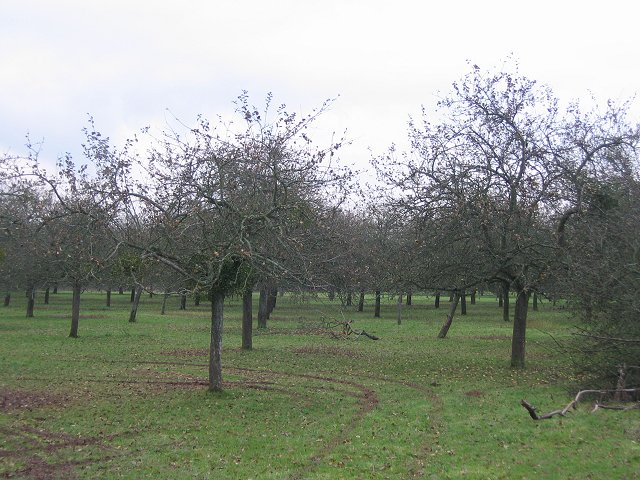
What you have inherited
A neglected orchard is a sleeping orchard.
Most old fruit trees can carry another thirty to fifty years of cropping if you read them right and cut slowly. The trees that look the worst (mossed trunks, hollow centers, a forest of vertical shoots) are not the ones in trouble. The ones in trouble are gone at the root.
This is a five-year job. Not a weekend.
Year 0: walk the rows
Before you sharpen anything, walk every tree twice. Once in winter for the structure. Once in midsummer for what is alive.
Four questions per tree:
- Is it alive? Scrape a thumbnail of bark from a small branch. Green underneath, the tree is breathing. Brown all the way down, the limb is dead. Test the trunk too.
- Is the trunk sound? Tap with a knuckle. A dull thud means heartrot. A clear knock means solid wood. A hollow trunk is fine if the cambium ring is thick and continuous. A hollow trunk with a split shell is not.
- Can you identify the rootstock? Look at the graft union, usually a knuckle 15 to 30 cm above ground. Vigorous regrowth from below that union is rootstock and will never bear the original fruit.
- Is the variety worth saving? Taste the fruit in late summer if any sets. Old cottage orchards carry cultivars that exist nowhere else. A bland russet on a dying tree might be the last of its kind in the county.
Mark trees with ribbon. Green for keep. Yellow for reassess next year. Red for remove. Do not cut the red trees yet. They feed the woodpeckers and beetles you want around. See dead wood habitat.
Year 1: the 25 percent rule
The hard rule that ends most orchard rescues before they start: never remove more than 25 percent of a tree's canopy in a single dormant season.
Push past that and the tree responds with panic growth. A hundred vertical watershoots in spring, no fruit buds, and a stressed root system that opens the door to canker and silver leaf. Two seasons of overcutting will kill a tree that survived forty years of neglect.
So year one is restraint. Dead wood first. Crossing branches second. The worst of the watershoots third. Stop counting cuts. Start counting what is left.
Dead wood. All of it, back to live tissue. A dead stub is an entry wound for fungus.
Crossing branches. Pick the weaker of any two limbs that rub. Bark damage at a rub point is where wood rot starts.
Watershoots. Vigorous vertical sprouts from the upper limbs. They bear no fruit and shade the productive horizontal wood. Remove most flush. Keep one or two well-placed verticals as future replacement leaders. You will need them in year two or three when you start reshaping.
Sterilise your saw between trees. A 70 percent alcohol wipe takes five seconds and stops canker spreading down the row. Cut on a dry day with frost forecast for the next three.
Year 2: shape returns
Now you can think about form.
Apples and pears want either an open-centre vase shape (three or four main scaffolds, no central leader, sunlight reaching the middle of the tree) or a modified-leader shape (one dominant trunk with tiered scaffolds). Old standard trees almost always rejuvenate better to open-centre. The scaffolds are already there. You are just clearing the middle.
Pick three to five main scaffold limbs spaced evenly around the trunk. Remove competing limbs in the upper canopy that block sun to those scaffolds. Again, never more than 25 percent of remaining canopy. If last year took 25 percent and this year takes another 25, the tree has lost almost half its leaf area in two seasons. That is the edge of what is survivable.
This is also the year to collect scion wood from any heritage variety on the red list. Cut pencil-thick dormant shoots in late winter from this season's growth. Wrap in damp paper, seal in plastic, store at 2 to 4 Celsius. Graft onto a compatible rootstock in spring. A single tree carrying a regional cultivar is one chainsaw away from extinction. The graft is the backup. See propagation.
Year 3 and beyond: productive pruning
By year three the structure holds. The cuts shift purpose.
Spur-bearing cultivars (most apples, most pears) fruit on short, knotty wood that lives three to five years on the same site. Shorten leaders by about a third to push lateral spur formation. Thin overcrowded spur clusters to the strongest two or three buds.
Tip-bearing cultivars (Bramley, Worcester Pearmain, most cherries, most plums) fruit at the end of last year's growth. Shorten those tips and you cut next year's crop off. Prune these by thinning whole branches at the base, not by tipping back.
Know which kind of tree you have before the saw moves. A spur prune on a tip bearer means no fruit for two years.
By year five you are pruning for yield, not survival. The rejuvenation curve flattens. Annual maintenance is light: half a day per tree in winter, summer walk-throughs to pinch vertical regrowth before it lignifies.
Underplant the floor with comfrey, daffodils, chives, and a nitrogen-fixing shrub or two. The classic apple guild. See fruit tree guilds and pruning basics.
When the tree tells you to stop
Some trees do not come back. Read the signs in year one.
Bark sloughing in vertical sheets from the south side: sun scald and cambium death underneath. Mushroom brackets at the base: root rot already advanced. A trunk that flexes in moderate wind: failing buttress roots.
Take those trees down for safety, but leave a three-metre standing snag where you can. Woodpeckers, bats, solitary bees, and beetles will move in within a season. The orchard you are rebuilding is bigger than the trees in it.
See also
- Pruning Basics
- Fruit Tree Guilds
- Propagation
- Dead Wood Habitat
- Hedgerow Care
- Grafting and Rootstocks