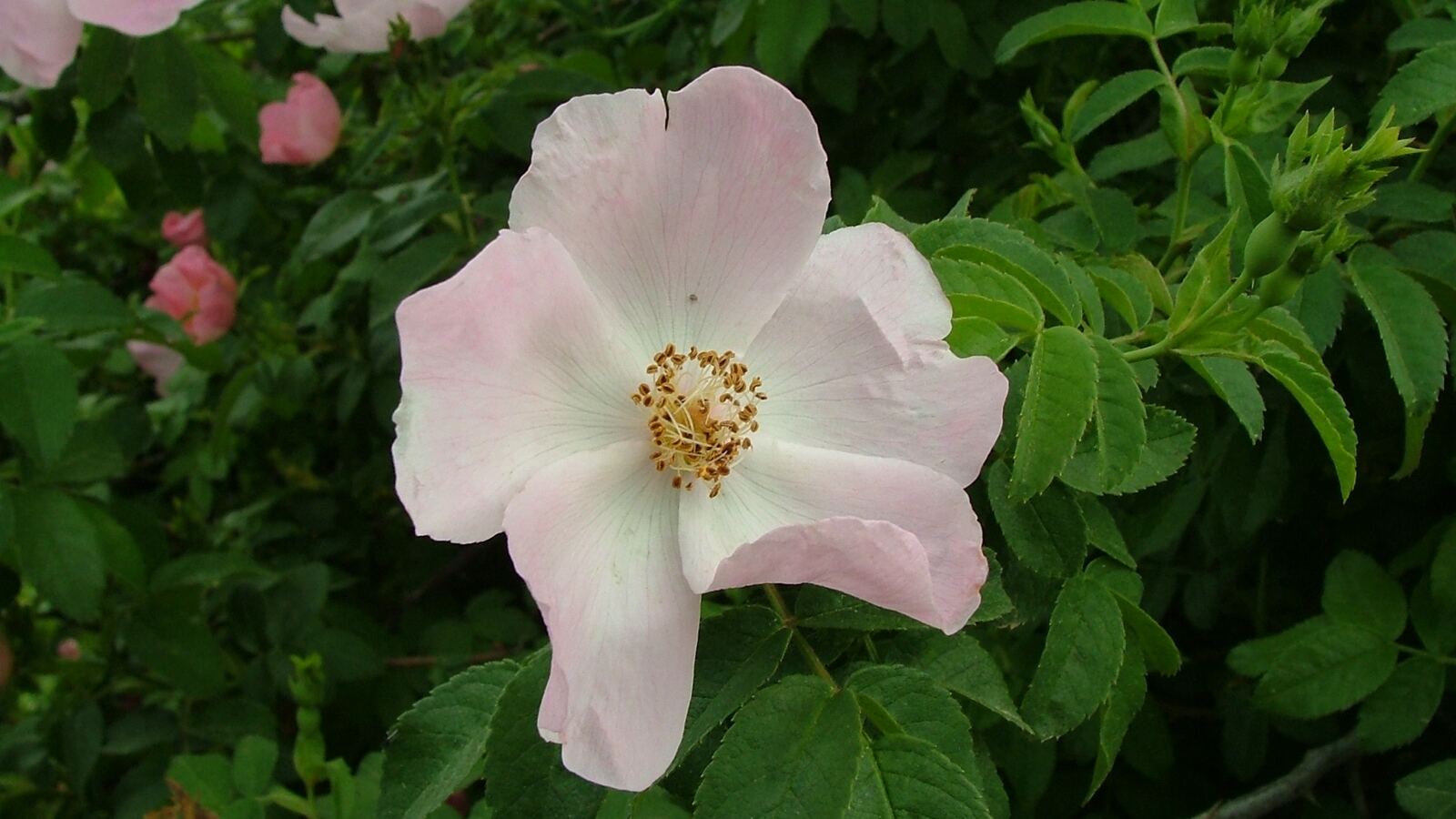
What they are
Rosa, the wild roses — the ancestors of the whole vast tribe of cultivated roses, and valuable hedgerow plants in their own right. The common ones include:
Dog rose, Rosa canina: the familiar hedgerow rose, a vigorous thorny scrambler with arching stems, single pale-pink-to-white flowers, and bright red hips.
Field rose, R. arvensis; sweet briar, R. rubiginosa, whose leaves smell of apples; and the tough, salt-resistant Japanese rose, R. rugosa, of coasts and roadsides.
They are woody shrubs and scramblers rather than trees, but they are a defining woody component of hedge and scrub, and belong with the blackthorn and hawthorn as the backbone of a mixed hedgerow.
Hips: the vitamin harvest
The great practical value of the wild rose is its hips — the red, fleshy fruit that follow the flowers, ripening in autumn and hanging through winter.
Rose hips are exceptionally rich in vitamin C, far higher than citrus, along with other vitamins and antioxidants. This was put to famous use in wartime Britain, when citrus fruit was unavailable: schoolchildren were sent out to gather wild rose hips by the tonne, which were made into rosehip syrup distributed to give children their vitamin C — one of the best-remembered episodes of foraging as national policy. Hips are still made into syrup, jelly, tea, and wine. (The one caution: the seeds are surrounded by fine irritant hairs — the original "itching powder" — so hips must be strained or the seeds removed.)
For wildlife, the hips are important winter bird food, and the dense thorny growth gives superb nesting cover and protection, in the same way as blackthorn. See seed-dispersing birds and wildlife shrubs. The open single flowers are excellent for bees and hoverflies, giving accessible pollen that the double garden roses often deny them. See pollinator habitat.
The rootstock beneath every garden rose
Here is the wild rose's hidden importance: most cultivated roses are grafted onto wild rose roots.
Garden roses — hybrid teas, floribundas, climbers, old roses — are usually budded (a form of grafting) onto the vigorous root system of a wild species, most often Rosa canina or R. laxa, because the named varieties grow poorly and unreliably on their own roots, while the wild rootstock gives vigour, hardiness, and tolerance of a range of soils. Every rose bed, in other words, sits on dog-rose roots.
This is why rose growers watch for "suckers" — vigorous shoots arising from below the graft union, which come from the wild rootstock, not the cultivated variety. Left alone, the tough wild sucker outgrows and eventually replaces the grafted rose, and the plant "reverts" to a thicket of single-flowered dog rose. Suckers must be pulled (not cut) from the root. The briar rootstock is stronger than the flower it carries — a neat everyday example of the grafting principle that also underlies the apple orchard.
The robin's pincushion, and the invasive rugosa
Two footnotes. Wild roses commonly carry the robin's pincushion — a fuzzy red-and-green moss-like gall on the stems, caused by a tiny gall wasp — one of the most conspicuous and harmless of plant galls, worth knowing when it appears.
And Rosa rugosa, though a tough and useful shrub for coastal and difficult sites (it thrives in pure sand and salt spray, useful in coastal dune stabilisation), has become an aggressive invasive species on the coasts of northern Europe and North America, forming dense thickets that displace native dune flora — the recurring caution for a tough, suckering, bird-sown plant.
Growing them
Wild roses are among the easiest of all woody plants: sun or part shade, almost any soil, and complete toughness. They are cheap as bare-root whips for hedging and thrive on neglect.
In a hedge, include a small proportion of dog rose or field rose with hawthorn, blackthorn, hazel, and the other mixed-hedge species — the arching thorny stems knit the hedge together and add flowers, hips, and cover. They can be laid and trimmed like the rest of the hedge. As rootstock, wild rose is grown from seed or cuttings and budded in summer. Grows readily from hips (seed is slow and doubly dormant), cuttings, and suckers. See propagation and nursery stock.
See also
- Hedgerow Care wild rose in a mixed native hedge
- Blackthorn the thorny hedge companion with the same role
- Grafting budding garden roses onto wild rootstock
- Apples and Pears the same rootstock principle in the orchard
- Raspberry and Bramble the other thorny rose-family scramblers
- Coastal Dunes rugosa rose on sand — useful and invasive
- Hardy Orange
- Galls and Gall-Formers