What they are
Magnolia, around 220 species split between eastern Asia and the Americas — the same disjunct distribution as tulip tree, its close relative in the same family.
The genus is genuinely ancient. Magnolia-like fossils date back around 95 million years, and the family diverged before the radiation of most modern flowering plants.
Forms range from large evergreen trees to small deciduous shrubs, with flowers from a few centimetres to 30 cm across.
Flowers built before bees existed
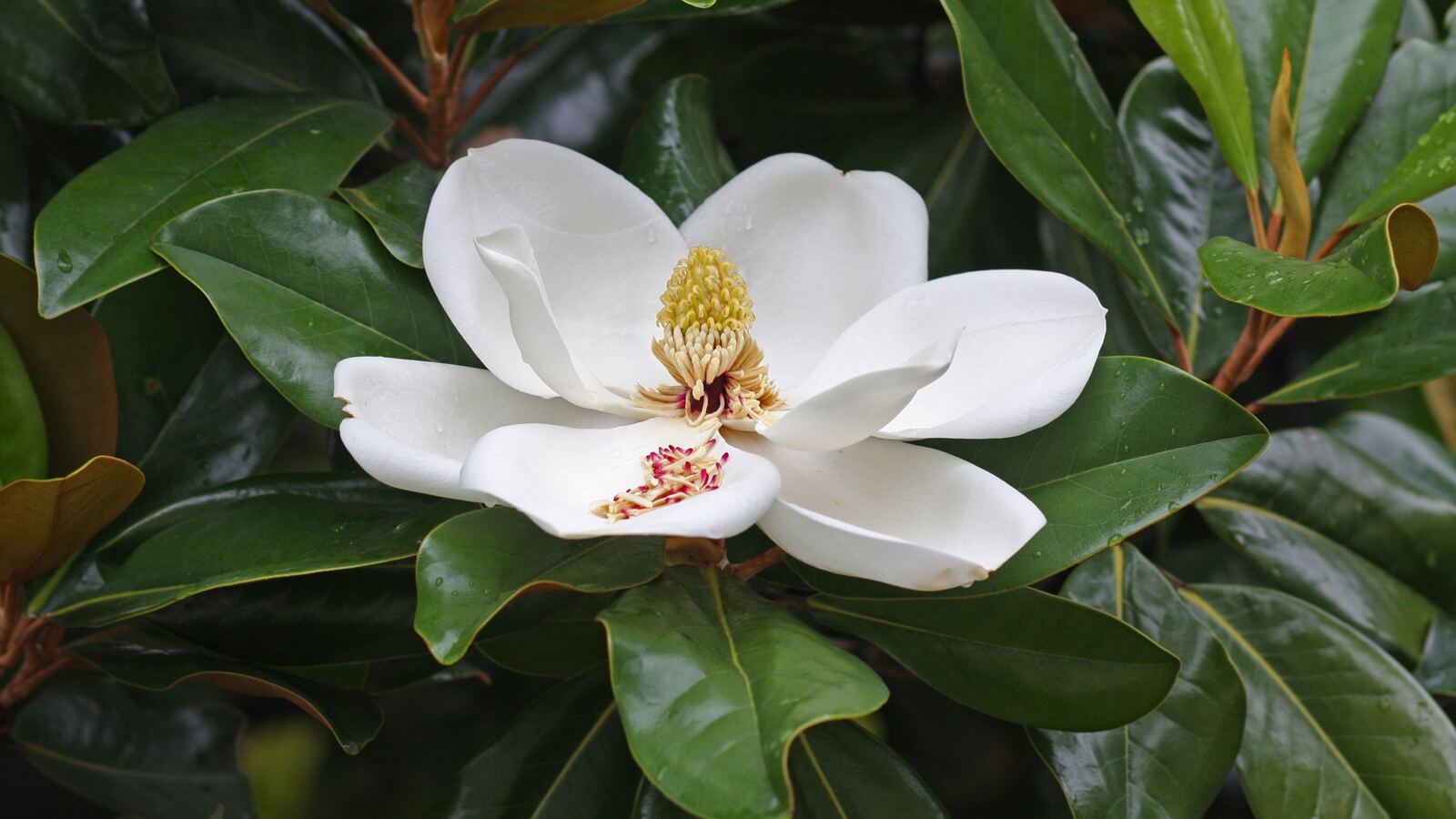
The most interesting thing about magnolias is that their flowers are adapted to an insect group that predates bees entirely.
Bees appeared roughly 100 million years ago and diversified later. Magnolias evolved alongside beetles, and the flower is built for them.
The consequences are visible:
No true petals. The floral parts are undifferentiated tepals — thick, waxy, and tough — because beetles are clumsy, chewing visitors rather than delicate ones. Fine petals would be destroyed.
The carpels are protected. The reproductive structures sit on a sturdy central cone, physically shielded from beetles that eat pollen and floral tissue as they blunder through.
Strong scent, little nectar. Magnolias produce fruity or fermented scents and abundant pollen rather than nectar rewards, which is a beetle-oriented strategy.
Flowers are protogynous — female parts mature first, then the flower closes overnight, trapping beetles inside, and opens again when the male parts release pollen. The beetle leaves dusted, having been an unwitting overnight guest. It is an effective mechanism for avoiding self-pollination.
Modern magnolias are visited by bees too, but the architecture is a record of a much older arrangement, and it is one of the clearest examples in a garden of a flower that tells you about deep evolutionary time.
The species worth knowing
Southern magnolia, M. grandiflora. Evergreen, glossy, with enormous cream flowers and a lemon scent. The tree of the American South, hardy in mild temperate climates and often wall-trained further north.
Star magnolia, M. stellata, and saucer magnolia, M. × soulangeana. The common deciduous garden magnolias, flowering on bare branches in early spring. The saucer magnolia is a hybrid and by far the most planted.
Yulan, M. denudata. Chinese, cultivated in temple gardens for over a thousand years, and a parent of the saucer magnolia.
Cucumber tree, M. acuminata. A full-sized eastern North American forest tree, up to 30 m, with inconspicuous greenish flowers and a good timber.
Sweetbay, M. virginiana, tolerates wet ground, unusually for the genus.
Magnolia officinalis and M. obovata are grown for bark used in traditional Chinese and Japanese medicine.
Frost is the enemy
The defining practical problem with deciduous magnolias is timing.
They flower very early, on bare branches, before the leaves. A warm spell brings the buds forward, and then a single hard frost turns the whole display brown and slimy overnight.
The flowers are the entire point of the plant, so a badly sited magnolia can be disappointing for years running.
Mitigations, in order of usefulness:
Avoid frost pockets and valley bottoms, where cold air pools. See frost protection.
Avoid east-facing positions. Frosted buds thaw fast in early morning sun, which causes far more damage than slow thawing in shade. A north or west aspect is genuinely better for an early-flowering tree.
Choose later-flowering varieties — some hybrids flower two or three weeks later and dodge most frosts.
Shelter from wind.
Fleshy roots
Magnolia roots are thick, fleshy, brittle, and unusually shallow, and they resent disturbance badly.
Practical consequences:
Plant in spring, not autumn, so the plant has a full growing season to re-establish before winter wet.
Do not cultivate beneath them. Forking or hoeing around a magnolia damages surface roots. Mulch instead.
Do not plant deep — the crown should sit at the same level it grew at.
Transplant only when small.
Prune minimally. Magnolias heal wounds poorly and resent hard cutting. Remove dead or crossing wood only, in summer after flowering — never a hard winter reduction.
Growing them
Moist, fertile, well-drained, slightly acid soil with plenty of organic matter. Most magnolias dislike shallow chalk and thin dry ground, though M. kobus and the saucer magnolias tolerate mild alkalinity better than the rest. See soil pH.
Shelter and light shade to full sun.
Mulch generously, which suits the shallow root system, and keep it clear of the trunk. See mulching for moisture.
They are largely trouble-free, with occasional scale insects and honey fungus on poorly drained sites. See mealybugs and scale.
Grafted plants flower much sooner than seedlings, which can take 10 to 20 years. See grafting and rootstocks.
Wildlife and use
The seeds are conspicuous — bright red or orange, hanging on threads from the cone-like fruit — and are taken by birds and small mammals. See seed-dispersing birds.
The evergreen species make dense cover and good nesting habitat.
Timber from the larger species — cucumber tree in particular — is pale, straight-grained, and used much as tulip tree is, for furniture, joinery, and pallets, often sold together with it.
Magnolia flower buds are used as a spice in parts of Japan, and M. grandiflora leaves are used in wreaths and floristry.
See also
- Tulip Tree the close relative and the family's timber
- Frost Protection siting an early-flowering tree
- Native Bees the pollinators that came later
- Soil pH why most magnolias dislike chalk
- Tree Planting handling fleshy shallow roots
- Pollinator Habitat beetles as pollinators
- Silverbell and Snowbell
- Star Anise
- Champak
- Mountain Pepper