Three tropical nut trees
The temperate nut trees — walnut, chestnut, hickory and pecan, hazel, and the nut pines — have tropical counterparts with genuinely strange biology. Three are worth knowing in detail.
Macadamia
Macadamia integrifolia and M. tetraphylla, from the rainforests of eastern Australia, and one of the very few significant food crops domesticated from the Australian flora.
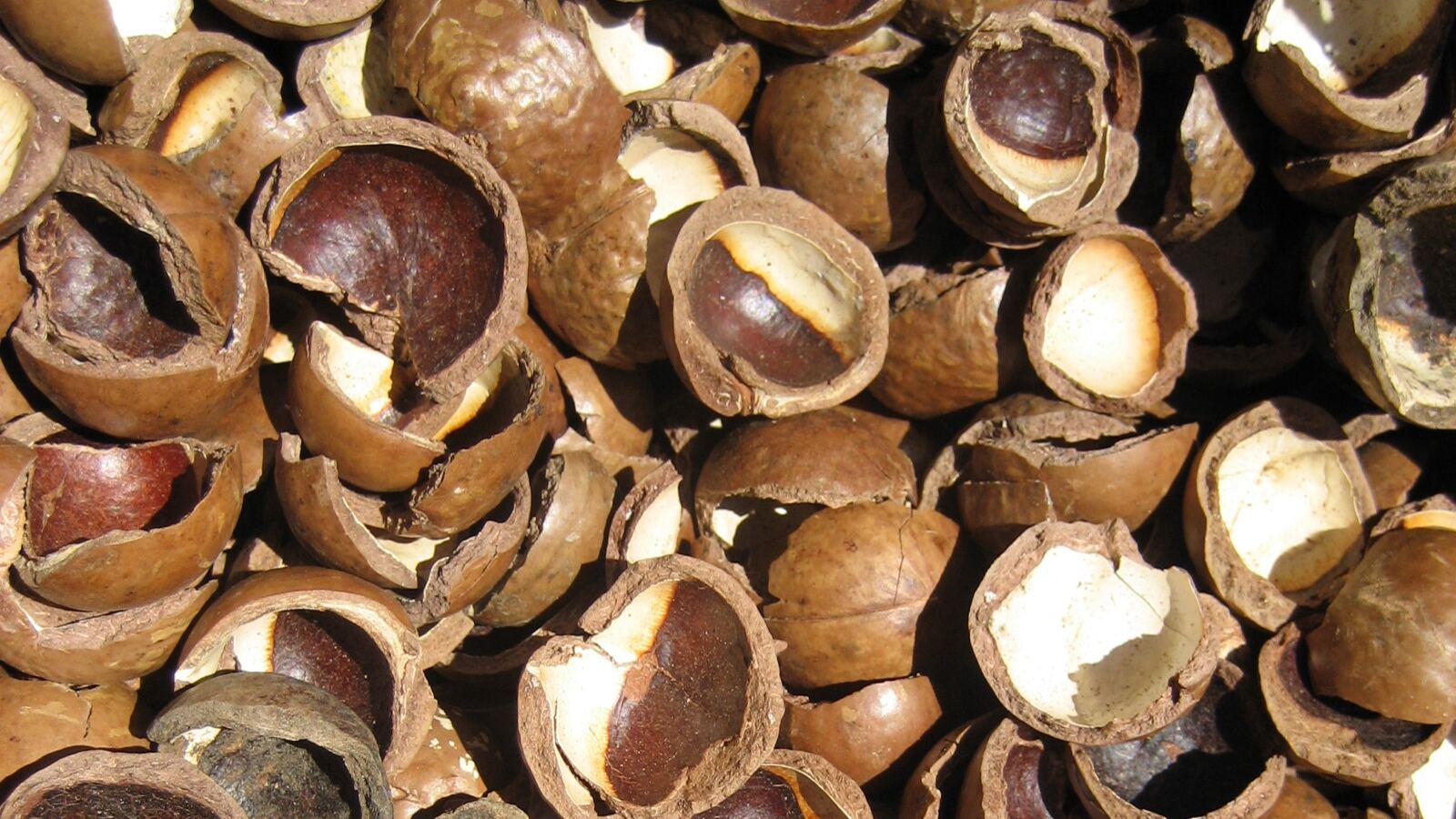
The shell is the defining feature. The macadamia has one of the hardest shells of any nut — it needs around 2,000 newtons of force to crack, far beyond hand pressure, which is why macadamias are almost always sold shelled and why home cracking needs a proper vice or the seam-and-tap technique.
That shell is why macadamia commercialised late, in the twentieth century, despite being eaten by Aboriginal Australians for millennia. Curiously, the crop was developed largely in Hawaii, which became the centre of the industry before Australia reclaimed it, so the world's premier Australian nut spread from the Pacific.
Growing. A subtropical evergreen, frost-tender, wanting deep rich soil, high rainfall, and shelter — the trees are brittle and shed limbs in wind. It bears from about 5 to 7 years, is long-lived, and the nuts fall when ripe and are gathered from the ground, like chestnuts. Grafted for named varieties, since seedlings are variable and slow.
Macadamia is a good component of a subtropical food forest and is grown in alley cropping systems.
Cashew
Anacardium occidentale, from northeastern Brazil, and structurally the strangest of the three.
The nut grows outside the fruit. What looks like the fruit — the swollen, sweet, juicy cashew apple — is a false fruit, an enlarged flower stalk. The true fruit is the kidney-shaped nut hanging beneath it, on the outside.
The shell is caustic. The cashew is in the same family as poison ivy, mango, and pistachio (the Anacardiaceae), and the shell contains urushiol and related compounds — the same blistering allergens as poison ivy. Raw cashews in the shell are genuinely hazardous to handle and process, causing severe skin burns, and the "raw" cashews sold in shops have in fact been steamed or roasted to drive off the oil. A truly raw in-shell cashew is not a food.
This is why cashew processing is labour-intensive and has historically involved serious occupational injury, and why the nut is expensive despite the tree's productivity.
The cashew apple is edible, sweet, and astringent, and is used for juice, fermented drinks, and preserves in producing regions — but it bruises and ferments within a day of picking, so it rarely travels, another fruit you can only really have where it grows, like mulberry.
Growing. A tough, fast, drought-tolerant tree of hot lowland tropics with a marked dry season, tolerant of poor sandy soil — which is why it is grown for cashew apple and nut, and also planted for erosion control and land stabilisation on degraded tropical ground. See erosion control and dryland restoration.
Brazil nut
Bertholletia excelsa, and the one that cannot be farmed — a genuinely remarkable case of a crop that is still, essentially, wild-harvested.
It depends on intact rainforest. The Brazil nut tree is an emergent giant of the Amazon, reaching 50 m and living 500 years or more, and its reproduction is locked into a web of forest relationships that plantations cannot reproduce:
Pollination requires large-bodied orchid bees strong enough to force open the coiled flower. Those bees, in turn, depend on specific orchids elsewhere in the forest for the males to gather scent and attract mates. No orchids, no bees; no bees, no nuts.
Seed dispersal depends largely on the agouti, a large rodent with teeth strong enough to gnaw open the extremely hard seed pod. Agoutis bury caches and forget some, which germinate.
Attempts to grow Brazil nut in plantations have failed to produce economically, because the pollinators are absent. So the nut is harvested from standing wild trees in intact forest, by collectors gathering the fallen pods.
That makes the Brazil nut one of the strongest economic arguments for keeping rainforest standing: it is a high-value export crop that only exists if the forest exists. It is a living illustration of the pollination-and-dispersal keystone relationships in keystone species, and of the extractive-economy case in restoration economics. The pods are also heavy and fall from 40 m, which is a real hazard for collectors.
Brazil nuts are notable nutritionally for extremely high selenium content — high enough that a couple of nuts meet the daily requirement and that eating many is inadvisable.
The pattern
These three tropical nuts together make a point the temperate nuts do not force as clearly: a nut crop is embedded in a system.
Macadamia's shell, cashew's caustic chemistry, and the Brazil nut's absolute dependence on wild pollinators and dispersers are all reminders that the tree is one part of a web — and that in the Brazil nut's case, the web cannot be assembled in a plantation, so the only way to have the crop is to keep the forest. See tropical fruit trees and pollinator habitat.
See also
- Walnut the temperate high-value nut
- Hickory and Pecan the temperate relatives
- Chestnut the other gathered-from-the-ground nut
- Keystone Species the Brazil nut's pollination web
- Restoration Economics crops that keep forest standing
- Tropical Fruit Trees the wider tropical canopy
- Shea and Argan
- Tupelo
- Banksia and Grevillea
- Brazil Nut
- Pili Nut