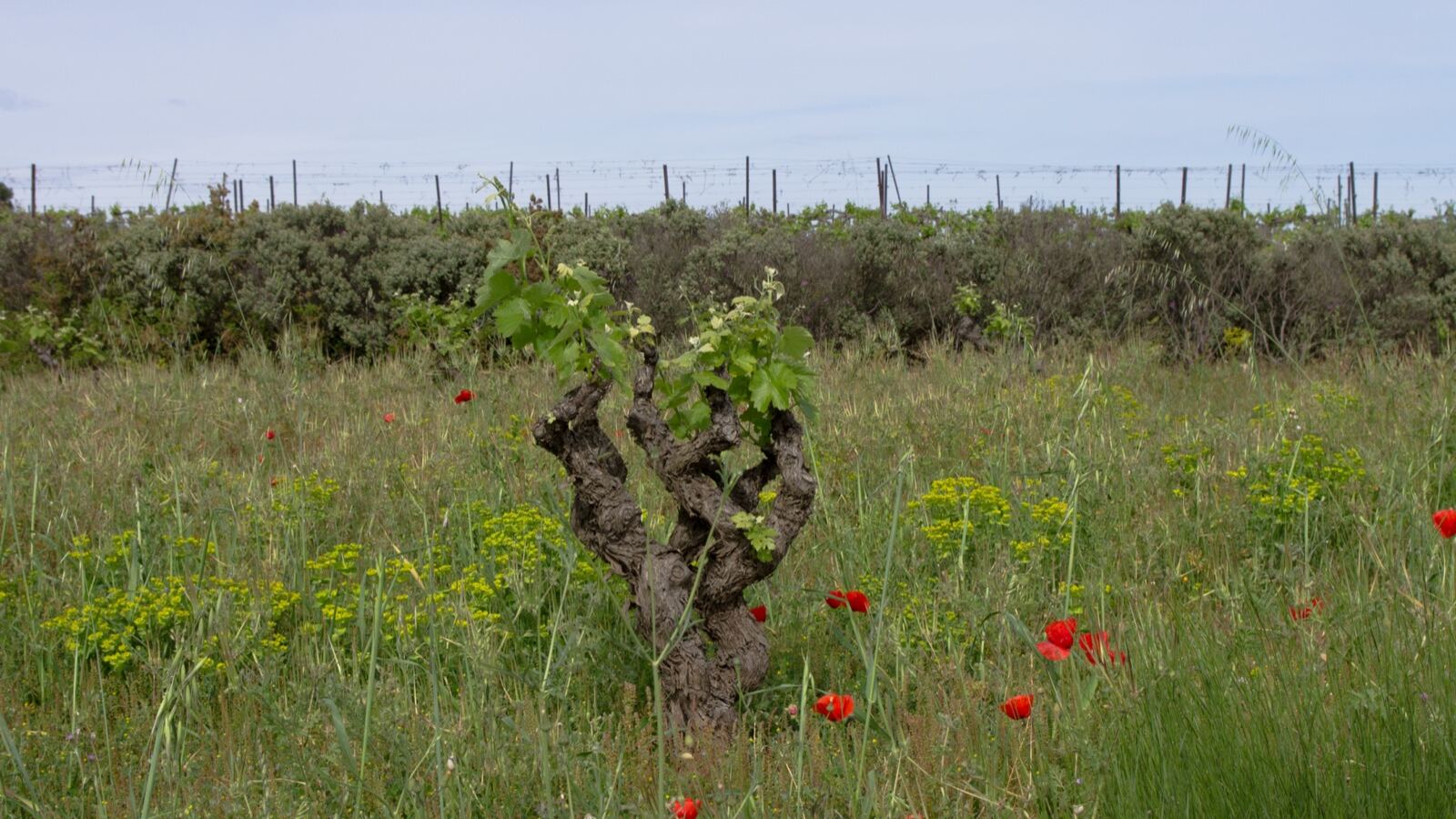
What it is
Vitis vinifera, domesticated in the Caucasus and Near East around 8,000 years ago, and the source of essentially all wine grapes and most table grapes.
American species — V. labrusca, V. riparia, V. rupestris, V. berlandieri — matter enormously, not usually for their fruit but for what is below ground.
Phylloxera
The single most consequential event in the history of the crop, and it turns on a root aphid.
Daktulosphaira vitifoliae is native to eastern North America, where wild Vitis species coevolved with it and tolerate it. It feeds on roots, and American vines respond by walling off the damage.
V. vinifera does not. Its roots respond to feeding with galls that rot, the vine is progressively girdled below ground, and it dies over two to three years.
Phylloxera reached France around 1863, almost certainly on American vines imported for study — the era's fashion for exchanging plant material, and the arrival of faster steamships that let insects survive the crossing.
Within about twenty years it had destroyed a very large share of European vineyards. Estimates of French production losses run to two-thirds or more, and the economic and social disruption was severe.
Nothing worked: flooding, carbon disulphide injection, sandy-soil refuges, and bounties for a cure all failed.
The solution was grafting. European scion wood — the variety, which carries the fruit character — grafted onto American rootstock, which tolerates the aphid.
Essentially every vineyard in the world is now grafted this way, and vine nurseries are a grafting industry. It is the same logic as apples and pears and grafting and rootstocks, arrived at through catastrophe rather than convenience.
The exceptions are instructive: Chile, parts of Australia, and pockets elsewhere remain phylloxera-free through geography and strict quarantine, and grow ungrafted vines. So do vineyards on very sandy soils, which the insect cannot move through.
Rootstock choice now does far more than resist phylloxera — it governs vigour, drought tolerance, lime tolerance, nematode resistance, and ripening date, and it is a major viticultural decision in its own right.
The whole episode is the clearest single case study for tree diseases and nursery stock: the plant trade moved the pest, monoculture amplified it, and genetic diversity from the pest's home range provided the answer.
Fruiting on new wood
The principle that governs all vine pruning.
A grapevine fruits on shoots produced this season, growing from buds laid down on last season's wood.
So the wood that matters is one year old. Two-year-old and older wood produces nothing directly.
Everything else follows:
Prune hard, every year, in winter. A vine left unpruned produces a mass of unproductive old wood and fruit only at the extremities. Removing 80 to 90 percent of the previous season's growth is normal and correct.
Prune when fully dormant, midwinter. Vines bleed heavily from cuts made as sap rises, which weakens them — so late pruning is a real mistake, and the window closes earlier than people expect.
Two systems, both doing the same thing:
Spur pruning (cordon). A permanent horizontal arm carries short spurs cut back to 2 to 3 buds each winter. Simple, and the usual choice for a garden.
Cane pruning (Guyot). No permanent arm — each winter you select one or two canes of the previous season's wood, tie them down horizontally, and cut everything else away. Also leave a short spur to produce next year's replacement cane. More work, better for varieties whose basal buds are unfruitful.
Summer pruning matters too: pinch laterals, remove excess shoots, and open the canopy around the bunches for light and airflow. Fruit exposed to some sun ripens better and rots less.
Under cover and outdoors
In cool climates the decision is essentially about ripening and disease.
Outdoors works for early-ripening varieties on a warm, sheltered, sunny wall — the same stored-heat principle as espalier and training. Choose disease-resistant varieties.
Under glass gives reliable ripening for dessert varieties and much better control of mildew and botrytis. The traditional arrangement plants the vine outside and trains the rod in through a hole in the wall, so the roots get natural rainfall and the fruit gets glasshouse warmth.
Disease is the limiting factor in damp climates:
Powdery mildew and downy mildew, both introduced from North America in the same nineteenth-century plant exchanges that brought phylloxera. Downy mildew is the reason Bordeaux mixture exists.
Botrytis, grey mould, in wet weather at ripening. The same organism, under the right dry autumn conditions, produces the noble rot that concentrates sugars for sweet wines — the same fungus being catastrophic or essential depending on humidity.
Open canopies, airflow, and resistant varieties do most of the work. Interspecific hybrids — crosses of vinifera with American and Asian species, known as PIWI varieties — carry strong disease resistance and are increasingly grown in cool damp regions specifically to avoid spraying.
Growing them
Full sun, shelter, free drainage. Vines tolerate poor and stony soil well — the traditional view that struggling vines make better wine has a real basis, since excess vigour and water give large dilute berries.
Do not over-feed, especially with nitrogen. Vigorous leafy growth shades the fruit and worsens disease.
Water while establishing, then sparingly. Deep roots find their own.
Support properly: a vine is heavy, long-lived, and permanent. Wires on a wall or a substantial post-and-wire structure.
Thin the bunches for dessert grapes. Fewer, better bunches beat many poor ones, and thinning individual berries within a bunch with fine scissors is the traditional method for exhibition fruit.
Propagate from hardwood cuttings, which root readily — though a cutting of a vinifera variety will be ungrafted and phylloxera-susceptible where the insect is present. See propagation.
Vines are extremely long-lived; productive vineyards of a century or more are common.
Beyond fruit
Leaves are a crop — dolmades — and are picked young and tender.
Vine prunings are excellent for grilling and smoking, and make good kindling.
Verjuice, the pressed juice of unripe grapes, is a traditional acidic seasoning like the crab apple version in crab apple.
Grapes also make a good overhead crop on a pergola, where they provide summer shade and let winter light through after leaf fall — a genuinely useful piece of passive design. See shade management and permaculture design.
See also
- Grafting and Rootstocks the technique phylloxera forced on the world
- Tree Diseases the plant-trade vector, again
- Espalier and Training wall heat and trained forms
- Pruning Basics why timing matters for bleeding
- Currants and Gooseberries the other wall-trained soft fruit
- Shade Management vines on a pergola
- Melons
- Sea Grape