What it is
Mangifera indica, the mango, a large evergreen tree of South and Southeast Asian origin, domesticated in the Indian subcontinent and Myanmar over 4,000 years ago, and now the most widely grown tropical fruit tree after the banana.
It is a member of the cashew family, Anacardiaceae — kin to the pistachio, the sumac, and cashew — a relationship that matters for handling, as explained below.
A mature mango is a substantial tree, 15 to 30 m, with a dense dark evergreen crown, and it is long-lived — productive orchard trees over a century old are known, and some claimed far older. New growth flushes in coppery-red before turning green.
Thousands of varieties
There is no single mango. India and Southeast Asia have developed thousands of named cultivars over millennia, differing enormously in size, colour, flavour, fibre, and season — Alphonso, Kesar, Dasheri, and Langra in India; Nam Dok Mai in Thailand; Ataulfo and Tommy Atkins and Kent in the trade; and countless local kinds known only in their own district.
This vast varietal diversity — maintained by grafting, since seedlings do not come true — is comparable to that of the apple and the grape, and mango holds the same cultural place in South Asia that the apple holds in the temperate world: woven through cuisine, religion, poetry, and daily life. The unripe fruit is as important as the ripe, used green in pickles, chutneys, and the souring powder amchur.
Flowering, fruiting, and the alternate-bearing problem
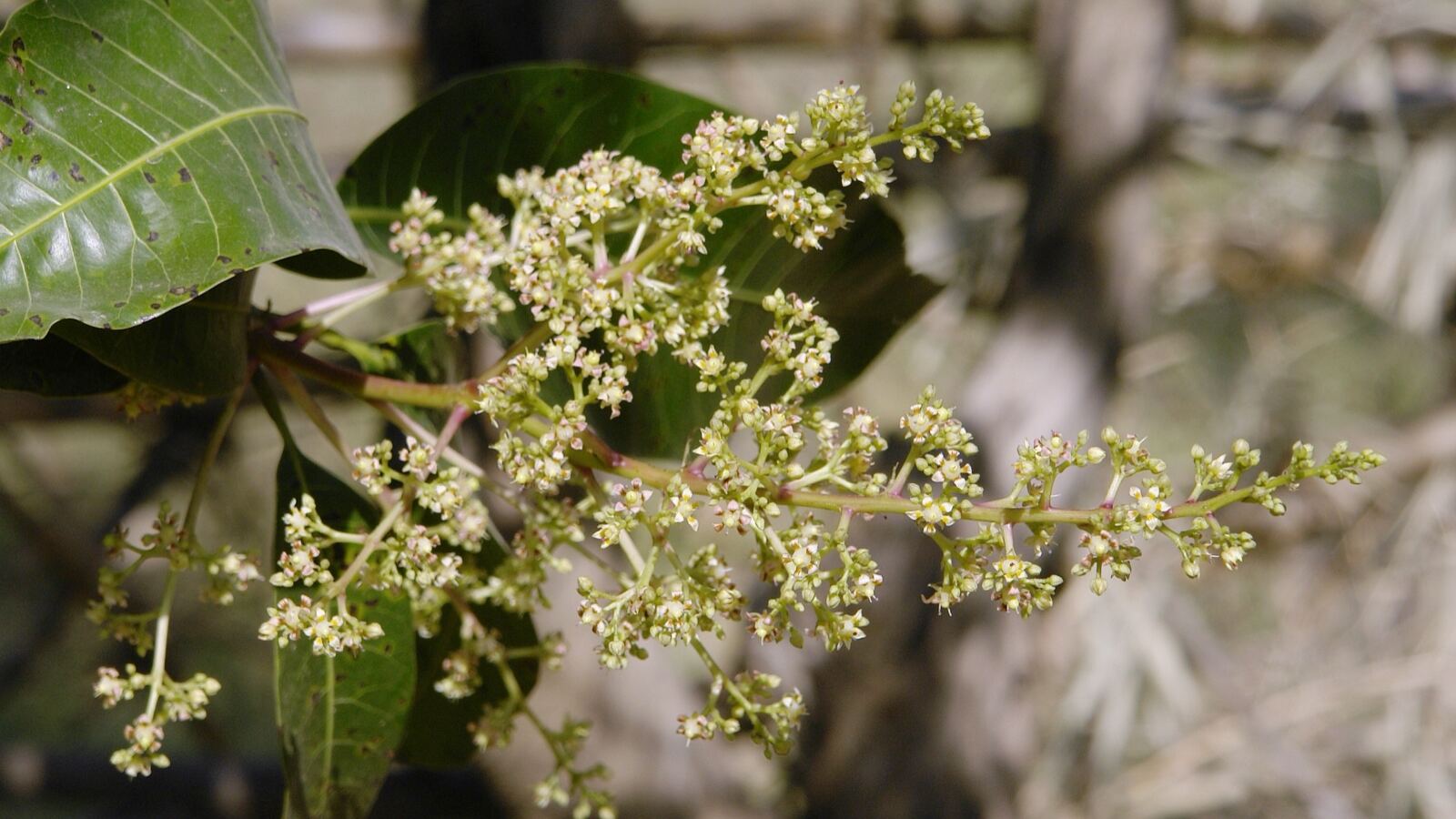
Mango flowers in enormous terminal panicles of thousands of tiny flowers, of which only a handful set fruit. Flowering is triggered by cool or dry conditions, and the fruit hangs on long stalks, ripening months later.
Two problems shape mango growing. First, alternate bearing: like many fruit trees, mango tends to a heavy crop one year and little the next, and much orchard technique aims to even this out. Second, flowering is vulnerable to rain and cold at the wrong moment, which cause flower drop and the fungal disease anthracnose, the major limit on mango in humid climates. The pests and diseases — anthracnose, powdery mildew, fruit fly, and mango hopper — are the usual concerns, managed within integrated pest management.
The cashew-family catch
Because mango is in the Anacardiaceae, the tree carries the family's irritant chemistry.
The sap, and the skin of the fruit, contain urushiol — the same allergenic compound as poison ivy and poison sumac — and people sensitive to poison ivy can get a blistering rash around the mouth from handling or eating unpeeled mango, or from the sap when picking. In mango-growing regions "mango dermatitis" is a recognised complaint, and pickers wear gloves. Peeling the fruit removes the problem for most people. It is a good reminder that a delicious fruit and a violent skin irritant can sit in the same family and the same tree.
Growing it
Mango is strictly tropical to warm-subtropical: it needs heat, tolerates considerable drought once established, and is killed or damaged by frost, which confines it to frost-free lowlands.
Climate. A dry or cool period to trigger flowering, followed by warm dry weather through fruiting, gives the best crops; wet weather at flowering ruins them. This is why the finest mangoes come from monsoon climates with a sharp dry season.
Soil. Deep, well-drained soil; it dislikes waterlogging but is otherwise adaptable, and its deep roots make it fairly drought-hardy — a reasonable component of a tropical food forest and drylands with a water table.
Propagation. Seedlings are variable and slow, so named varieties are grafted — an ancient practice in India. Some mangoes are polyembryonic (a seed yields several clonal seedlings that do come true), and these are grown from seed in parts of Southeast Asia. See grafting and propagation.
Size control. Traditional seedling mangoes are huge and hard to harvest; modern orchards use dwarfing techniques, close planting, and pruning to keep trees small and pickable, the same intensification seen in apple growing. See pruning basics and harvest and storage.
Mango is, after banana, the tree that most defines tropical fruit growing — enormous varietal wealth, deep cultural roots, a long productive life, and a place in millions of gardens and orchards across the warm world.
See also
- Tropical Fruit Trees mango among the wider tropical orchard
- Banana and Plantain the only tropical fruit grown more widely
- Pistachio the edible-nut member of the same family
- Sumac and Smoke Tree the family's urushiol chemistry
- Grafting how mango varieties are propagated
- Apples and Pears the temperate parallel in varietal wealth
- Lychee and Longan
- Carambola
- Marula
- Mombin and Ambarella
- Quebracho