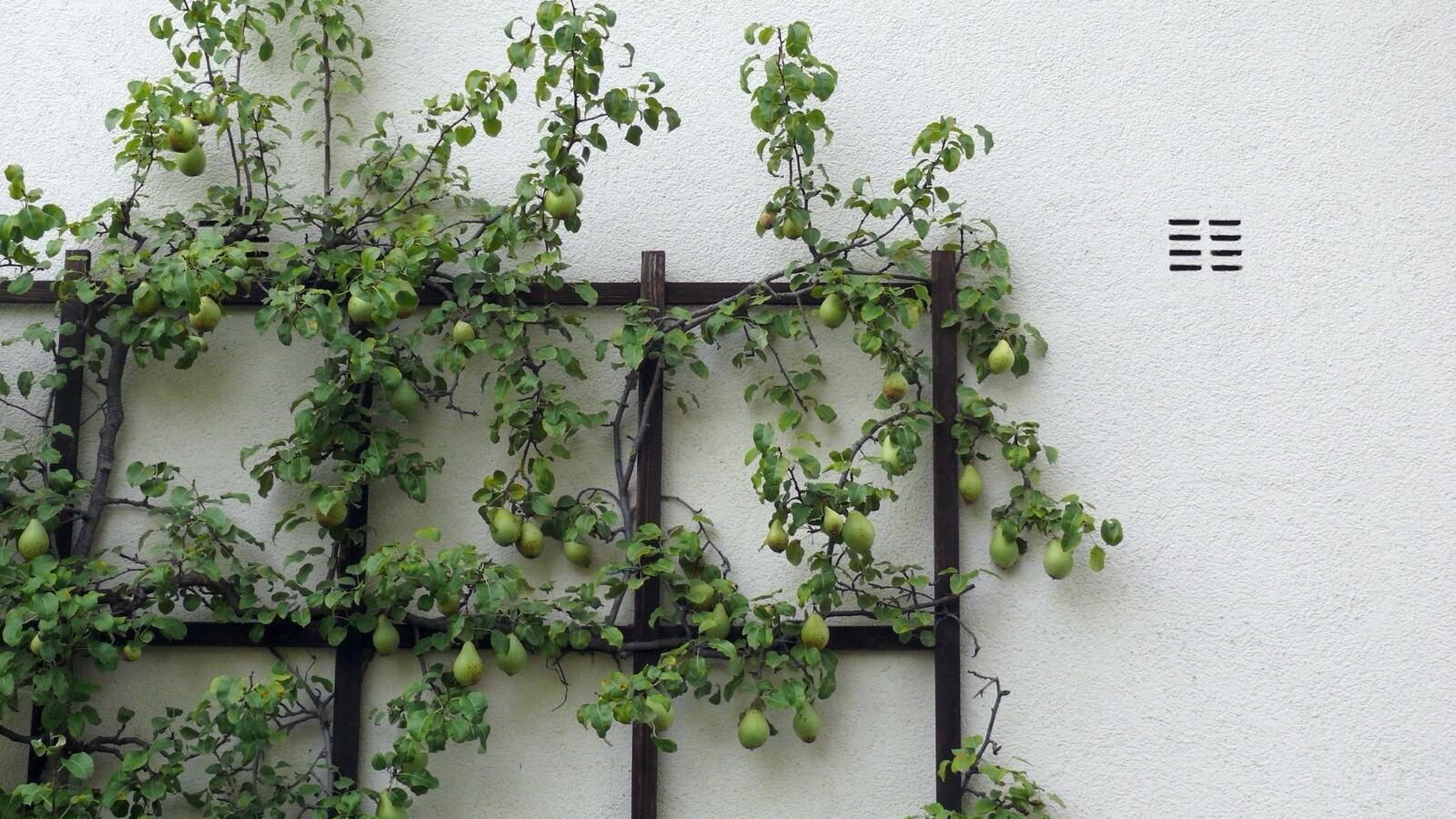
What it is
Growing a fruit tree flat, in a deliberate two-dimensional form, against a wall, fence, or wire framework.
It is not topiary and it is not decoration, though a mature espalier is among the more beautiful things in a garden. It is a production method, and the reasons for it are entirely practical.
Why bother
Space. A trained tree occupies 30 to 45 cm of depth. A row of cordons along a fence produces a serious crop from ground you were not using.
Heat. A south or west-facing wall stores solar heat and releases it overnight, raising the local temperature by a degree or two and extending the season at both ends. This is what allowed pears, peaches, apricots, and even figs to be grown reliably in northern Europe, and it is the whole logic of the walled garden.
Light on every fruit. No interior shade. Every fruit colours and ripens properly, and the sugars are better.
Reach. Everything is at arm's length. Pruning, thinning, netting, spraying, and picking all happen from the ground with no ladder. For an ageing grower this alone justifies it.
Air movement. An open flat canopy dries fast after rain, which directly reduces fungal disease pressure. Scab and mildew are far less trouble on a trained tree. See tree diseases.
Yield per square metre is high, even though yield per tree is lower.
The forms
Cordon. A single stem, usually planted at 45 degrees, with all growth pruned back to short fruiting spurs. The most space-efficient form there is: plant at 60 to 75 cm spacing and grow eight varieties along a fence. Ideal for apples and pears on dwarfing rootstock.
Espalier. A central stem with pairs of horizontal arms at regular tiers, typically 35 to 45 cm apart, three to five tiers high. The classic form for apples and pears. Formal, productive, and long-lived.
Fan. Branches radiating from a short trunk. The form for stone fruit, peaches, apricots, cherries, and plums, because they fruit on young wood rather than spurs and need a constant supply of new growth rather than permanent spur systems.
Stepover. A single-tier espalier about 40 cm high, used as an edging along a path. Productive, and it makes a beautiful border to a vegetable garden.
Belgian fence. Diagonal cordons crossed in a lattice. Decorative, and a genuinely productive screen.
Pleaching applies the same idea to non-fruit trees, creating a hedge on stilts.
Rootstock decides whether it works
The commonest failure is a trained form on a vigorous rootstock. The tree spends its life trying to become a tree, throwing vertical growth faster than you can cut it, and you lose.
Use dwarfing or semi-dwarfing rootstock. For apples, M9 or M26 for cordons and espaliers, MM106 only for a large espalier with space. For pears, Quince C or A. For cherries, the Gisela series changed trained cherry growing completely.
See grafting and rootstocks for the full picture, and apples and pears for varieties. Spur-bearing varieties suit cordons and espaliers; tip-bearers do not, because the pruning removes the fruit buds.
The support
Build it before you plant, and build it properly. A mature espalier carries real weight and lasts fifty years.
Horizontal wires at the tier spacing, tensioned, on straining posts or wall vine eyes. Keep wires 10 to 15 cm off a wall so air circulates behind the tree; a tree flat against brick gets mildew and bakes.
Tie with soft ties and check them annually. A tie left to bite in girdles the branch, exactly as in tree planting.
Training the form
Espalier, tier by tier. Plant a maiden whip. Cut it back to just above the first wire, to a bud with two good buds below. Three shoots grow: the top becomes the new leader, the two below become the first tier arms.
Train the arms at 45 degrees through the first season to keep them growing vigorously, then lower them to horizontal at the end of the season. Lowering to horizontal early is the classic beginner error, because a horizontal shoot slows and may not reach the length you need.
Repeat at each wire. A four-tier espalier takes four to five years to build.
Fan. Cut the maiden low, select two strong shoots as the initial arms, and build ribs outward from those, spacing them evenly.
Cordon. Plant at 45 degrees, tie the single stem to a cane on the wires, and prune everything else to spurs.
Keeping it
The maintenance is summer pruning, and this is the part that distinguishes trained forms from ordinary trees.
Summer pruning, roughly mid to late summer once the base of the current season's shoots has gone woody, removes leaf area, checks vegetative growth, and converts growth buds into fruit buds. Winter pruning does the opposite: it stimulates vigorous regrowth.
So the rhythm is: prune in summer to control and to form fruiting spurs, prune in winter only to renew and restructure. A trained tree pruned only in winter turns into a thicket of watershoots.
The standard method for spur-bearers cuts new side shoots back to about three leaves above the basal cluster, and shoots from existing spurs back to one leaf.
Rub off vertical watershoots as they appear, when they are soft. Ten seconds in June saves a saw cut in December.
Fans on stone fruit are managed differently: constantly renewing young wood, tying in replacement shoots and cutting out what has fruited, closer to the way a vine is handled. Prune stone fruit in summer only, never winter, because of silver leaf.
Spur systems become congested after ten or fifteen years and need thinning to keep fruit size up.
What it suits
Apples and pears are the natural candidates, especially on a shaded or awkward boundary.
Against a warm wall: peaches, apricots, nectarines, and figs, in climates where they would otherwise be marginal. Morello cherries are the great exception, since they fruit well fanned on a cold north wall where nothing else will.
Also worth doing on redcurrants and gooseberries as cordons, which lifts the fruit off the ground, makes picking a gooseberry bearable, and improves air movement. See berry bushes.
For small gardens this is the highest-value technique available, and it pairs naturally with container growing and intensive succession planting in the same space.
See also
- Pruning Basics the underlying cuts
- Grafting and Rootstocks choosing stock that stays small
- Apples and Pears the varieties to train
- Container Growing the other small-space method
- Tree Diseases why airflow matters
- Aged Orchard Rejuvenation restoring neglected trained trees
- Quince and Medlar
- Currants and Gooseberries
- Grapes