What it is
Pistacia vera, from the dry highlands of central and western Asia — Iran, Turkmenistan, Afghanistan — and one of the oldest cultivated nut trees, grown for at least 4,000 years.
A small, tough, deciduous tree in the Anacardiaceae, the cashew and mango family, and a relative of the cashew — though without the caustic chemistry.
It is a dryland tree in the fullest sense, and its tolerances are the whole reason it matters: it grows and fruits where softer nut trees cannot.
Extreme tolerances
Heat and drought. Pistachio thrives in fierce desert summers and deep-roots to survive drought that would kill most crops. It is a genuine low-rainfall tree.
Salt. It is among the most salt-tolerant of all nut and fruit trees, growing on saline soils and irrigated with saline water that would destroy almonds or walnuts — which, with the date palm and pomegranate, makes it a crop for salinised drylands. See salinity.
But it needs winter cold. The catch that pins its geography: pistachio requires substantial winter chilling — a long cold dormancy — to break bud and flower properly, and it also needs a long, very hot, dry summer to fill and ripen the nut.
That combination — cold winters and blazing dry summers — is a continental desert climate, and it is uncommon. It is why pistachio production is concentrated in Iran, and in the Central Valley of California, Turkey, and a few other regions with exactly that pattern, and why it fails in mild maritime climates that lack the winter chill and in humid ones that rot the crop. See climate adaptation.
Dioecious
Like the date palm, holly, and yew, pistachio is dioecious — separate male and female trees — and only females bear nuts.
Pollination is by wind, not insects, so a male must be positioned upwind within range. One male pollinates a good many females, so orchards keep a small ratio of males, and the flowering of male and female must overlap — a mismatch in timing, which cold springs can cause, means no crop.
The trees are grafted: a productive female variety on a hardy rootstock, with the sex and variety therefore chosen deliberately, as in apples and pears and grafting. A pistachio grown from seed is a gamble on sex and quality.
The shell splits itself
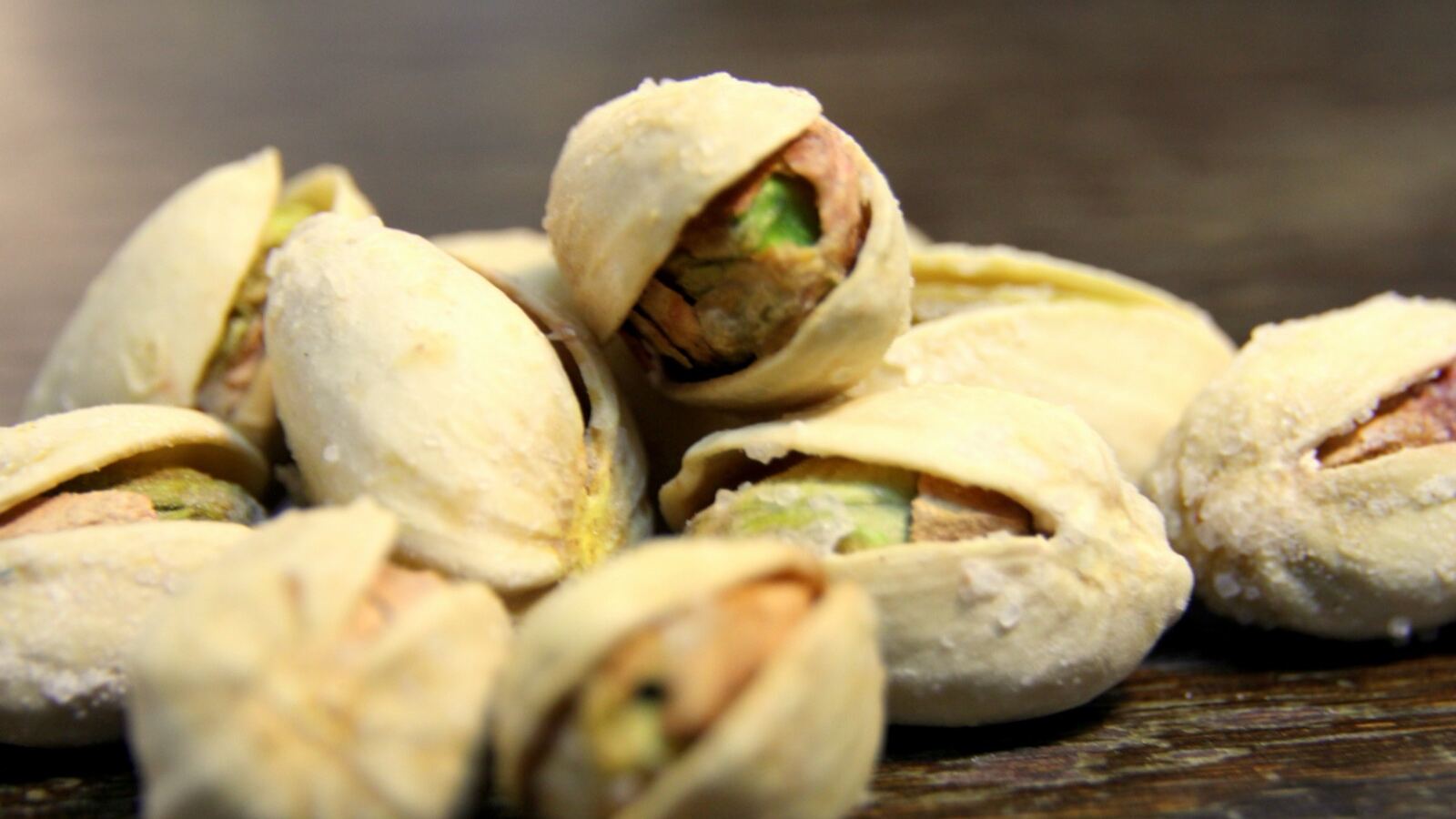
The distinctive half-open shell is a natural feature, not processing.
As the nut ripens and the kernel expands, it splits its own shell along the seam with an audible pop — the trees are said to be full of the sound at harvest. A split shell means a ripe, filled nut; closed shells are usually immature or poorly filled, and are the lower-grade product.
The nut is enclosed in a fleshy hull that is removed at harvest; leaving it on stains the shell, which is why processing must be prompt. The natural reddish-purple of a fresh shell is sometimes dyed red in older commercial practice, a cosmetic tradition rather than anything intrinsic.
Alternate bearing
Pistachio is a pronounced alternate bearer — a heavy crop one year, a light one the next, driven by the same reserve-depletion cycle described in olive and apples and pears, where a big crop suppresses the flower buds for the following year.
The cycle is strong enough that commercial orchards manage around it, and it means average annual yields are lower than a peak year suggests. It also tends to synchronise across a region, which has real market effects.
Growing it
Realistically a crop for hot dry continental and Mediterranean climates with cold winters — it is not a temperate maritime tree, and it will not fruit where the summer is cool or damp or the winter mild.
Full sun, free drainage, and poor tolerant of alkaline and saline soil. Waterlogging is the main killer; pistachio roots rot readily in wet ground, and it is far more likely to die of wet feet than of drought or cold.
Slow. It bears from about 5 to 8 years and reaches full production at 15 to 20, and it is very long-lived — productive orchards of a century or more exist. This is a plant-once, harvest-for-generations tree, in the mould of olive and date palm. See perennials first.
Plant a male and females, both grafted, and give them decades.
Where the climate suits, pistachio is a genuinely valuable dryland tree crop — high-value, drought- and salt-hard, long-lived — and a strong candidate for productive planting on marginal hot-climate land, including as a component of dryland alley cropping and silvopasture. See dryland restoration.
The genus also includes the mastic tree, Pistacia lentiscus, tapped for mastic resin, and terebinth, P. terebinthus, both Mediterranean shrubs with their own long histories.
See also
- Macadamia, Cashew and Brazil Nut the tropical nut relatives
- Date Palm the companion salt- and heat-hard desert crop
- Pomegranate the other dryland fruit that tolerates salt
- Salinity why pistachio grows on saline ground
- Olive the same alternate bearing and longevity
- Dryland Restoration productive trees for hot marginal land
- Mango
- Cashew