The myrtle-family fruits
A group of subtropical fruit trees in the Myrtaceae — the same family as eucalyptus, clove, and allspice — sharing aromatic foliage, prolific flowering, and heavy fruiting.
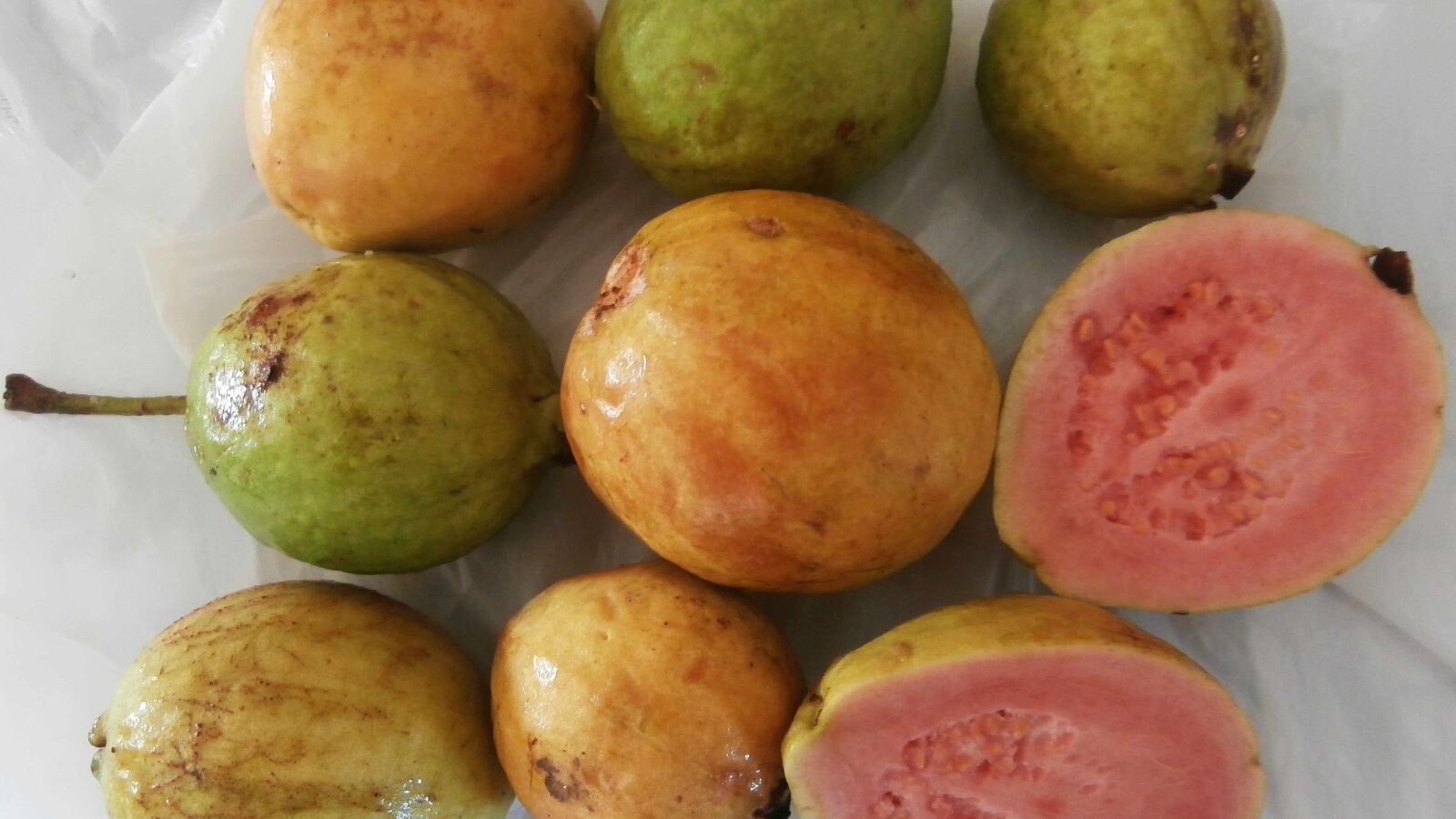
Common guava, Psidium guajava, from tropical America. The main crop, sweet, aromatic, with white, pink, or red flesh.
Strawberry guava, Psidium cattleianum, smaller and hardier, with a distinctive strawberry note — and a serious invasive, below.
Feijoa or pineapple guava, Acca sellowiana, from southern Brazil and Uruguay, the hardiest of the group and a genuine option in mild temperate gardens.
Cherry guava, Chilean guava (Ugni molinae, the Victorian favourite murtilla), and several other minor relatives round it out.
Common guava
One of the fastest and most productive fruit trees in the tropics and warm subtropics.
Fast. It fruits within 2 to 4 years from seed, grows rapidly, and crops heavily and continuously in warm conditions.
Undemanding. Tolerates poor soil, drought once established, and a wide pH range, and it is genuinely hard to kill.
Nutritious. The fruit is exceptionally high in vitamin C — several times that of citrus — and rich in fibre and pectin, which is why it makes such good paste and jelly.
Eaten fresh, seeds and all, or made into the guava paste (goiabada, bocadillo) eaten with cheese across Latin America, and into juice, jelly, and jam. The leaves are widely used medicinally.
Its ease and speed are also its liability: common guava has naturalised and become weedy across much of the tropics, spread by the birds and mammals that eat the fruit. See below and invasive species.
Strawberry guava: a warning
Psidium cattleianum deserves separate and blunt treatment, because it is one of the most damaging invasive plants in tropical island ecosystems.
Introduced widely as a fruit and ornamental, it:
Forms dense monospecific thickets that shade out and exclude native vegetation entirely.
Suckers aggressively and resprouts from the base, so cutting stimulates it.
Is spread by feral pigs and birds, which eat the fruit and carry the seed into intact forest.
Hosts fruit flies that then attack commercial fruit crops.
In Hawaii, Mauritius, La Réunion, and elsewhere it has invaded and degraded native rainforest on a landscape scale, and it is a principal target of island restoration and biocontrol programmes. It is a textbook case of the pattern in invasive species: a useful, attractive, easily grown plant that becomes an ecological catastrophe outside its range, especially on islands with no defences against it.
Its hardiness makes it tempting in marginal climates. Check local status before planting, and prefer feijoa.
Feijoa
The one for temperate gardeners, and a genuinely good plant.
Acca sellowiana is the hardiest of the group, surviving to about minus 10 C, and it fruits reliably in mild temperate and Mediterranean climates — southwest Britain, New Zealand (where it is almost a national fruit), and the mild United States.
The flowers are edible — the fleshy petals are sweet and are eaten as a delicacy or added to salads, while the plant keeps the flower and still sets fruit. Few crops let you eat the flowers and the fruit.
The fruit is aromatic, green, with a soft granular flesh tasting of pineapple, guava, and mint. It does not ripen well off the tree and is best gathered as it drops — ripe feijoas fall, so the harvest is a windfall crop, as with mulberry and pawpaw.
Pollination in many varieties needs a second plant and is done by birds in its native range, which take the sweet petals and transfer pollen — so in gardens without those birds, hand pollination or bird-attracting planting improves set. Self-fertile varieties exist.
Feijoa also makes an excellent dense evergreen hedge, tolerant of clipping, salt wind, and drought, with silver-backed leaves and showy red-and-white flowers — ornamental and productive at once. See hedgerow care.
Growing them
Common guava: frost-tender, wants tropical or warm-subtropical conditions, otherwise a container or glasshouse crop. Fast from seed, and grafted for named varieties. It fits the fast-fruiting gap-filler role in a tropical food forest, alongside banana and papaya.
Feijoa: full sun, free drainage, shelter, tolerant of a wide soil range. Slow to establish then reliable, and a strong candidate for a mild-climate edible hedge or a food forest shrub layer.
All propagate from seed (variable) or from cuttings and layering for named types. See propagation.
Being Myrtaceae, they are potential hosts of myrtle rust, Austropuccinia psidii, a serious spreading disease of the whole family that threatens guavas, feijoa, and native myrtles alike across Australia, the Pacific, and beyond. See tree diseases.
See also
- Tropical Fruit Trees the wider tropical fruit context
- Eucalyptus the family relative, and myrtle rust
- Invasive Species strawberry guava as an island invader
- Hedgerow Care feijoa as an edible hedge
- Food Forest Design guava as a fast gap-filler
- Blueberry and Acid Shrubs another productive fruit shrub
- Sapotes
- Feijoa
- Jaboticaba
- Acerola
- Lilly-Pilly