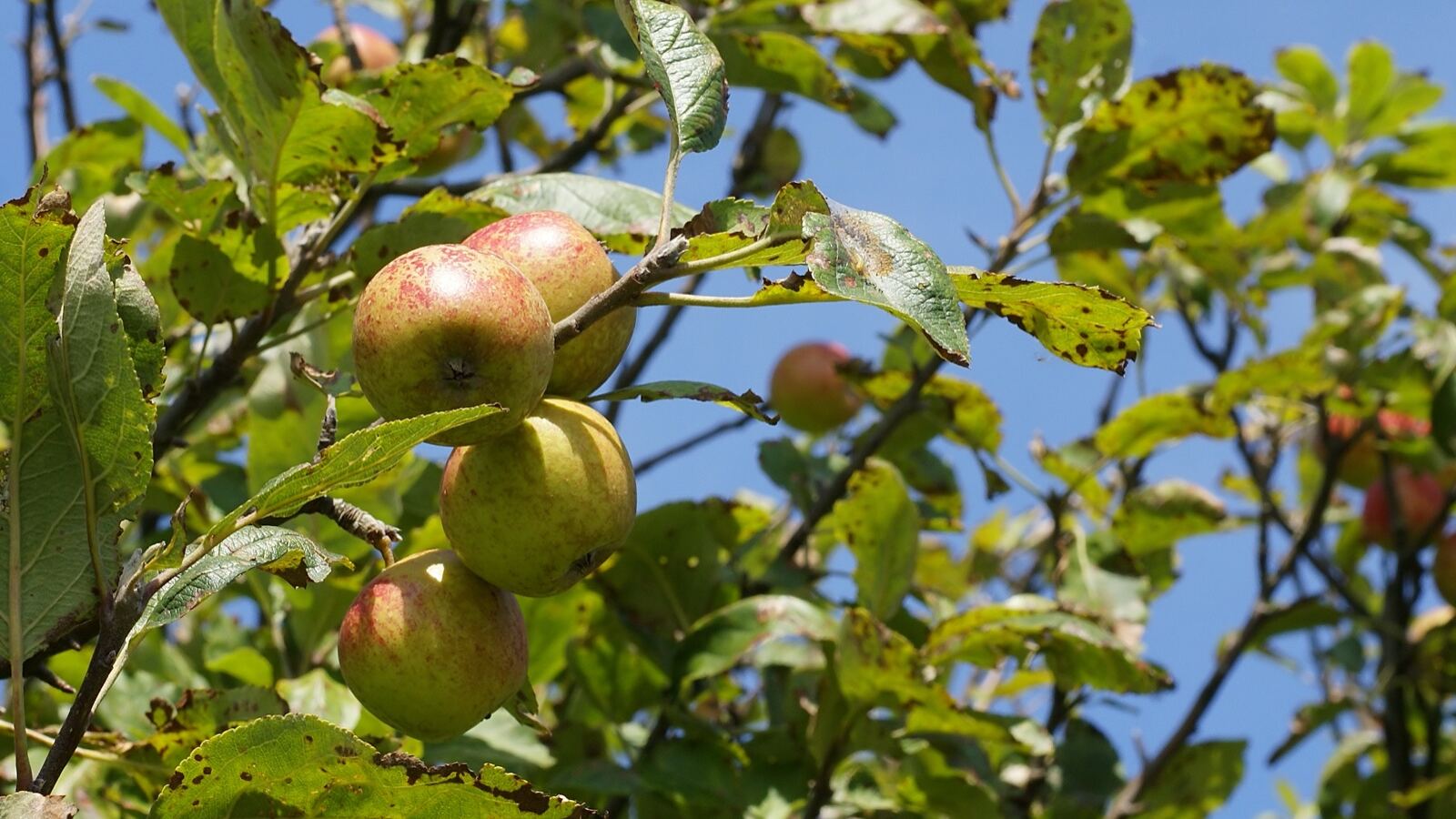
What it is
Malus sylvestris is the European wild crab, and M. baccata, M. floribunda, M. hupehensis and many others are Asian species widely planted as ornamentals.
Loosely, a crab apple is any apple with small fruit — under about 5 cm — and the distinction from a cultivated apple is size and palatability rather than taxonomy.
The domestic apple, M. domestica, descends chiefly from M. sieversii of the Tian Shan, with a substantial genetic contribution from European crab acquired as it moved west. See apples and pears.
The universal pollinator
The single best practical reason to plant one.
Most apple varieties are self-incompatible and need a compatible partner flowering at the same time. Matching pollination groups is fiddly, and triploids like Bramley need two partners because their own pollen is sterile.
A crab apple solves the whole problem. Crabs flower profusely and over a long period, overlapping with almost every cultivated variety, and they are compatible with nearly all of them.
One crab apple in a garden, hedge, or orchard corner will pollinate everything around it. Commercial orchards plant them deliberately at intervals for exactly this reason, and some varieties — Golden Hornet, Evereste, John Downie — are grown chiefly as pollinators.
It is a good example of solving a design problem with a species rather than a schedule. See fruit tree guilds.
Pectin
Crab apples are extremely high in pectin and acid, which makes them the traditional setting agent for preserves.
Crab apple jelly sets hard with nothing added. More usefully, crab apple juice added to a low-pectin fruit — blackberry, strawberry, elderberry — will set a jam that would otherwise stay syrup, which is why crabs were a fixture of hedgerow cookery long before commercial pectin existed.
The fruit is sharp and astringent raw, and excellent cooked. Also traditional for verjuice, the sour juice used as a vinegar substitute in medieval cooking, and for cider blending, where a proportion of sharp crab adds acidity and structure.
Some Asian species have sweeter, more palatable fruit.
Wildlife
Crab apple earns its place beyond the orchard.
Blossom is heavily worked by native bees, honeybees, and hoverflies over a long flowering period.
Fruit persists on the tree well into winter on many varieties, and is taken by thrushes, blackbirds, fieldfares, redwings, and waxwings, plus badgers, foxes, and small mammals on the ground. Like holly, the value is partly that it is still there in February.
Foliage supports a wide range of moth larvae. See caterpillars.
Old trees develop rot holes, deadwood, and rich lichen communities, and orchard and hedgerow crabs are disproportionately valuable veteran trees in farmland. See dead wood habitat and lichens and mosses.
In the hedge and the wood
Wild crab is a genuine native component of hedgerows and woodland edge across Europe, and it is a good indicator of old hedgerows and ancient woodland boundaries.
It is not a competitive forest tree — it needs light and gets shaded out — so it belongs on edges, in gaps, in hedges, and in open situations. See edge effects and hedgerow care.
Distinguishing true wild crab from a feral seedling of a domestic apple is genuinely difficult, and much of what is called wild crab in hedgerows is hybrid. Wild crab is typically thorny, with smaller, hairless leaves.
Rootstock and grafting
Crab apple seedlings were the traditional rootstock for grafted apples before the clonal M and MM series were developed at East Malling.
Seedling crab rootstocks produce large, vigorous, long-lived, well-anchored standard trees — which is exactly what a traditional orchard wanted and exactly what a modern intensive one does not. See grafting and rootstocks.
They remain a reasonable choice for a grazing orchard, a wood pasture, or a tree intended to outlive its planter. See silvopasture.
Growing it
Easy. Tolerates most soils, exposure, cold, and part shade, though it fruits and flowers best in full sun.
Small — typically 4 to 10 m — which makes it one of the better small garden trees, with blossom, fruit, autumn colour, and genuine wildlife value.
Prone to the same problems as cultivated apples: scab, canker, mildew, and fireblight, though generally with more resistance. See tree diseases.
Prune lightly in winter, and only to shape. Crabs need far less intervention than orchard apples.
Many ornamental crabs are bred for flower and fruit display rather than for wildlife, and some heavily double-flowered forms produce little nectar and no fruit. If the point is pollination and birds, choose a single-flowered variety with persistent fruit.
See tree planting and pruning basics.
See also
- Apples and Pears the crop it pollinates
- Fruit Tree Guilds designing the orchard around it
- Grafting and Rootstocks crab as seedling rootstock
- Hawthorn the other small hedgerow tree with winter fruit
- Native Bees what the long flowering feeds
- Hedgerow Care crab as a hedgerow standard
- Grapes