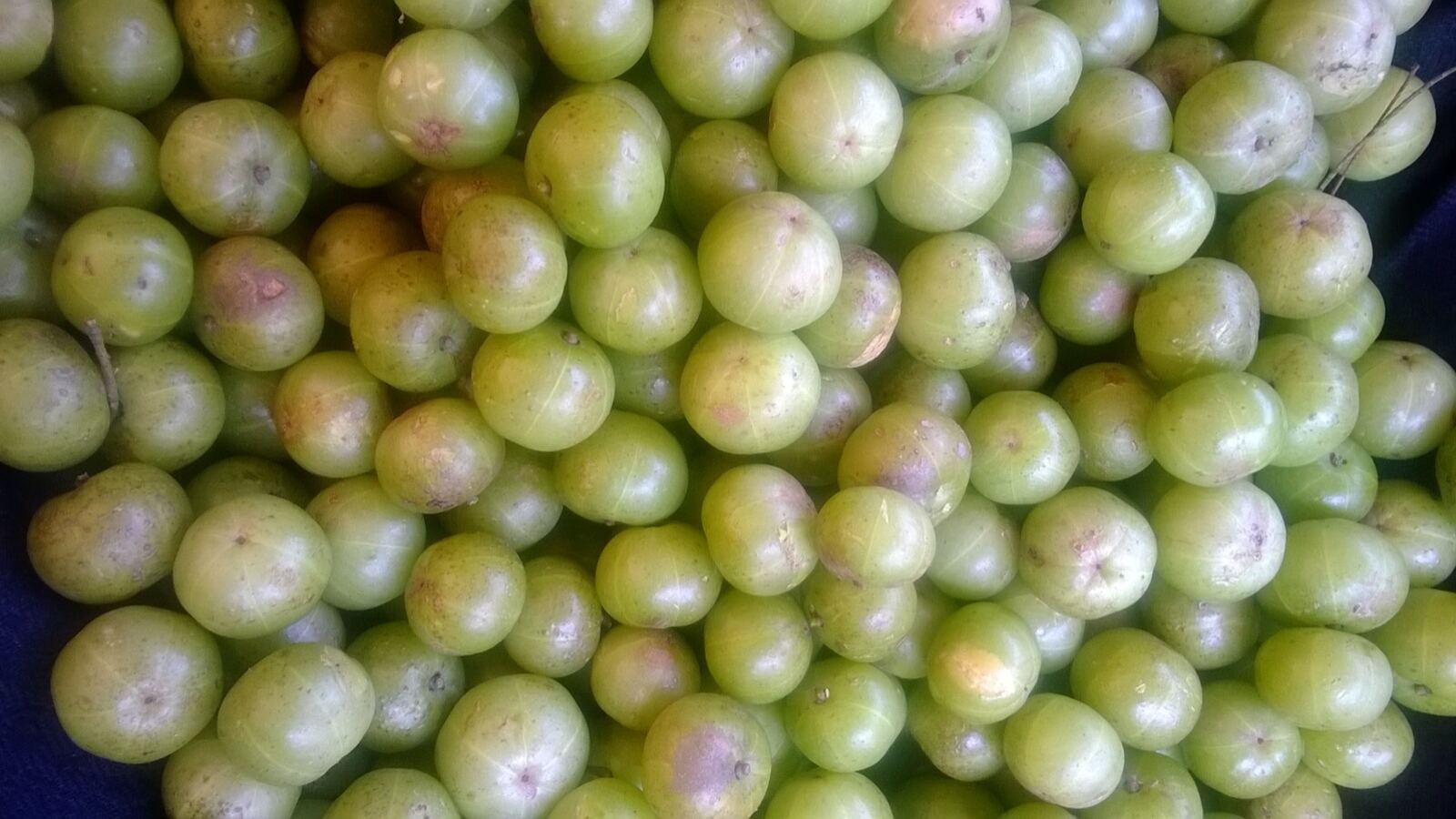
What it is
Phyllanthus emblica (also Emblica officinalis), the amla or Indian gooseberry — a small-to-medium deciduous tree of South and Southeast Asia, bearing round, pale-green, translucent, hard fruit with a taste that is famously and intensely sour, astringent, and bitter all at once, with a strange sweet aftertaste.
The tree has fine, feathery foliage (the small leaflets ranged along the twigs look almost like a compound leaf), and it is one of the most revered plants in Indian culture and medicine — held sacred in Hinduism, worshipped in its own festival, and treated in Ayurveda as one of the most valuable of all healing plants.
A concentrated dose of vitamin C
The amla's great claim, and the basis of much of its reputation, is its exceptional richness in vitamin C — among the highest of any common fruit, far above citrus, and unusually stable because tannins in the fruit protect the vitamin from breaking down when the fruit is dried or cooked. This makes even dried amla and amla preparations a potent source, which is part of why it was so valued long before vitamins were understood.
The fruit is far too sour to eat raw in quantity, so it is preserved and transformed: candied into sweet murabba and amla candy, pickled, dried, juiced, and powdered. It is also, being high in tannins, used for tanning leather, dyeing, and making ink and a natural hair conditioner (amla hair oil is a staple across South Asia).
The keystone of Ayurveda
In Ayurvedic medicine, amla is a cornerstone — one of the three fruits (with the two myrobalans, relatives of the tropical almond) that make up triphala, the most widely used of all Ayurvedic formulas, taken for digestion and general health; and it is the principal ingredient of chyawanprash, the famous herbal jam-tonic taken across India as a general restorative. Amla is regarded as a rasayana — a rejuvenating tonic said to promote longevity and vitality — and modern research has taken a genuine interest in its antioxidant, anti-inflammatory, and cholesterol-lowering effects. Whatever the pharmacology, the cultural and medicinal weight of amla in South Asia is immense, matched among trees only by the neem and a few others. See historical ecology.
Growing it
Tropical to subtropical, and fairly hardy for a tropical fruit tree (it tolerates light frost and a wide range of climates from the plains to the lower hills), the amla is tough and adaptable — drought-tolerant once established, tolerant of poor, dry, sandy, and alkaline soils where many fruit trees fail, and generally undemanding, which is why it grows across such a range of India.
It wants full sun and does best with a distinct dry season, and it is a reliable, heavy cropper. Grown from seed (variable) and, for named high-yielding varieties, by grafting and budding. The flowers are small and inconspicuous but feed bees, and the tree is a good, tough, multi-purpose component of a subtropical food forest and dryland planting. See propagation, grafting, and drought-tolerant species.
See also
- Neem the other great sacred, medicinal tree of India
- Arjuna the myrobalan relatives that join amla in triphala
- Tropical Almond the Terminalia kin of amla's triphala partners
- Curry Tree another everyday useful tree of the subcontinent
- Bael a fellow sacred, medicinal Indian fruit tree
- Food Forest Design amla as a tough, multi-purpose fruit tree
- Acerola
- Myrobalan
- Kakadu Plum