What it is
Hamamelis, a small genus of large shrubs or small trees — American witch hazel, H. virginiana, and the Ozark H. vernalis of North America, and H. japonica and H. mollis of East Asia, plus the widely grown hybrid H. × intermedia — another eastern-Asia–eastern-North-America pairing.
Not a hazel and not witchy — the name probably comes from an old word for pliant or bending, from the use of its forked twigs, and the plant became associated with dowsing, hence "witch." It gives its name to the plant family Hamamelidaceae, which also holds Persian ironwood and sweetgum.
Winter flowers
The reason witch hazel is planted, and one of the highlights of the winter garden.
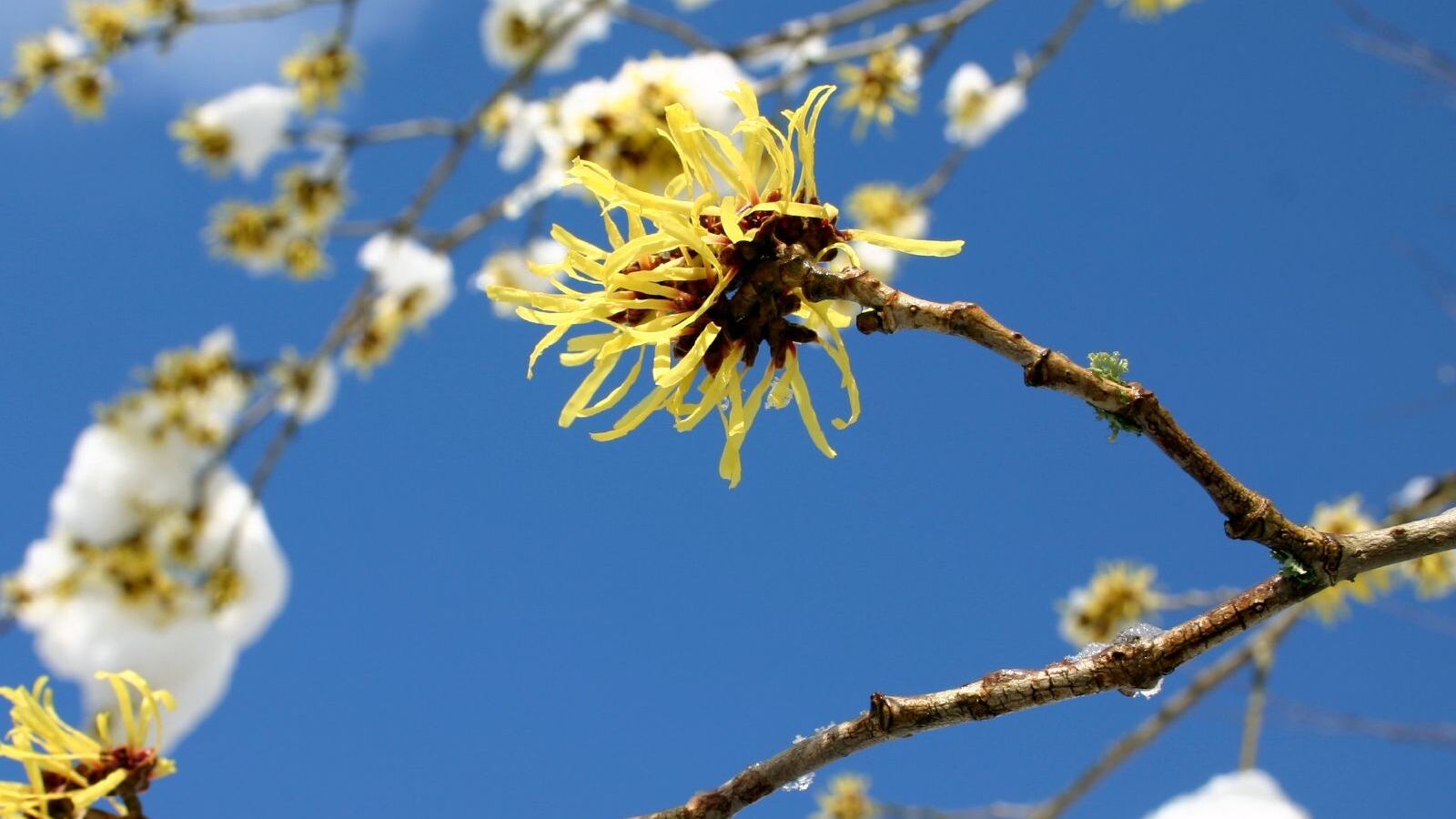
It flowers on bare stems in the depths of winter — the Asian species and hybrids from midwinter, the American H. virginiana uniquely in autumn, as its own leaves are falling. The flowers are unmistakable: clusters of narrow, crumpled, spidery petals, in yellow, orange, or red, that look like little ragged streamers along the branches.
Crucially, they are frost-proof in a specific way: the thin ribbon petals curl up tight in hard frost and uncurl again when it thaws, so the flower survives freezing that would destroy a normal bloom, and a witch hazel can flower unharmed through weeks of frost. Many are also strongly, sweetly scented, carrying fragrance across a still winter garden when almost nothing else is out.
That winter flowering makes witch hazel a rare and valuable early nectar source for the few insects flying on mild winter days. See pollinator habitat and the winter-flowering cornelian cherry.
Exploding seeds
Witch hazel has one of the more dramatic seed-dispersal mechanisms of any temperate plant.
The woody seed capsules, which take a full year to ripen, dry and build tension until they split explosively and fire the two hard black seeds several metres — up to 10 m in some accounts — with an audible snap. It is ballistic dispersal, the same principle as gorse and broom pods, and it means witch hazel seeds land well clear of the parent.
The capsules ripen and fire at the same time the plant is flowering the next year's blooms, so an autumn-flowering American witch hazel carries flowers and exploding fruit together.
The astringent
Witch hazel is one of the few plants whose common name is also the name of a product on the bathroom shelf.
A distillate of the bark and leaves of H. virginiana is a mild astringent, used for centuries and still sold widely for skin — bruises, insect bites, minor inflammation, and as a toner and aftershave. The astringency comes from tannins, and the traditional use is well established even if the clinical evidence for many claims is modest, the familiar pattern seen with tea and turmeric. It was a significant folk and commercial medicine of the eastern United States and remains a genuine cottage and commercial product.
Growing it
Moist, fertile, well-drained, neutral to acid soil with plenty of organic matter — witch hazel dislikes shallow chalk and drought, and does best in the woodland-edge conditions it comes from. See soil pH.
Sun to light shade, and shelter to hold the winter scent.
Slow-growing, reaching 3 to 5 m, with an open spreading habit, and it gives excellent autumn colour — clear yellow to orange-red — as a bonus before the winter flowers, so it earns its place in two seasons.
The garden hybrids and Asian species are grafted onto H. virginiana rootstock, and a common problem is the rootstock suckering and overtaking the grafted variety — remove suckers promptly. See grafting and propagation.
Few pests or diseases trouble it. It is grown almost entirely as a winter-flowering ornamental — the frost-curling scented flowers in the dead of winter are its whole case — with the autumn colour and the exploding seeds as bonuses.
See also
- Persian Ironwood the close family relative
- Sweetgum another member of the family
- Cornelian Cherry the other winter-flowering shrub
- Pollinator Habitat winter nectar for early insects
- Soil pH why it dislikes chalk
- Grafting and the rootstock-suckering problem
- Loquat
- Sandbox Tree