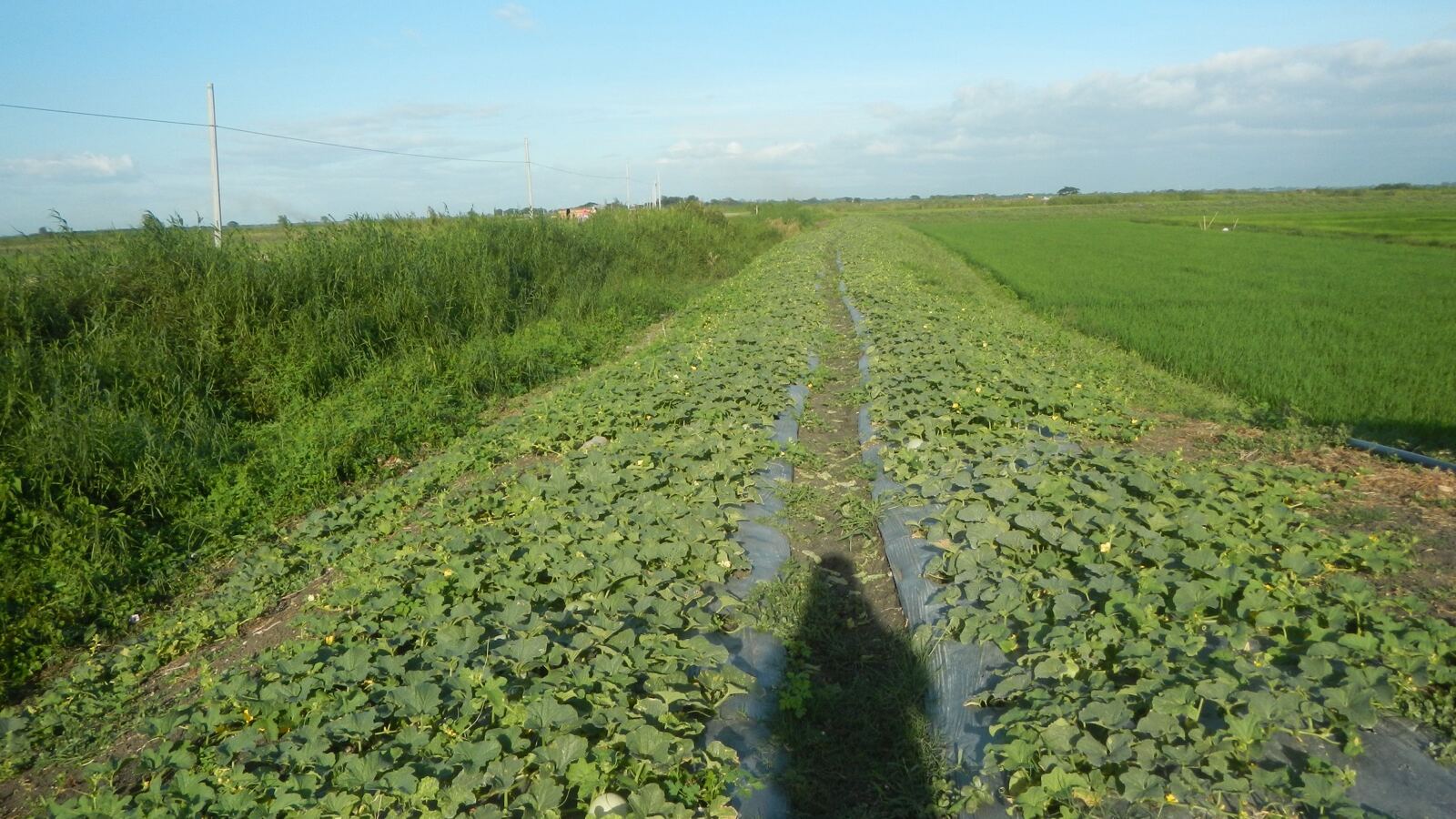
What they are
Cucurbits, and two separate genera despite being used the same way.
Melon, Cucumis melo — the same genus as cucumber. Enormously variable: cantaloupe, muskmelon, honeydew, Charentais, Galia, and the crisp Asian types.
Watermelon, Citrullus lanatus, a different genus, domesticated in northeast Africa, and physiologically distinct in ways that matter at harvest.
Both share the family habits described in squash and courgettes: separate male and female flowers, insect pollination, sprawling growth, heavy feeding, and frost tenderness.
Sugar arrives at the end
The single most important thing about growing melons, and it governs every harvest decision.
Melons store no starch reserve. Unlike apples, bananas, or tomatoes, which continue converting stored starch to sugar after picking, a melon's sugar is delivered from the plant in the final one to two weeks on the vine.
Pick it before that and the sugar never arrives. It will soften — melons are climacteric and continue to ripen in texture and aroma — but it will not get sweeter.
That is why a supermarket melon picked for shipping is soft and bland: the texture ripened and the sugar did not.
Watermelon is even stricter. It is non-climacteric and does essentially nothing after picking — no softening, no aroma development, no sugar. What you cut is what you get, permanently.
So the whole skill is judging ripeness on the plant, and the tests differ by type.
Judging ripeness
Cantaloupe and muskmelon types — the netted, aromatic ones — give the clearest signal: full slip. The stem develops a crack all the way around where it joins the fruit, and the melon detaches with the gentlest lift. If you have to cut or pull it, it is not ready. Add a strong sweet aroma at the blossom end and a background colour turning from green to buff.
Honeydew and Charentais types do not slip. Judge by: background colour change, a slight softening at the blossom end, aroma, and the stem tendril nearest the fruit drying out.
Watermelon gives three signals, and it is worth using all three:
The ground spot — the patch resting on the soil — turns from white to creamy yellow. The tendril nearest the fruit shrivels and dries. The skin dulls and loses its gloss, and resists a thumbnail.
The knuckle-thump test is real but genuinely hard to learn; a ripe watermelon sounds lower and hollower than an unripe one.
Heat, and how to fake it
Melons want 25 to 30 C, sustained, plus a long season — 80 to 120 days depending on type.
In cool temperate climates the practical measures are:
Grow under cover — polytunnel or greenhouse — which is the reliable route.
Choose short-season varieties. Charentais and small early cantaloupes ripen where a full-size watermelon never will. Small fruit is the point, not a compromise.
Black plastic mulch raises soil temperature meaningfully and is standard practice. See mulching for moisture.
Plant through a raised ridge or mound, which warms faster and drains better.
Start indoors 3 to 4 weeks before planting out, in deep modules — like all cucurbits they resent root disturbance, so plant out young before they are pot-bound.
Growing them
Rich soil and heavy feeding, as for squash. A planting hole loaded with compost or well-rotted manure suits them.
Water generously while the vine grows and the fruit swells — then reduce sharply as the fruit approaches ripeness. Heavy watering at ripening dilutes sugars and causes splitting. This is the one crop where deliberately backing off water at the end genuinely improves quality, alongside the deficit approach mentioned in irrigation scheduling.
Water the soil, not the foliage — mildew is the usual disease.
Limit the fruit. In a marginal climate, four to six melons per plant, or two to three watermelons. Remove the rest. A plant carrying a dozen fruits in a cool summer ripens none.
Support the fruit off wet soil on a tile, board, or straw pad, which prevents rot and helps ripening. Melons trained vertically need individual slings.
Pollination is by insects, and poor set in a closed greenhouse is common — hand-pollinate as described in squash and courgettes if fruit is aborting.
Problems
Powdery mildew, almost universal late on. Space, ventilate, water at the base, choose resistant varieties.
Red spider mite under cover in hot dry air. See whiteflies and spider mites.
Aphids, and the viruses they carry — cucumber mosaic virus affects melons badly. See aphids.
Splitting from irregular water at ripening.
Slugs and mice, both of which find ripening melons before you do.
Fusarium wilt, soil-borne, and a reason to rotate cucurbits. See crop rotation.
Grafting
Worth knowing about, because it is standard commercial practice and increasingly available to gardeners.
Melons and watermelons are frequently grafted onto squash or gourd rootstocks — typically Cucurbita interspecific hybrids or bottle gourd.
The rootstock provides resistance to soil-borne fusarium and verticillium, greater vigour, better performance in cool soil, and improved drought tolerance.
It is the same logic as grafting and rootstocks in fruit trees and grapes, applied to an annual crop — and it is one of the few annual vegetables where grafting is routine.
Saving seed
Straightforward, with the usual cucurbit caution.
C. melo varieties cross freely with each other but not with watermelon, cucumber, or squash, which are different species. So melons must be isolated from other melons, and watermelons from other watermelons.
Scoop, rinse, dry thoroughly, store cool. Viable 5 years or more. Seed from a fully ripe fruit you have just eaten is ready to save with no fermentation needed. See seed saving.
Watermelon seeds are also edible roasted, and are a significant snack food in parts of Africa and Asia — some varieties are grown for seed rather than flesh.
See also
- Squash and Courgettes the family, pollination, and feeding
- Cucumbers the same genus as melon
- Irrigation Scheduling backing off water at ripening
- Frost Protection extending a marginal season
- Grafting and Rootstocks grafted melon rootstocks
- Harvest and Storage why picking early cannot be undone