What they are
Two related subtropical fruit trees of southern China and Southeast Asia, long cultivated and now grown across the warm world.
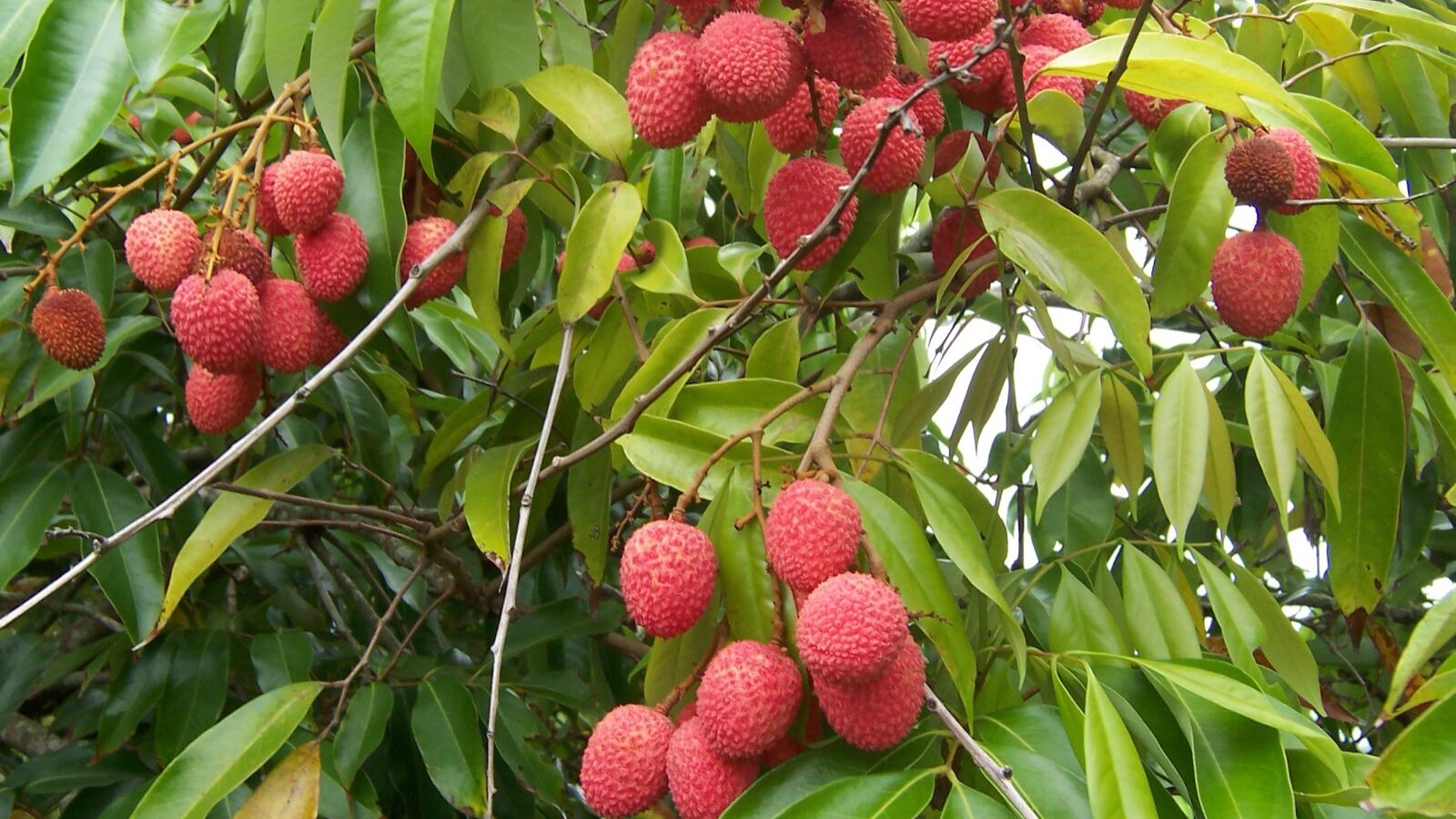
Lychee, Litchi chinensis: a handsome evergreen bearing clusters of red, knobbly-skinned fruit whose thin shell peels to reveal translucent, fragrant, sweet-tart white flesh around a single brown seed.
Longan, Dimocarpus longan — the name means "dragon eye": a close relative with smaller, smooth, tan-skinned fruit and similar translucent flesh, milder and muskier than lychee, the seed showing through like a dark pupil.
Both belong to the soapberry family, Sapindaceae — which, on modern classification, also contains the maples and the horse chestnut, so these tropical fruit trees are surprisingly close cousins of the familiar temperate shade trees. The rambutan, with its hairy red shell, is another Sapindaceae fruit of the same group.
The fruit and the aril
The edible part of both is an aril — a fleshy outgrowth wrapped around the seed, not the fruit wall itself — the same structure that makes the flesh of the yew and the spice mace (from nutmeg). It is why the flesh peels cleanly away from both shell and stone.
Lychee especially is highly perishable: the bright red shell browns within a day or two of picking, so fresh lychee was historically a luxury of the growing regions, and much of the crop is dried (dried lychee and longan are pantry staples, and dried longan is a common ingredient in Chinese soups and tonics) or canned. The trade in fresh lychee is a triumph of modern cold chains over a fruit that wants to spoil immediately.
Why they are hard to flower
The central difficulty in growing lychee and longan is that they need a cool, dry winter to flower — a period of low temperatures triggers the flush of flower panicles, and without enough winter chill the tree grows vegetatively and fruits poorly or not at all.
This makes them frustratingly climate-specific: too cold and the frost-tender trees are damaged; too warm and tropical and they will not flower. They fruit reliably only in a fairly narrow subtropical band with a distinct cool-dry season, which is why lychee is a signature crop of southern China, northern Vietnam, and comparable climates, and why it disappoints in the wet tropics and the frosty temperate zone alike. They are also strongly alternate-bearing, heavy one year and light the next, like mango. See climate adaptation.
The litchi poisoning
Lychee carries a genuine and sobering hazard worth knowing. Unripe lychees contain toxins (hypoglycin A and MCPG) that block the body's ability to make glucose. In several regions — notably Bihar in India and parts of Vietnam and Bangladesh — clusters of previously mysterious child deaths during the lychee harvest were traced to children eating quantities of unripe lychees on an empty stomach, which crashed their blood sugar overnight.
The lesson embedded in the public-health response is simple: eat ripe fruit, not green, and not in large amounts on an empty stomach, especially for undernourished children. Ripe lychee eaten normally is entirely safe; it is the unripe fruit and the empty stomach together that cause harm.
Growing them
Warm frost-free subtropics with, paradoxically, a cool dry winter to induce flowering.
Soil. Deep, moist, slightly acid, well-drained soil; both dislike waterlogging and drought and want steady moisture through fruiting. Mulch and shelter from wind, which tatters the foliage and dries the developing fruit.
Propagation. Seedlings are slow and variable, so both are propagated by air-layering (marcotting) — rooting a branch while still attached to the parent — an ancient Chinese technique that gives a true-to-type, quick-fruiting tree, as well as by grafting. See propagation and grafting.
Handsome evergreen trees for a frost-free garden with the right winter, and a fine addition to a subtropical food forest, if the climate will coax them into flower.
See also
- Maples the temperate cousins in the same soapberry family
- Horse Chestnut another Sapindaceae relative
- Mango the other great subtropical fruit, sharing the alternate-bearing habit
- Tropical Fruit Trees lychee and longan in the wider orchard
- Yew the other plant whose edible part is an aril
- Propagation air-layering for true-to-type trees
- Golden Rain Tree
- Ackee
- Soap Nut
- Yellowhorn