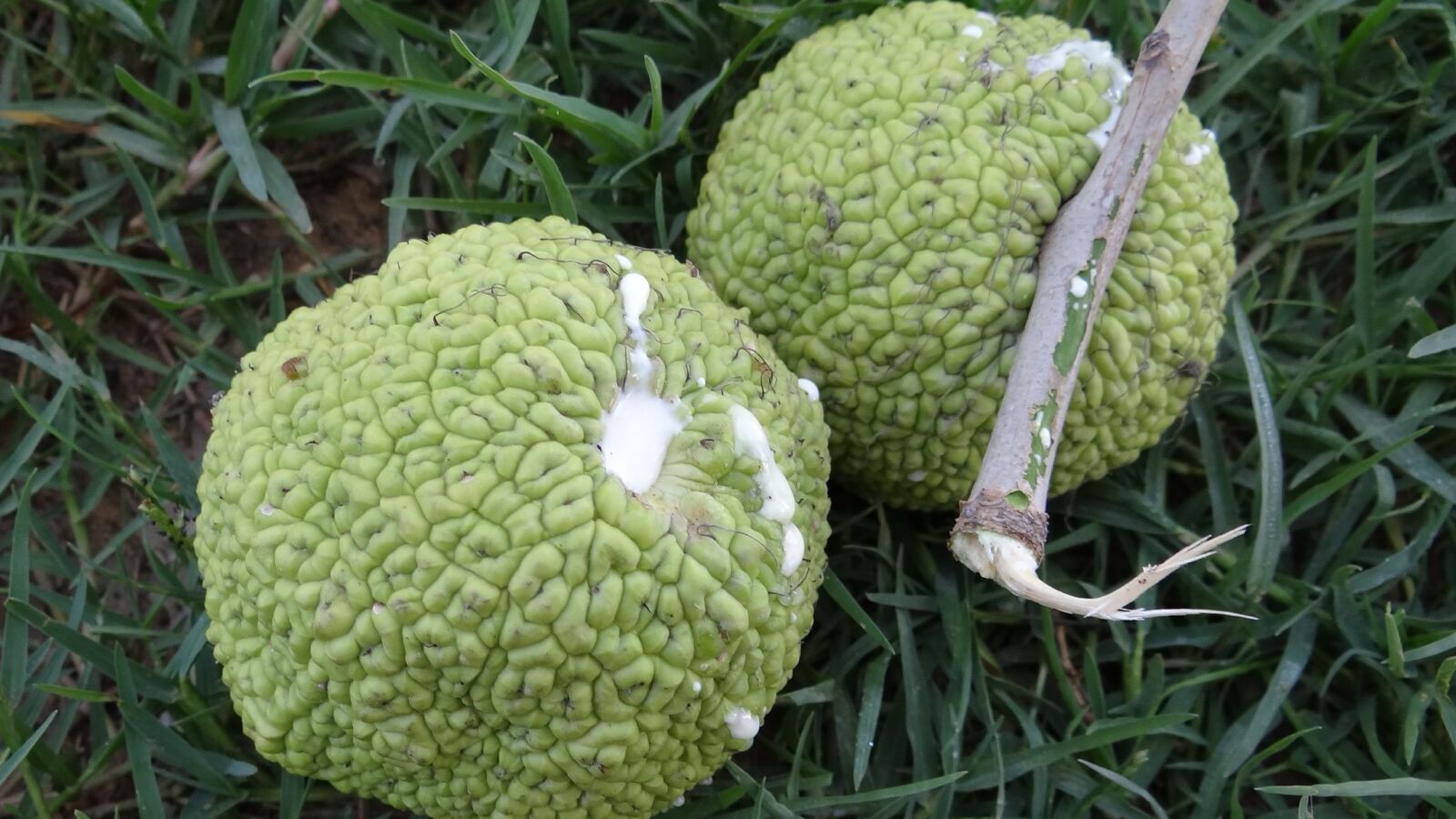
What it is
Maclura pomifera, from a small original range in the south-central United States, in the mulberry and fig family — which shows in the milky sap and the aggregate fruit.
Also called hedge apple, bois d'arc, bodark, and horse apple. The osage part refers to the Osage people, whose territory held the best stands and who prized its wood.
It is a thorny, tough, medium-sized tree, and its story is a series of superlatives: the best hedge, the best bow wood, and one of the strangest fruits in North America.
The hedge that fenced the plains
Before barbed wire, the treeless American prairie had a fencing problem: no wood for rails, no stone, and open range in every direction.
Osage orange solved it. Planted close and cut back, it forms a hedge that is horse-high, bull-strong, and pig-tight — the period phrase — dense, thorny, and genuinely impenetrable to livestock. Millions of miles of osage orange hedge were planted across the Midwest in the mid-nineteenth century, and it enclosed the prairie farm.
Then, in the 1870s, barbed wire was invented, and it made the living hedge obsolete almost overnight — cheaper, faster, and needing no land. The osage orange hedges were largely abandoned, though many survive as lines of old trees across the landscape, and the same trees supplied the posts that carried the barbed wire that replaced them, since osage orange is among the most rot-resistant of all woods. It is a neat historical hinge: the hedge tree that fenced the plains, then propped the wire that ended it.
The hedging technique is the same living-barrier principle as blackthorn and the mixed hedges of hedgerow care, taken to an extreme.
Bow wood
Bois d'arc means bow wood, and it is the name the French gave it for good reason: osage orange is widely regarded as the finest bow wood in North America, and among the best in the world.
The wood is dense, hard, extremely strong in both tension and compression, elastic, and rot-proof — the combination that makes a bow store and return energy without breaking, the same demand that made yew the European bow wood. Plains and prairie peoples valued bois d'arc bow staves so highly that they were a significant trade item, carried and exchanged over long distances.
The timber more generally is one of the most durable there is — untreated fence posts last 50 years and more, rivalling black locust — and it is a brilliant golden-yellow when fresh, ageing to brown. It is exceptional firewood, burning hotter than almost any North American wood, and it yields a yellow dye.
The fruit nothing eats
The osage orange fruit is one of the classic examples of an evolutionary anachronism, the same puzzle as the pawpaw and the avocado.
It is large — the size of a grapefruit — green, heavy, wrinkled, and full of a bitter milky latex, and no living North American animal disperses it. It drops beneath the tree and rots, or is occasionally gnawed by squirrels for the seeds. It is inedible to people and largely to livestock.
The likely explanation is that it evolved to be eaten and dispersed by the Pleistocene megafauna — mammoths, mastodons, giant ground sloths — that went extinct around 12,000 years ago. Left without its disperser, the tree's natural range collapsed to a small area, and it survives and spreads today essentially because people valued its wood and hedges and planted it far beyond where it could disperse itself. It is a tree kept going by human use after its ecological partner vanished.
The persistent folk belief that the fruits repel spiders and insects has little support.
Growing it
Extremely tough: full sun, and tolerant of drought, heat, wind, poor soil, and urban conditions — another resilient tree in the hackberry and catalpa mould.
Fast-growing, reaching 8 to 15 m, thorny, and dioecious — only females bear the large fruit, so male, thornless, fruitless clones are selected for amenity planting to avoid both hazards, exactly as with ginkgo. Grows readily from seed and from cuttings and root cuttings.
It is planted today mainly as a tough windbreak and shelterbelt tree, for its remarkable wood, and increasingly as a durable-timber crop and biomass tree, since it coppices and yields rot-proof posts. See windbreaks and coppice rotation.
See also
- Blackthorn the other great thorny hedging tree
- Black Locust the comparable rot-proof durable timber
- Yew the European bow wood
- Pawpaw and Persimmon the megafauna-dispersal anachronism
- Mulberry the family relative
- Hedgerow Care living-hedge stockproofing
- Honey Locust
- Avocado
- Joshua Tree and Yuccas
- Hardy Orange
- Logwood