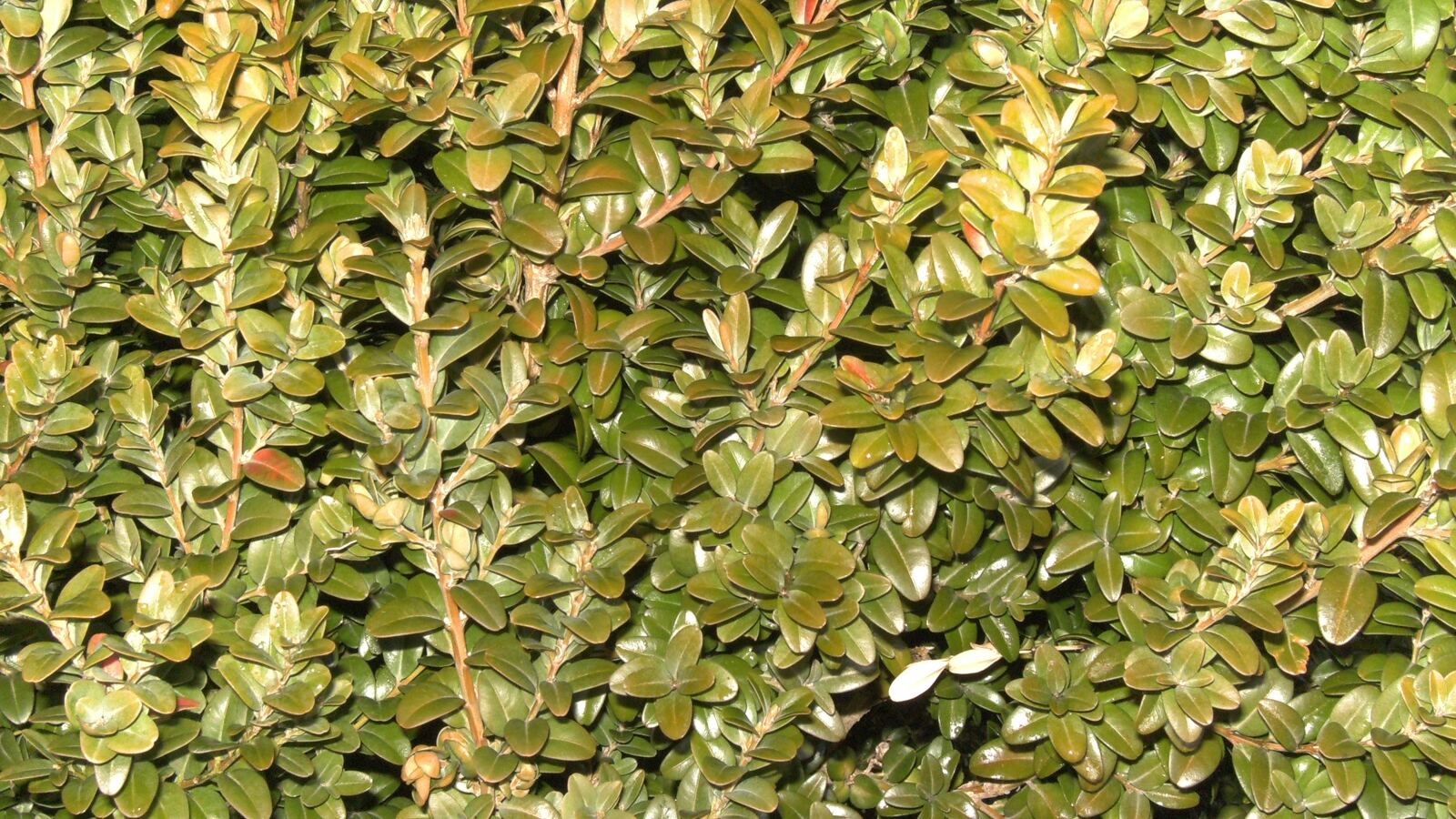
The two workhorses of the clipped hedge
Two dense evergreens have done more clipping duty than any others in temperate gardens — one aristocratic and slow, one cheap and fast.
Box, Buxus sempervirens and its relatives: slow, fine-leaved, and dense, the classic plant of low formal edging, parterres, knot gardens, and detailed topiary.
Privet, Ligustrum — common privet, wild privet, and the fast Japanese privets: the quintessential cheap suburban hedge, semi-evergreen, tough, and endlessly obliging.
Box: fine wood and a formal past
Box is the plant of the clipped, geometric garden. Its tiny dense leaves and slow, even growth let it be sheared into crisp low hedges and intricate topiary that hold their shape for years, and it has defined formal European gardens since Roman times.
The wood is extraordinary — the hardest, densest, and finest-grained of any common European timber, so dense it sinks in water, pale, and able to hold the sharpest detail. That made it the wood for wood-engraving blocks (the fine printed illustrations of the eighteenth and nineteenth centuries were cut in end-grain box), for chess pieces, rulers, measuring instruments, wind-instrument parts, tool handles, and inlay — anywhere extreme hardness and fine detail were needed. It shares this dense-fine-wood niche with the spindle and dogwood. Boxwood grows so slowly that it is always scarce and valued.
Box under siege
The great sadness in gardens now is that box is collapsing under two introduced enemies at once.
Box blight (Cylindrocladium and Volutella fungi) causes leaf drop, dark stem lesions, and rapid dieback of clipped box, spreading fast in the humid, still conditions inside a dense hedge, and it has devastated box hedges and topiary across Europe. Box tree moth (Cydalima perspectalis), a caterpillar from East Asia, defoliates and kills box, and has spread explosively through Europe and into North America. Between them, blight and moth have made box almost ungrowable in many gardens, and there has been a widespread search for alternatives — small-leaved holly (Ilex crenata), yew, and others — to replace the box that formal gardens depended on. It is a clear, painful case of imported tree diseases and pests overwhelming a plant with no resistance, the same story as hemlock and the elm. See integrated pest management.
Privet: fast, tough, and troublesome
Privet is box's opposite: cheap, fast, and undemanding, which made it the default hedge of Victorian and twentieth-century suburbia. It grows almost anywhere, in sun or shade, poor soil or good, tolerates pollution and clipping, and quickly makes a solid green screen.
It has three things worth knowing. Left unclipped it produces heads of small, heavily-scented white flowers (some find the scent cloying) followed by black berries; the flowers are excellent for pollinators and the privet is the foodplant of the magnificent privet hawk-moth, one of the largest moths in the region. See pollinator habitat and butterflies and moths. The berries are poisonous to people (though eaten by birds, which spread the seed). And the vigorous Asian privets are serious invasive species in North America, Australia, and New Zealand, where bird-sown privet invades woodland and forms dense thickets exactly as cherry laurel and buckthorn do — a modest hedge plant turned woodland weed.
Growing them
Box wants moist, well-drained soil in sun or part shade, and shelter; clip in dry settled weather (not humid conditions that spread blight), keep the centre open to air, and clear fallen leaves. Given the blight and moth, weigh alternatives before planting a new box hedge, and buy from reputable, disease-free stock. Slow but very long-lived. See pruning basics.
Privet grows anywhere and needs only regular clipping to stay dense — an unclipped privet becomes leggy and open. Cheap from bare-root or cuttings, which root very easily. Site the invasive Asian kinds with care, or choose native alternatives. Both propagate readily from cuttings. See propagation and hedgerow care.
See also
- Yew the premier alternative for clipped hedges and topiary
- Holly small-leaved holly as a box substitute
- Tree Diseases box blight and the box tree moth
- Spindle and Dogwood the other very fine, dense hedgerow woods
- Hedgerow Care native alternatives to a privet hedge
- Invasive Species Asian privets in woodland
- Lignum Vitae