What it is
A line of woody plants kept dense by cyclical cutting. Hawthorn, blackthorn, hazel, field maple, holly. Standard trees rising through at intervals. Managed on a horizon of centuries, not seasons.
A good hedge is a wildlife corridor, a windbreak, a stock barrier, and a small linear woodland at once. Some English hedges have stood on the same line since the Anglo-Saxon period.
Cut wrong, you get a brown strip. Cut right, you get a structure that shelters thousands of species and outlives you by generations.
The A-shape and why it matters
Cross-section first. Everything else follows from this.
A working hedge is wider at the base than the top. 1.5 m wide at the base, tapering to 0.5 to 1 m at the top, ideally 2 to 4 m tall. The A-shape lets light reach the lower branches and keeps the hedge dense from ground to crown. Square or top-heavy hedges go bare at the bottom within a decade.
The base width is where the wildlife lives. Dormice, hedgehogs, wrens, yellowhammers, slow worms. Bumblebees nest in the leaf litter. A 1.5 m base supports an order of magnitude more species than a 0.5 m one.
Leave a 1 to 2 m unmown margin of rough grass either side. That margin is half the value of the hedge. See pollinator habitat.
Trim cycles
The single most damaging hedgerow practice in the UK is the annual flail in autumn.
The flail removes next year's flower buds before they open. No flowers, no berries. No berries means no fieldfares, no redwings, no winter food for half the farmland bird community. A hedge cut every September is biologically inert.
The Hedgelink standard is cut on a 2 to 3 year rotation, in late winter, after the berries are gone. February to early March is the window. By then thrushes have stripped the haws and sloes, and birds are not yet nesting.
Stagger cuts across the farm. Cut a third of the length each year on a three-year rotation. Some sections always carry berries into the following winter, and the wildlife population never crashes at once.
Raise the cutting height by 5 to 10 cm each rotation. Hedges trimmed to the same height for thirty years thicken into a knuckle and stop producing new growth.
Standard trees in the line
Standard trees are the second layer. Oak, ash, field maple, wild cherry, holly. Allowed to grow on through the hedge to full canopy.
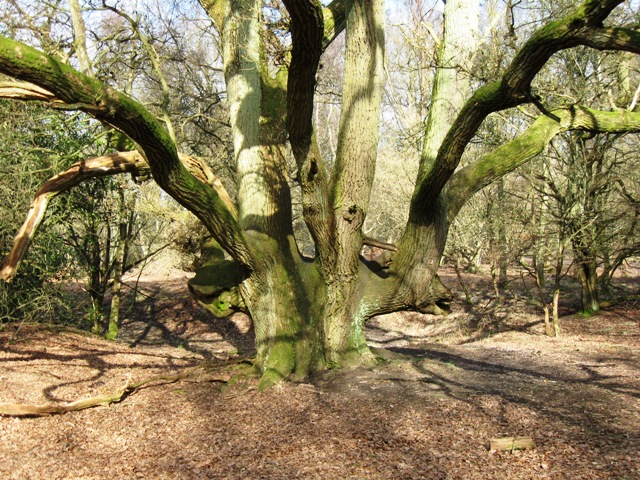
One standard per 10 m of hedge length is the working ratio. Mark them while you cut. Leave a strong upright stem from a coppice stool, tag it with bailer twine, and never cut it again. In thirty years it is a sapling. In a hundred it is a tree.
Standards turn a linear hedge into a linear woodland over time. A 300 year oak in a hedge line supports more invertebrate species than entire industrial plantations. Bats commute along the canopy. Tawny owls hunt from a single perch.
See native oaks and dead wood habitat. The hedge generates its own snags and rot holes in time.
Laying the hedge
Every 15 to 25 years, a managed hedge needs to be laid.
By that point the stems have grown beyond the reach of trimming. The base is opening up. The hedge becomes a row of small trees with daylight underneath. Laying resets it.
The cut is called the pleach. You saw through 80 to 90 percent of the stem at the base, close to ground level. The remaining hinge of bark and sapwood keeps it alive. You bend the stem over at roughly 45 degrees and weave it into upright stakes (hazel, usually) driven into the line. Hazel rods called binders run along the top to bind the stakes.
Within one growing season, dormant buds at the base burst and shoot vertically. Five years on, the hedge is denser than it has been in a generation.
Regional styles differ. Midland Bullock style for cattle country. Welsh Border style for sheep, lower and tighter. The British Hedgelaying Society publishes the standards. Find a local practitioner. The craft is faster learned with hands than from books.
A laid hedge does not need re-laying for two decades. The 2 to 3 year trim cycle carries it in between.
Gapping up
Sections fail. A standard falls, a tractor clips a corner, a stretch goes thin from shade or stock pressure.
Gap up in winter with bare-root whips of native species matched to what is already in the line. Five whips per metre of gap, in a double staggered row, 30 cm apart. Hawthorn and blackthorn as the backbone. Hazel, field maple, dog rose, holly, spindle for diversity.
Mulch heavily. Tube against rabbits and deer for three years. See deer and rabbits.
Skip gapping up and failure spreads. Gaps invite wind, which opens more gaps. A 5 m gap left for a decade becomes a 30 m one.
When it goes wrong
Hedge looks like a fence. Annual flailing for too long. Stop cutting for three years. Let it bush out. Restart a 2 to 3 year rotation at a raised height.
Bare at the base. Light is not reaching the lower branches. The section needs laying, or the side trim has been too vertical. Reshape to a clear A-profile on the next cut.
No berries even on a long cycle. Check the timing. September and October cuts strip the flower wood. Move the cut to February.
Whole sections dying back. Look for ash dieback in ash-heavy hedges, honey fungus on stumps, or compaction from machinery within 2 m of the line.
A managed hedge is a 500 year project handed between generations. You inherit one, work it for forty years, hand it on denser than you found it. That is the whole job.