What they are
Two related groups of yew-like conifers of shady, moist woodlands, mostly in East Asia and North America:
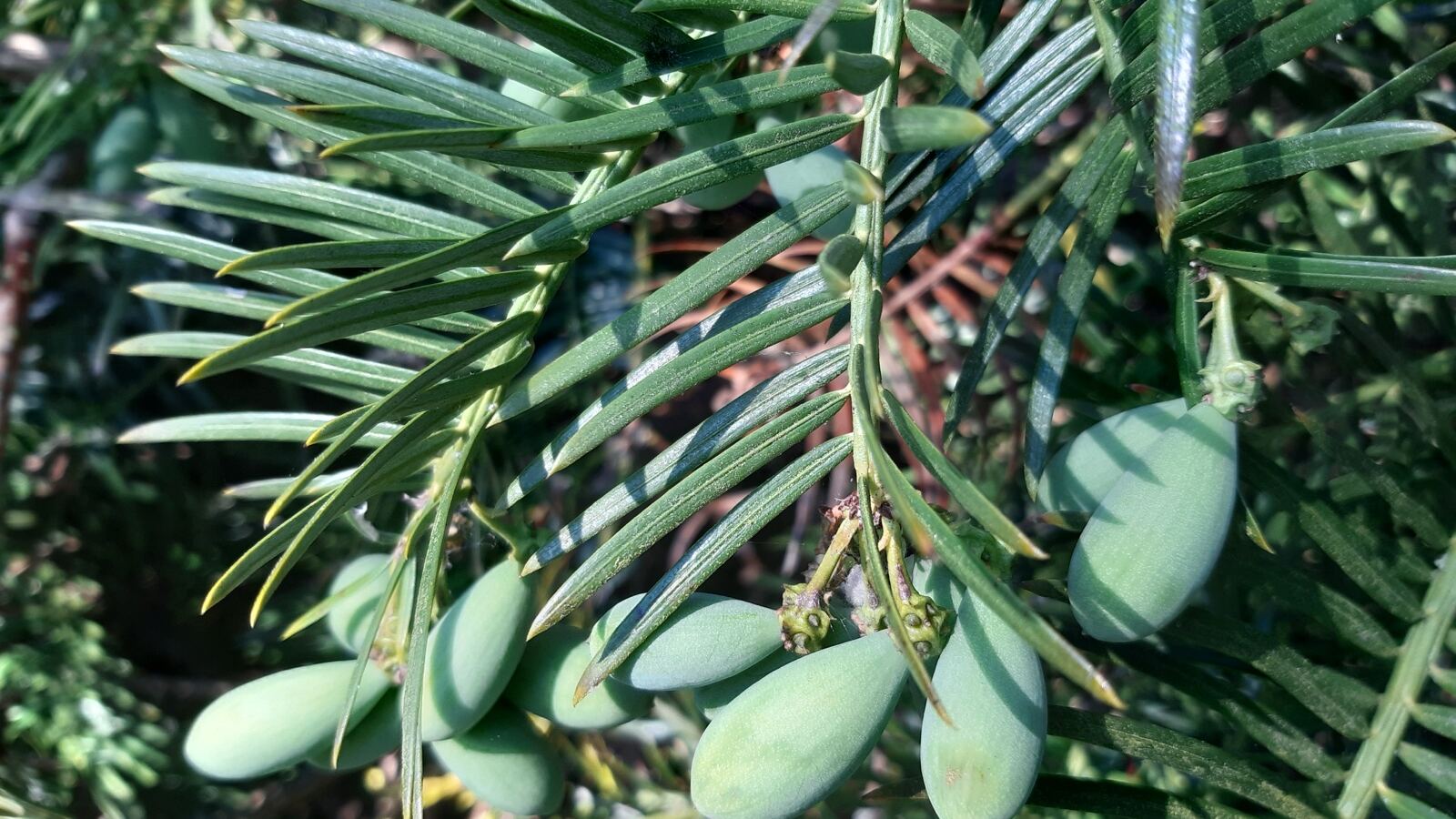
Plum-yews or cow-tail pines (Cephalotaxus) — Asian shrubs and small trees resembling the yew, with dark, glossy, needle-like leaves and fleshy, olive- or plum-like seeds;
Torreyas or nutmeg-yews (Torreya) — including the Japanese and Chinese torreyas and the rare American ones, similarly yew-like, with hard spiny-tipped needles and a fleshy fruit.
Both look much like the yew, and both bear their seeds not in a dry cone but wrapped in a fleshy, fruit-like coat — the same strategy of animal dispersal by fleshy "berry" that the yew, juniper, and podocarps reached, giving up the wind-blown cone. They are prized as tough, elegant, deeply shade-tolerant evergreens for the difficult dry shade beneath other trees, where few conifers will grow.
The cancer drug in the plum-yew
The plum-yews have a distinction that lifts them well above their quiet garden role: they are the natural source of a genuine anti-cancer drug.
Cephalotaxus contains alkaloids — chiefly homoharringtonine — that are active against certain cancers, and homoharringtonine (as the drug omacetaxine) is an approved treatment for chronic myeloid leukaemia, used particularly when the disease has resisted other drugs. This puts the plum-yew alongside its lookalike the yew — whose bark gave the great chemotherapy drug paclitaxel (Taxol) — as one of the conifers that have yielded real, life-saving cancer medicines, a remarkable coincidence of two similar, poisonous, yew-like trees each hiding a different anti-cancer compound. It is a powerful reminder of the medicines still to be found in the chemistry of trees, in the tradition of willow and quinine.
The dying torreya
The torreyas carry a darker story — one of the most acute tree-conservation emergencies in North America.
The Florida torreya (Torreya taxifolia), a small conifer confined to a tiny area of bluffs along the Apalachicola River in Florida, has been devastated by a fungal blight and has collapsed to near-extinction in the wild — the surviving plants mostly stunted, repeatedly killed back, and unable to mature and reproduce. It is often called the most endangered conifer in North America, and possibly one of the most endangered trees in the world. Efforts to save it include growing it in botanic collections and safe sites (a form of insurance planting, like the wollemi pine and franklinia), and it has become a focus of the contentious debate over "assisted migration" — deliberately moving a species to a cooler, safer range to escape a threat it cannot outrun. See tree diseases, seed banking, and climate adaptation. (The seeds of the healthier Asian torreyas, by contrast, are edible and even a minor crop — the "nutmeg-yew" nut of China and Japan.)
Growing them
Both groups want cool, moist, humus-rich, well-drained soil and — their great virtue — tolerate deep shade, so they are among the best conifers for the dry, shaded ground beneath large trees and on shady banks, where they make dense, dark, elegant evergreens. They are hardy, slow-growing, and long-lived, and dislike drought, waterlogging, and hot exposed sites.
Plum-yews (Cephalotaxus) are the easier and more available garden plants, valued for shade tolerance and their neat form; torreyas are grown by collectors and in conservation. Both are grown from the fleshy seed (cleaned of pulp) and from cuttings. As shade-tolerant, distinctive, and — in the plum-yew's case — medicinally important conifers, they deserve to be far better known. See propagation.
See also
- Yew the lookalike that gave the cancer drug Taxol
- Podocarps and Juniper other conifers with fleshy, berry-like seeds
- Willow and Quinine Tree more medicines from trees
- Wollemi Pine and Franklinia other trees saved by insurance planting
- Tree Diseases the blight killing the Florida torreya
- Climate Adaptation the assisted-migration debate around the torreya