What they are
Abies, the true firs — a genus of tall, elegant, evergreen conifers of the cool temperate and mountain forests of the northern hemisphere, including the European silver fir, the balsam and Fraser firs of North America, the noble and grand firs of the west, and the Nordmann fir of the Caucasus.
Firs are often confused with the spruces, and telling them apart is a useful skill, because two clear features separate them.
How to know a fir
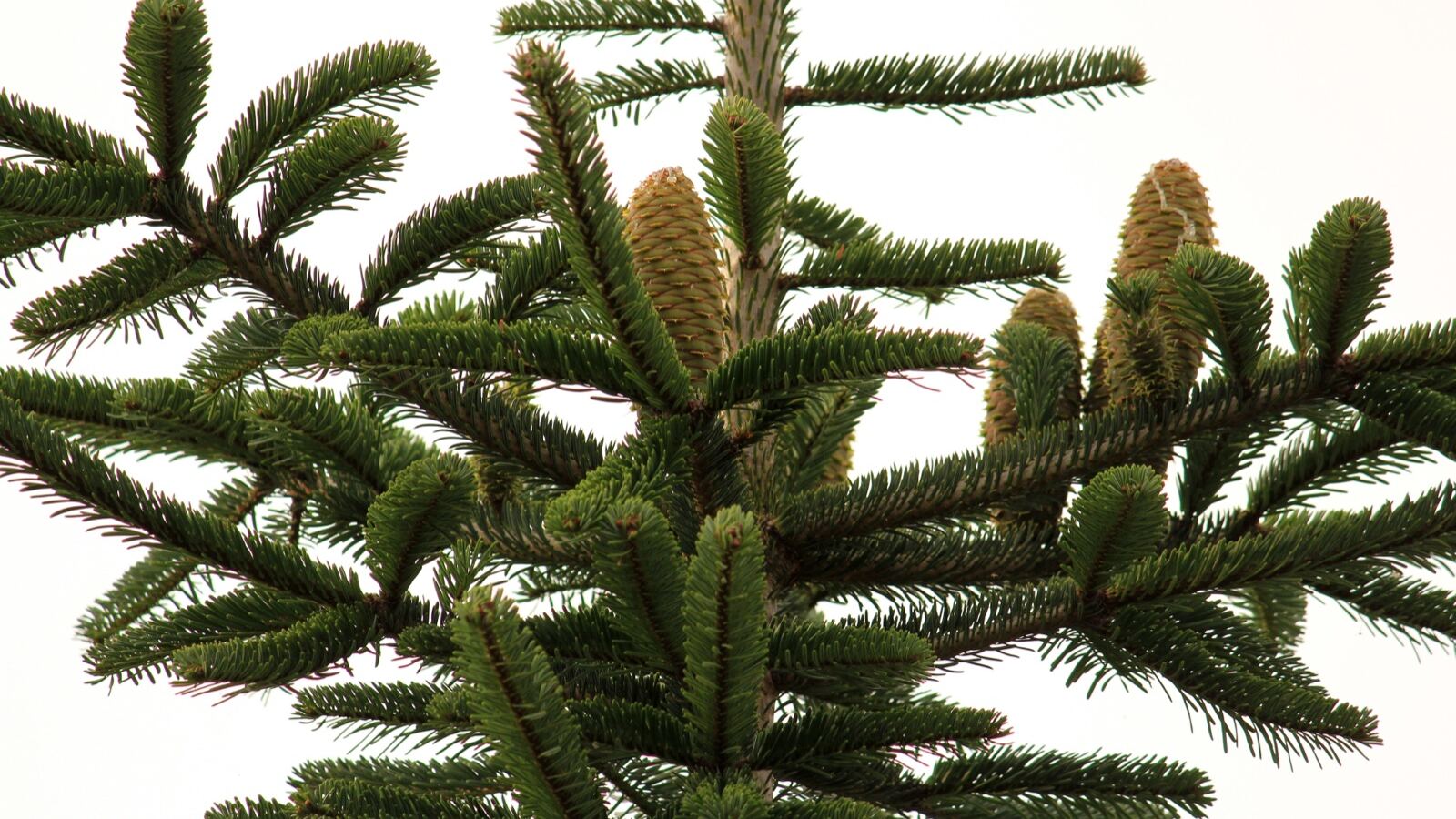
The needles. A fir's needles are flat and soft, usually blunt-tipped, with two pale white or silvery bands (stomatal bands) on the underside, and they are attached to the twig by a little sucker-like base that leaves a smooth, round scar when pulled off — so a fir twig stays smooth. (A spruce, by contrast, has stiff, sharp, four-sided needles on little woody pegs that leave the twig rough and knobbly.) The old mnemonic: flat and friendly needles are fir; sharp, spiky, square needles are spruce.
The cones. This is the surest sign of all. A fir's cones sit upright on the branches, like candles, rather than hanging down — and when ripe they do something no other conifer does: they disintegrate on the tree, the scales and seeds falling away one by one and leaving a bare central spike standing on the branch. You will almost never find a whole fir cone on the ground, because they fall apart before they fall off. A spruce's cones hang down and drop whole. Once you know this, firs and spruces are never confused again.
The Christmas tree
The firs' greatest fame is as the world's favourite Christmas trees, and for good reason: a good fir has the classic conical shape, soft needles that do not prick, a fine fragrance, and — crucially — it holds its needles for weeks after cutting, where a cut spruce drops its needles quickly in a warm room.
Different firs dominate the trade in different regions: the Nordmann fir is the premium European Christmas tree, prized for its excellent needle retention and soft, glossy, non-drop foliage; the Fraser fir and balsam fir are the classic North American choices, loved for their fragrance and shape; and the noble fir gives the finest cut foliage and wreaths. Growing Christmas firs is a major agricultural industry, the trees raised on a rotation of roughly 8 to 12 years, sheared annually into the ideal dense cone. See restoration economics.
Canada balsam and other uses
Beyond Christmas, firs are useful trees. Their soft, light, pale timber is used for construction, pulp, and packing, and — being odourless — for food containers, in the manner of the spruces.
The balsam fir gives a special product: Canada balsam, a clear, sticky resin tapped from blisters in its bark, which dries to a transparent glass-clear film with almost exactly the refractive index of optical glass. This made it the standard cement for gluing lenses in microscopes, telescopes, and other optics, and the classic mounting medium for microscope slides, for well over a century — a piece of high technology that came, quite literally, out of the bark of a fir tree. The resinous blisters of firs also yield fragrant oils used in medicine and perfume, and fir needles make a vitamin-C-rich tea.
Firs are also important forest and treeline trees, forming the dark subalpine and boreal forests up to the cold limit of tree growth alongside the spruces, providing timber, watershed protection, and habitat, and shaping the structural diversity of mountain forests. See woodland management.
Growing them
Firs want cool, moist, humid climates and deep, moist, well-drained, acid-to-neutral soil — they are mountain and northern trees, and most dislike heat, drought, pollution, and dry chalky soils, which limits them in warm or dry lowland gardens (the Spanish and Greek firs are more heat- and drought-tolerant exceptions).
Given the cool, moist conditions they like, they make magnificent, stately, symmetrical specimen trees, and the dwarf and blue-foliaged cultivars (of noble, Korean, and other firs, several with showy upright cones even when small) are prized garden conifers. Slow to moderate, long-lived, and grown from seed. See propagation.
See also
- Silver Fir the great European timber fir
- Spruces the look-alikes, and how to tell them apart
- Conifers the wider cone-bearing group
- Douglas Fir a "fir" that is not a true Abies
- Cedars another group with upright, disintegrating cones
- Structural Diversity firs in the subalpine forest
- Pines
- China Fir