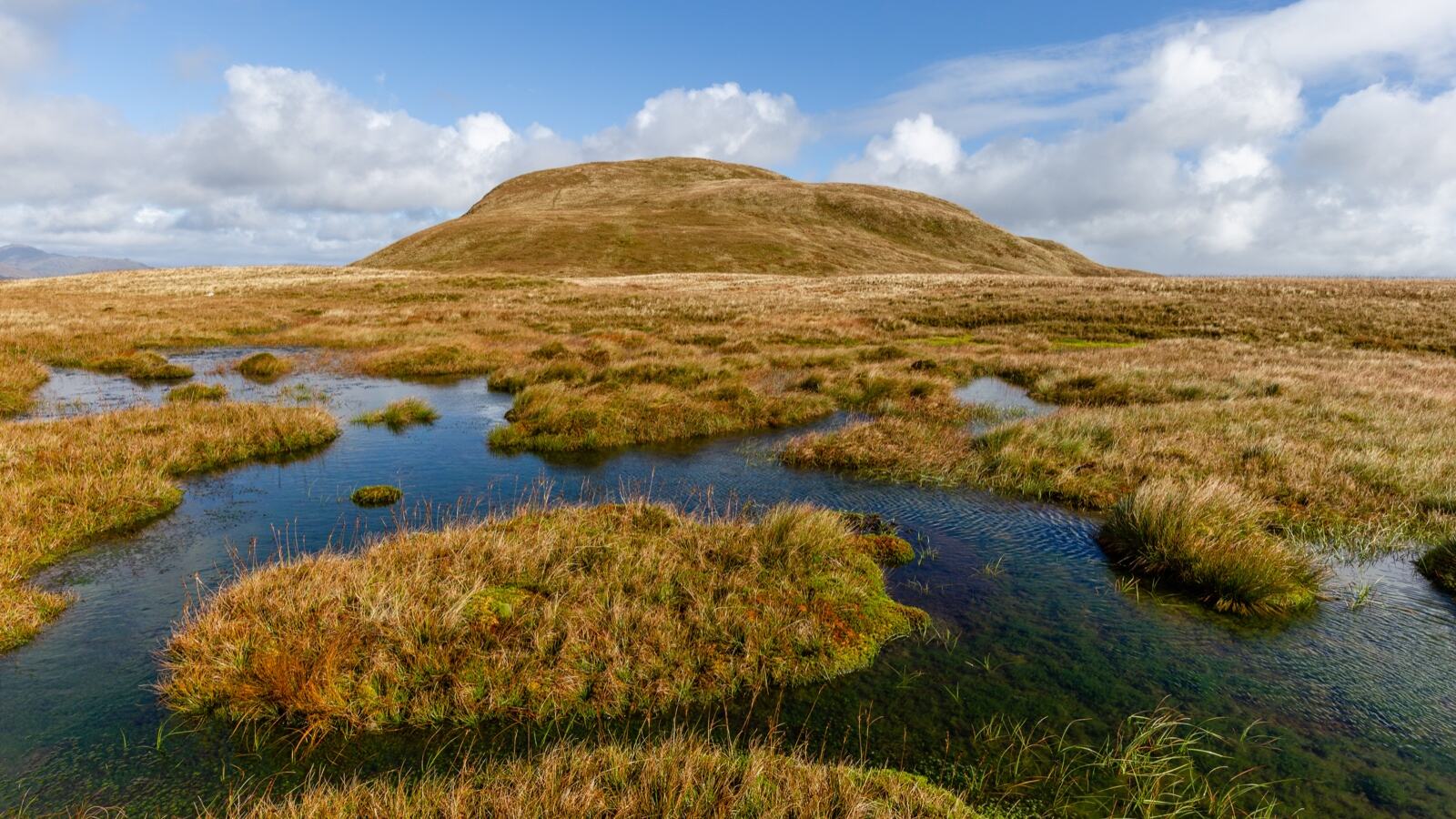
What peat is
Partially decomposed plant material that has accumulated because it could not rot.
In waterlogged ground, oxygen cannot reach the dead material. Decomposition nearly stops, and each year's growth piles onto the last. Peat accumulates at roughly 0.5 to 1 mm per year, which means a metre of peat represents one to two thousand years of accumulation.
The result is the most concentrated carbon store in the terrestrial world. Peatlands cover about 3 percent of the land surface and hold roughly twice the carbon of all the world's forests combined. A hectare of deep peat can hold more carbon than a hectare of tropical rainforest by a wide margin.
That store is stable only while it is wet.
What drainage does
Cut a ditch and the water table drops. Oxygen enters peat that has been anoxic for millennia, and decomposition restarts on the entire accumulated store.
The peat oxidises to carbon dioxide and the surface subsides, typically 1 to 3 cm per year, sometimes far more on cultivated lowland peat. Drained peatlands are among the highest per-hectare emission sources in any land use, and they keep emitting for as long as they stay dry, which is centuries.
Drained peatlands cover a small fraction of global farmland and produce a wholly disproportionate share of land-use emissions. They also burn. A dry peat fire can smoulder underground for months, is nearly impossible to extinguish, and consumes carbon laid down over millennia in a single season.
The subsidence is self-reinforcing: as the surface drops, drainage has to deepen to keep the land workable, which accelerates the loss.
Do not plant trees on peat
This is the point most often got wrong by well-meaning schemes, and it is worth stating bluntly.
Planting trees on deep peat requires drainage, usually by ploughing furrows. The drainage oxidises peat across the whole area. The carbon released from the peat generally exceeds anything the trees will ever accumulate, often by a wide margin, and the loss continues for as long as the drains function.
Large areas of blanket bog in Britain and Ireland were afforested this way in the twentieth century under tax incentives. Restoration now involves removing those trees and blocking the furrows.
The rule is straightforward: on deep peat, rewetting stores far more carbon than planting. Trees belong on mineral soil. If a carbon project proposes planting on peat, the accounting is wrong. See carbon accounting.
Rewetting
The whole of peatland restoration is one objective: get the water table back near the surface and keep it there, stably, year round.
Block the ditches. Dams at intervals along drains, built from peat, plastic piling, timber, or stone depending on scale and access. Peat dams made from local material are cheap and effective where the peat is deep enough to dig. The aim is to raise the water table within about 10 cm of the surface across the drained area.
Reprofile gullies. Eroding gullies drain surrounding peat and export it downstream as particulate carbon. Reshaping the sides to a stable angle and revegetating stops the loss.
Stabilise bare peat. Exposed peat erodes fast and supports nothing. Cover it: geotextile, brash, nurse grass, or lime and seed on acid-damaged sites. Bare peat is the emergency; get it covered before anything else.
Remove the trees. Self-seeded conifers on bog dry it further through interception and transpiration. Removal is standard practice on restoration sites, and it looks like vandalism to anyone who has not read the carbon numbers.
Reintroduce sphagnum. Sphagnum moss is the peat-forming engine. It holds many times its weight in water, acidifies its surroundings, and creates the conditions that prevent decomposition. It is not decoration; it is the mechanism. Reintroduced as plugs, beads, or spread material where the seed source is gone.
Control grazing and burning. Both suppress sphagnum and the dwarf shrubs that shelter it. See rotational grazing and fire management, noting that peat is one system where fire is generally destructive rather than restorative.
How long
Slower than almost any other restoration.
Hydrology responds within a season or two of blocking. Vegetation shifts back toward bog species over 5 to 15 years. The site can move from net source to net sink within a decade or two if rewetting is good.
Actual peat formation resumes at that same 0.5 to 1 mm per year. Rebuilding a metre lost to subsidence takes a millennium or more.
So the case for peatland work is overwhelmingly about stopping ongoing loss, not about accumulating new carbon. Every year a drained bog stays drained is emissions that cannot be recovered on any useful timescale. This is a system where prevention is worth orders of magnitude more than restoration, and where restoration is still very much worth doing.
The other functions
Carbon dominates the discussion, and the rest matters too.
Water. Peatlands sit at the head of catchments and regulate flow. Intact bog slows runoff and reduces flood peaks downstream. Degraded peat sheds water fast and releases dissolved organic carbon that colours drinking water brown, which water companies then pay to remove. Several utilities now fund upland restoration because it is cheaper than treatment.
Habitat. Bogs support a specialised community that exists nowhere else: sundews and other carnivorous plants adapted to extreme nutrient poverty, specialist invertebrates, and internationally important breeding waders.
Archive. Waterlogged anoxic peat preserves pollen, macrofossils, and artefacts in sequence. Peat cores are among the best records available of vegetation and climate history, which makes them a direct input to historical ecology.
Agricultural peat
Lowland peat drained for cropping is the hardest case, because the land is often highly productive and privately farmed.
Full rewetting ends conventional cropping. The middle options are raising water tables partially, which cuts emissions substantially while retaining some production, and paludiculture: farming wet, with crops such as reeds, sphagnum, and typha grown on rewetted ground.
This is where restoration becomes a livelihoods question rather than an ecological one, and it will not move without funding and negotiation. See stakeholder mapping and community engagement.
See also
- Wetland Restoration the broader wet-systems case
- Carbon Accounting why peat inverts the usual maths
- Historical Ecology peat as a pollen archive
- Fire Management where fire is purely destructive
- Monitoring tracking water tables and vegetation change
- Climate Adaptation protecting stores under warming
- Spruces
- Stormwater Management
- Mangrove Restoration
- Barley
- Oil Palm