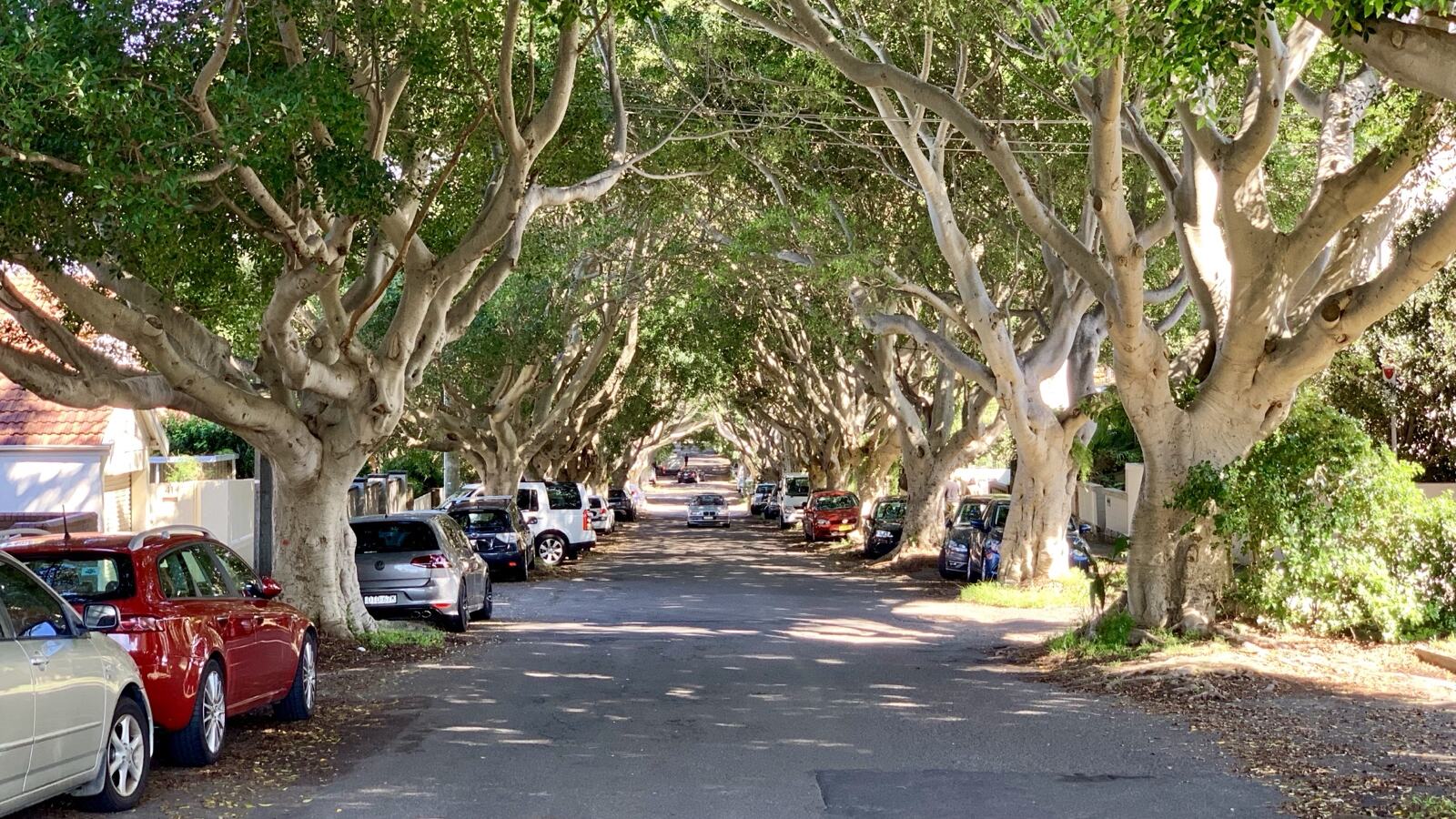
The hardest site there is
A street tree is asked to grow in compacted subsoil under paving, in a pit the size of a bathtub, with reflected heat from every direction, road salt in winter, and its roots severed periodically by utility work.
Average street tree lifespan in dense urban settings is frequently cited at 7 to 15 years, against a natural span of well over a century. Many die before they have returned the cost of planting.
Meanwhile the same trees deliver more measurable benefit per individual than trees anywhere else, because there are people underneath them.
What they actually deliver
Cooling. The urban heat island raises city temperatures several degrees above the surrounding countryside, and much more at surface level. A mature canopy cuts air temperature beneath it by 2 to 8 C and surface temperature of shaded asphalt by 11 to 25 C. This is a health intervention: heat kills, disproportionately the old and the poor, and shade is the cheapest mitigation available. See shade management.
Stormwater. Canopy intercepts rainfall, roots open soil, and the tree transpires. A mature street tree can intercept thousands of litres a year that would otherwise hit the drainage system in the first ten minutes of a storm. Cheaper than upsizing pipes, which is why utilities increasingly fund planting. See permeable surfaces and rain gardens.
Air quality. Real but oversold and more nuanced than usually presented. Trees intercept particulates, and a dense canopy over a narrow street canyon can also trap pollution at street level by preventing dispersal. Open-crowned trees and hedges at kerb level work better than a closed canopy in a canyon.
Health and behaviour. The evidence here is stronger than people expect: measurable associations between canopy cover and reduced cardiovascular and mental health problems, faster recovery in hospitals with views of trees, lower recorded crime on greener streets. Effect sizes are modest and consistent.
Property and retail. Streets with mature canopy carry higher property values and, in repeated studies, higher retail spend.
Habitat. Urban trees support a surprising amount, particularly when mature and when deadwood is tolerated. See pollinator habitat and native bees.
Soil volume is the whole game
If you take one thing from this: the tree pit is almost always too small, and that single factor explains most urban tree failure.
A rough working figure is 0.6 to 1 m³ of usable rooting soil per square metre of eventual canopy. A tree intended to reach a 100 m² crown therefore needs something in the region of 60 m³ of soil. Typical street pits provide 2 to 5 m³.
The tree does not die of this immediately. It grows to the limit of its rooting volume, stalls, declines, and dies in its second decade, which is exactly the observed pattern.
The engineering answers all aim at the same thing, giving roots access to soil under the pavement without the pavement sinking:
Structural soil. A load-bearing skeleton of angular stone with soil in the voids. Compacts to bear pavement while leaving root space. Lower soil volume per cubic metre than the alternatives.
Soil cells or crates. Modular plastic frames that carry the paving load while the space inside holds uncompacted soil. More expensive, much better rooting volume, now the standard for serious schemes.
Connected trenches. Linking pits along a street so trees share a continuous soil volume. Often the cheapest large gain available.
Suspended pavement. Paving carried on piers over open soil.
Plus the simplest option: make the planting bed bigger, and put more than one tree in it. A shared verge outperforms individual pits.
The related problem is compaction. Construction traffic compacts soil beyond what roots can penetrate, and it happens before the tree arrives. See decompaction.
Water
Urban trees suffer both drought and waterlogging, often on the same site.
The pit is surrounded by impermeable surface, so almost nothing infiltrates, while the sealed surround can also trap water in a bathtub with no drainage.
Design for both: check drainage before planting, and route runoff into the pit deliberately rather than into the gutter. Kerb inlets directing street runoff into tree pits and structural soil turn a liability into irrigation, which is the core idea of urban rain gardens.
Then commit to watering for the first three to five years. Establishment watering is where municipal programmes fail, because planting is a capital budget with a ribbon-cutting and watering is a revenue budget with neither. See tree planting and deep watering.
Species choice, and the 10-20-30 rule
Urban tree populations have repeatedly been devastated by single pathogens because they were planted as monocultures. Dutch elm disease removed the elm-lined street from entire countries; emerald ash borer is doing the same to ash in North America.
The widely used guideline: no more than 10 percent of the urban forest from one species, 20 percent from one genus, 30 percent from one family. Nothing magic about the numbers, but the principle is sound and repeatedly vindicated. See tree diseases and structural diversity.
Then select for the site honestly:
Tolerance of compaction, drought, reflected heat, and salt. Appropriate mature size for the space, because a tree that has to be topped every five years is a permanent cost and an ugly one. Crown form suited to the street. Low limb-drop and manageable fruit over pavements. And increasingly, tolerance of the climate expected in fifty years rather than today's, which is where climate adaptation and provenance choice come in.
Natives support more insect life and therefore more birds, and should be the backbone. But rigid nativism fails in genuinely artificial urban conditions, where some non-natives survive what natives cannot. Mix, and keep the diversity limits.
Getting it to maturity
Plant well. Correct depth, flare exposed, no circling roots. The urban pit magnifies every planting error.
Formative prune early. Cheap from the ground in years 2 to 8, expensive from a platform later. Removing a bad fork at year three prevents a limb failure at year forty. See pruning basics.
Protect the root zone. Most urban tree damage is trenching for utilities. Root protection areas, and where excavation is unavoidable, air-spading or hand-digging to preserve roots.
Do not over-tidy. A mature tree with some deadwood is a habitat. Removing every dead limb reflexively costs species and money. See dead wood habitat.
Count them. Inventory with species, size, condition, and location. You cannot manage a population you have not counted, and canopy cover targets mean nothing without a baseline. See monitoring.
Miyawaki in the city
Dense mixed native planting has become popular for small urban plots: a few hundred square metres, deeply prepared soil, 3 to 5 stems per square metre of mixed native species, heavily mulched, weeded for three years, then left.
The results are genuine, with fast canopy closure and high structural diversity in a small area, though growth claims are often exaggerated and the method needs real soil preparation to work. It suits leftover urban land that would otherwise be mown grass. See the Miyawaki method and Akira Miyawaki.
The equity dimension
Canopy cover in almost every studied city correlates with income. Wealthy districts have mature trees and shade; poorer districts have asphalt and higher heat-related mortality.
This is a distributional outcome of decades of investment, and it is measurable with a satellite image. Planting programmes that respond to requests reproduce it, because requests come from organised affluent neighbourhoods.
Programmes that target canopy deficit instead do better, and they need to be built with residents rather than delivered to them, since trees planted without local consent get vandalised or unwatered. See community engagement and stakeholder mapping.
See also
- Tree Planting the fundamentals, magnified by the site
- Tree Diseases why the 10-20-30 rule exists
- Rain Gardens routing street runoff to the roots
- Shade Management canopy as heat mitigation
- The Miyawaki Method dense planting on small urban plots
- Decompaction the condition under most pavements
- Horse Chestnut
- Plane Trees
- Stormwater Management
- Hackberry
- Ginkgo
- Hop-Hornbeam
- Persian Ironwood
- Honey Locust
- Jacaranda and Flame Tree
- Golden Rain Tree
- Bauhinia
- Pepper Tree
- Pagoda Tree
- Tree Lilac