What it is
Parrotia persica, from the Hyrcanian forests along the southern Caspian coast of Iran and Azerbaijan — an ancient relict forest that is one of the oldest continuously wooded landscapes in the world, holding many species left behind elsewhere by the ice ages.
It is in the witch-hazel family, Hamamelidaceae, close to witch hazel itself and sweetgum, and it shares the family's early flowering and fine autumn colour.
A small, wide-spreading, often multi-stemmed tree, slow and long-lived, grown almost entirely for two features: its autumn colour and its bark.
Autumn colour
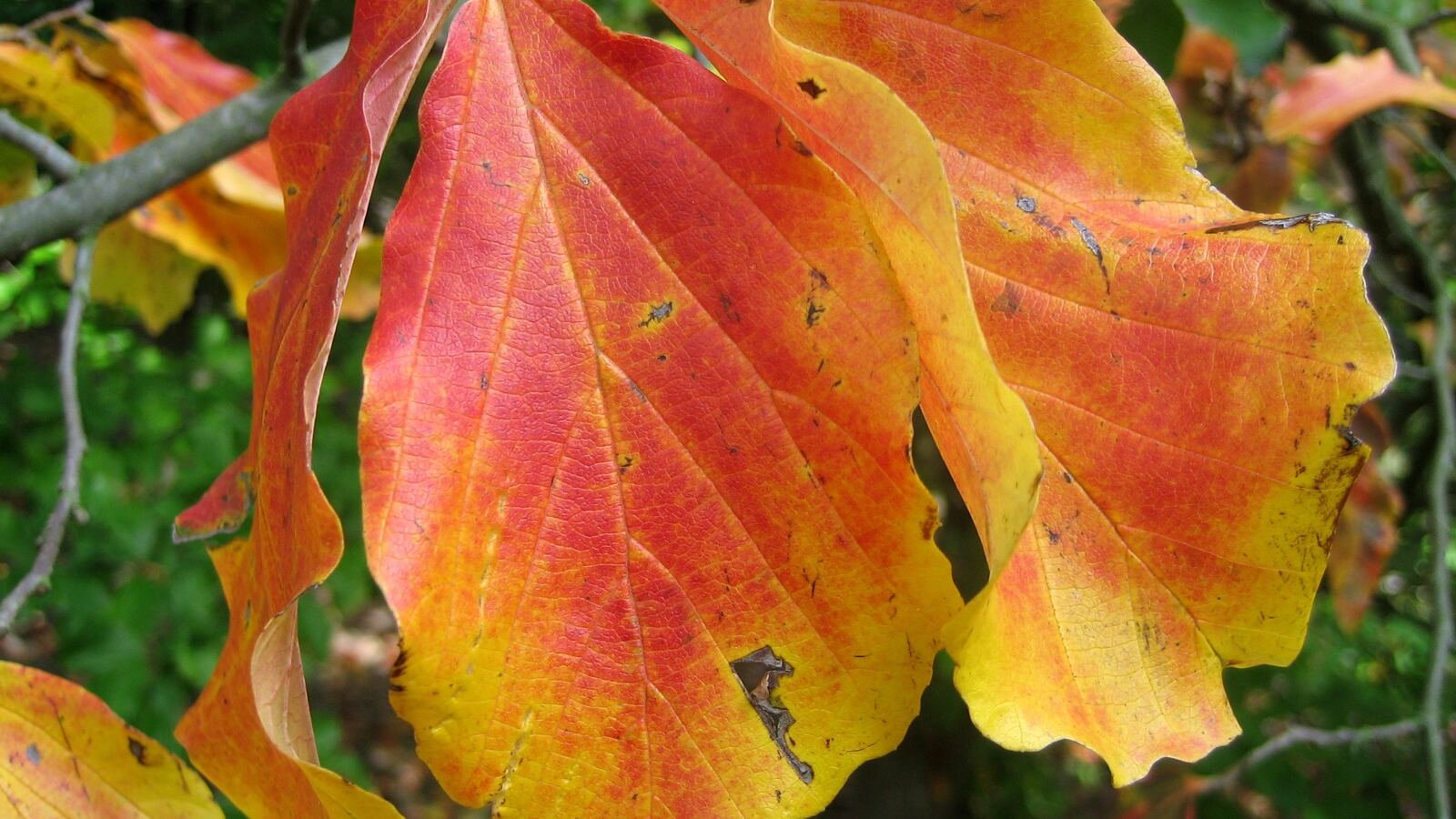
Persian ironwood gives some of the most spectacular and reliable autumn colour of any temperate tree, and it is grown for this above all.
The leaves turn over a long period, and a single tree carries yellow, orange, crimson, and deep burgundy at once, often starting at the leaf margins and working inward, so individual leaves are multi-coloured. The display is long, intense, and dependable, rivalling the maples, sweetgum, and tupelo.
It also flowers very early, in late winter on bare stems, with small clusters of red stamens — petalless, like its relative witch hazel — a quiet but genuine winter feature and an early nectar source. See pollinator habitat.
Camouflage bark
The second reason to grow it, and the feature that gives an old specimen year-round interest.
As Persian ironwood matures, its smooth grey bark begins to flake away in irregular patches, revealing paler cream, pink, and green underbark, and building up a mottled, patchwork, camouflage effect similar to a plane tree or a lacebark pine. On an old multi-stemmed tree the bark is a feature in every season, and especially striking in winter when the canopy is bare.
Ironwood
The name, like hop-hornbeam and the many other ironwoods, refers to the timber, which is exceptionally hard, dense, and heavy — hard enough to sink, and difficult to work. It has been used locally for tool handles and durable small work, but the tree is grown as an ornamental rather than for timber, and it is rarely large enough for useful wood.
Growing it
Genuinely easy and adaptable, which adds to its appeal.
Tolerates a wide range of soils, acid to alkaline — unusually for a Hamamelis relative, it takes chalk and lime well — and it is tolerant of drought once established, heat, cold, wind, and urban conditions. It dislikes only waterlogging and deep shade. That toughness makes it a good street and amenity tree as well as a garden specimen. See urban forestry.
Full sun for the best autumn colour, though it takes light shade.
Slow-growing and long-lived, usually reaching 6 to 10 m, wide-spreading and often broader than tall, frequently multi-stemmed with low branching that can be raised to show the bark.
Largely free of pests and diseases — another point in its favour.
Grows from seed, which is doubly dormant and slow, and from cuttings and layering. Upright and weeping cultivars exist for different situations. See propagation.
Persian ironwood is one of the best small trees available for a garden or a street: tough, adaptable, trouble-free, with superb long-lasting autumn colour, striking mature bark, and quiet early flowers — three or four seasons of interest from an easy, undemanding tree.
See also
- Witch Hazel the close family relative and its winter flowers
- Sweetgum another member of the family
- Maples the companions for autumn colour
- Plane Trees the comparable flaking patchwork bark
- Urban Forestry a tough, trouble-free amenity tree
- Hop-Hornbeam another of the ironwoods