What they are
Platanus, a small genus with a confusing naming history.
Oriental plane, P. orientalis, from the eastern Mediterranean and western Asia.
American sycamore, P. occidentalis, from eastern North America — and note that this is not the tree called sycamore in Britain, which is a maple, Acer pseudoplatanus. See maples. The same word means two unrelated trees on either side of the Atlantic, which causes endless confusion.
London plane, P. × acerifolia, a hybrid of the two, which arose in the seventeenth century — probably in Spain or southern France, despite the name — and became the defining street tree of temperate cities worldwide.
All have large palmate leaves, spherical bristly seed heads hanging on stalks, and the distinctive flaking bark.
Bark that sheds the city
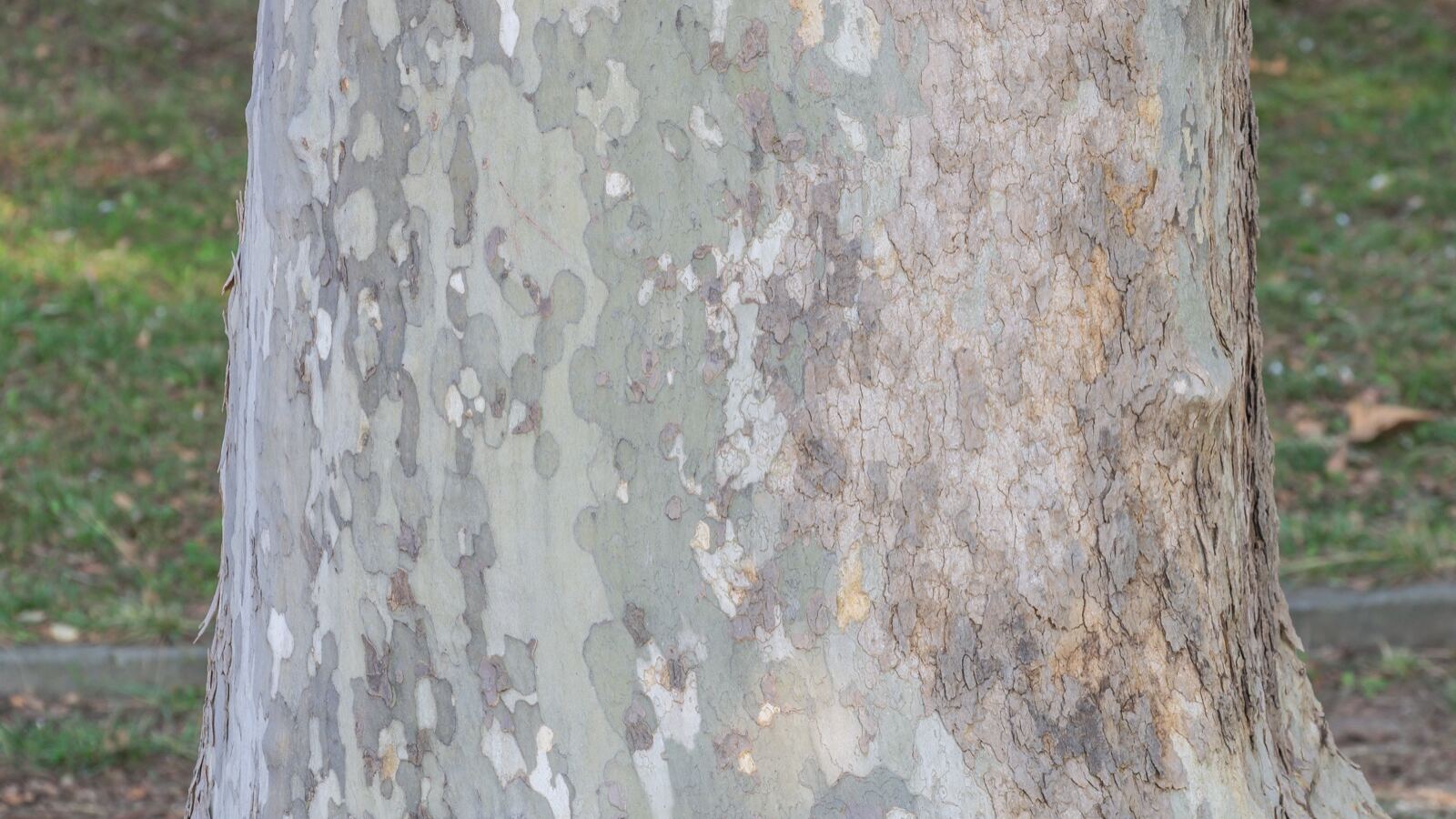
London plane's success in polluted nineteenth and twentieth century cities is usually attributed to one mechanism: it exfoliates its bark in irregular plates, leaving the mottled cream, olive, and grey camouflage pattern that identifies it instantly.
Most trees accumulate soot, tar, and particulates on the bark surface, which blocks the lenticels through which the trunk exchanges gases. Plane sheds the contaminated layer and exposes clean tissue beneath.
Combined with genuine tolerance of compacted soil, root restriction, drought, heat, and hard pruning, that made it the tree that survived where others died — and it is why the plane avenues of London, Paris, and New York exist.
The bark shedding is not unique to plane, but the scale and regularity of it are unusual, and it is a good visible example of a physiological adaptation being exploited for an entirely unforeseen purpose.
Pollarding
Plane tolerates extremely hard pruning, and city planes are routinely pollarded — cut back to the same knuckles every few years, producing the stark clubbed silhouettes of French and Italian town squares and the dense summer canopy that follows.
That tolerance is what allows a very large tree to be kept at a size a street can accommodate, indefinitely.
The commitment is permanent. Once pollarding begins it must continue on cycle — the heavy regrowth from a knuckle is attached to the outside of a mass of decayed wood and becomes unstable if allowed to grow large. Abandoned pollards are a genuine safety problem, and the same issue applies to the ancient hornbeam pollards of Epping Forest. See coppice rotation and tool care and safety.
The problems
Anthracnose, Apiognomonia veneta. A fungal disease causing shoot dieback, leaf blotching, and premature leaf drop, worst after cool wet springs. Rarely kills mature trees but disfigures them and weakens repeatedly infected ones. American sycamore is more susceptible than London plane, which was one of the hybrid's advantages.
Massaria disease, which causes rapid decay on the upper surface of large lateral branches. It is a serious safety issue in cities because branches fail suddenly with little external warning, and it has increased with hot dry summers. It has changed inspection practice for urban planes across Europe.
Canker stain, Ceratocystis platani, is the lethal one. It kills planes outright, spreads through root grafts between adjacent trees and on contaminated pruning tools, and has devastated plane avenues in southern France and Italy — including large stretches along the Canal du Midi, where thousands of trees have been felled. Strict tool sterilisation is mandatory in affected regions. See tree diseases and tool care and safety.
The hairs. Plane seed heads and young leaves shed fine bristly hairs that are a genuine respiratory and eye irritant, and a common complaint in cities where planes are dense.
Monoculture. Many cities planted plane almost exclusively, which is exactly the vulnerability described in urban forestry — and canker stain is the disease making that argument concrete.
American sycamore
In its own range, P. occidentalis is a floodplain and riverbank giant — the largest deciduous tree in eastern North America by trunk diameter, with old specimens over 3 m across.
The white upper bark makes it conspicuous along rivers from a distance.
Mature sycamores hollow out readily, and the resulting cavities are major habitat — historically used by chimney swifts before chimneys existed, and still important for bats, owls, and denning mammals. See dead wood habitat and bats.
It is a natural component of riparian buffers in its range, stabilising banks and shading water.
The timber is interlocked-grained and hard to split, which made it the traditional wood for butchers' blocks — the same property that recommends elm.
Growing them
Tolerant of almost everything urban: compaction, drought, heat, pollution, root restriction, and hard pruning.
Wants deep moist soil to do well, and in the wild both parents are floodplain trees.
Very large. 30 to 45 m with a broad crown, and fast. Not a garden tree in any ordinary sense — the planted street specimens are only manageable because they are pollarded.
Roots are vigorous and shallow-spreading, and plane is a frequent cause of lifted paving and drain problems where planted too close to structures.
Hardy across most temperate regions, though young trees can be frost-damaged.
Easy to propagate from hardwood cuttings, which is how London plane has been clonally distributed — and that clonal narrowness is part of why canker stain moves through avenues so effectively. See structural diversity.
If planting for a city today, plane is still a strong performer, and it should be a component of a diverse palette rather than the whole of it.
See also
- Urban Forestry soil volume, diversity limits, and street trees
- Maples the tree Britain calls sycamore
- Tree Diseases canker stain and Massaria
- Riparian Buffers sycamore on riverbanks
- Coppice Rotation pollarding as a permanent commitment
- Dead Wood Habitat hollow sycamores as cavity habitat
- Persian Ironwood
- Zelkova
- Stewartia