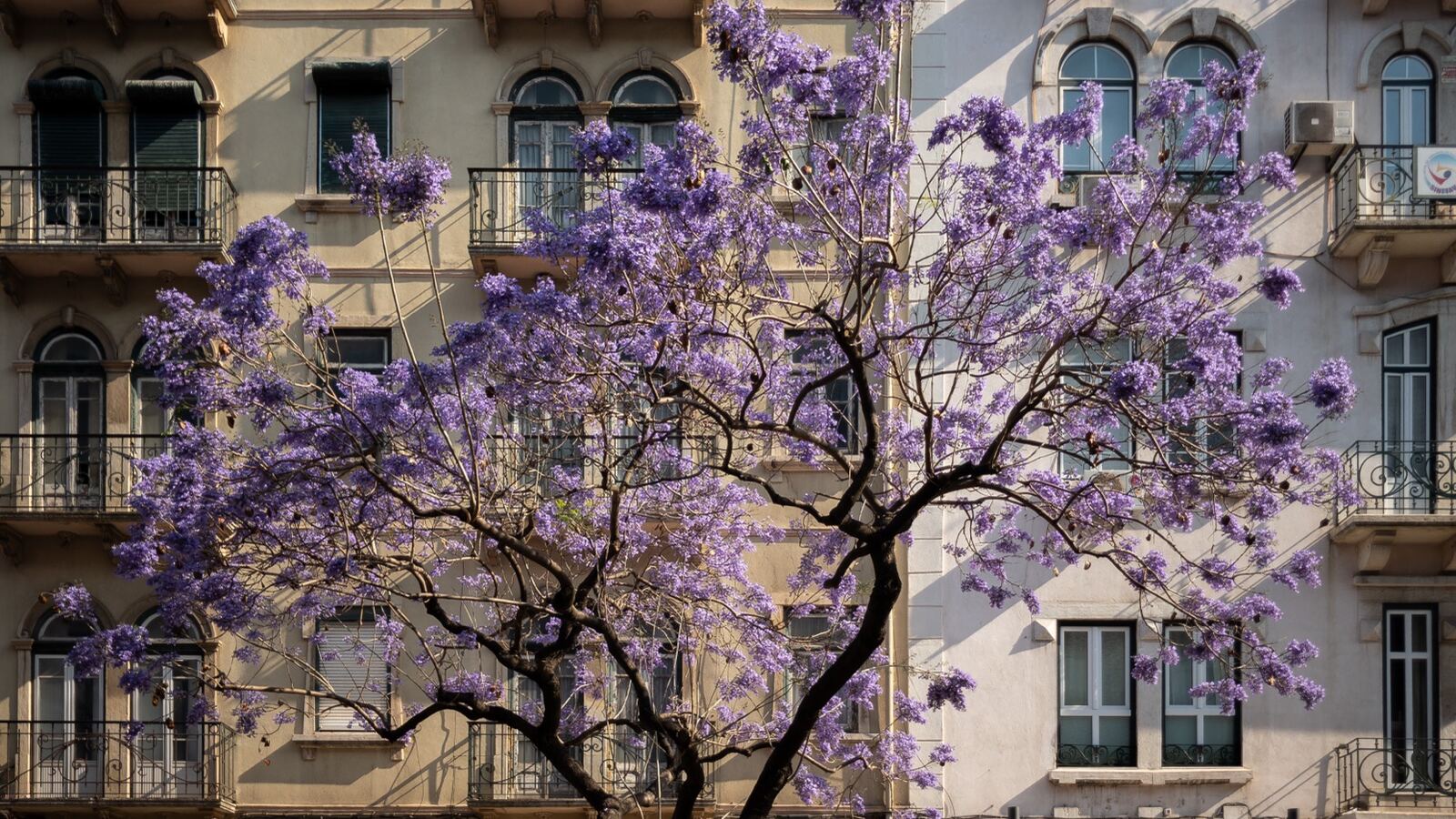
Two trees that paint cities
Some ornamental trees are grown one at a time; these two are grown by the avenue, because their value is a whole city changing colour at once. When they bloom, they transform entire streetscapes.
Jacaranda, Jacaranda mimosifolia, from South America: ferny, silk-tree-like foliage and great panicles of trumpet-shaped blue-purple flowers.
Flame tree or royal poinciana, Delonix regia, from Madagascar: a broad umbrella crown that erupts in flat masses of brilliant scarlet-and-orange bloom, one of the most vivid flowering trees in the world.
Both are legumes (the flame tree obviously so, with big pods), both tropical to subtropical, and both are planted across the warm world for the same reason: sheer spectacle.
The jacaranda cities
The jacaranda has been embraced so completely by certain cities that it has become part of their identity. Pretoria in South Africa is "the Jacaranda City"; Grafton in Australia holds a jacaranda festival; and Los Angeles, Lisbon, Buenos Aires, Harare, and many others turn lilac-blue for weeks when the trees flower, often before the leaves, so the whole crown is solid colour. In several of these places the jacaranda bloom is folklore — in South African university towns it is said that if the jacaranda flowers before you have started studying, you will fail your exams.
The trumpet flowers are rich in nectar and worked by bees and, in their native range, by hummingbirds, so the trees add real pollinator value to the display. The fallen flowers carpet the ground in blue, and the woody seed capsules ("castanets") are collected as curios.
The royal poinciana
The flame tree is, if anything, even more dramatic — a spreading, flat-topped tree that in the tropical dry season covers itself in a sheet of red-orange bloom so dense the foliage disappears. It is a signature tree of the tropics from the Caribbean to India to northern Australia, planted for shade and for that unmatched flowering, and it is the "gulmohar" of South Asia and the "flamboyant" of the French tropics. Its broad umbrella of ferny bipinnate foliage makes excellent shade the rest of the year, and it is a classic town, park, and avenue tree throughout the frost-free tropics.
The invasive footnote
The recurring caution applies. Both trees, so freely planted and so free-seeding, have jumped the garden fence in places.
Jacaranda is listed as an invasive species in parts of South Africa and Australia, where it seeds into watercourses and bushland and out-competes native vegetation — in South Africa it is a declared invader, and planting new ones is restricted, an awkward status for a tree a city is named after. The flame tree, likewise, is invasive on some tropical islands and in parts of Australia. It is the same story as so many beautiful, tough, prolific ornamentals: gorgeous in the street, a problem in the bush. The lesson is to enjoy them where they are managed and to be wary of planting them near natural areas.
Growing them
Both are tropical to warm-subtropical and frost-tender — jacaranda takes a few degrees of frost when established and is grown in the warmer temperate zones (it flowers in coastal California and the Mediterranean); the flame tree is strictly frost-free.
Site. Full sun and space — both make large, wide, spreading trees that need room and are unsuited to small gardens or narrow streets, though they are constantly planted in both. The flame tree's greedy surface roots lift pavement and compete fiercely, another reason to give it room.
Soil. Well-drained soil; both tolerate poor ground and drought once established, which is part of their toughness as street trees. See urban forestry.
Propagation. From seed, which germinates readily (and is part of the invasive problem), and from cuttings; named jacaranda forms are grafted. Slow to reach flowering size — several years — so patience is needed. See propagation.
For a large frost-free garden, park, or avenue, few trees give more drama for less care — just site them well away from anything they might invade.
See also
- Silk Tree the ferny-leaved legume jacaranda resembles
- Catalpa another trumpet-flowered ornamental
- Urban Forestry flowering trees as street and avenue plantings
- Pollinator Habitat the nectar the flowers provide
- Invasive Species jacaranda and flame tree beyond the garden
- Mesquite another pod-bearing dry-climate legume
- Sausage Tree
- Ipê and Pau d'Arco
- Kurrajong and Bottle Trees
- Frangipani
- Flame of the Forest