What it is
Koelreuteria paniculata, the golden rain tree or pride of India, a small-to-medium deciduous tree of China and Korea, widely planted across the temperate world as a tough, pretty street and garden tree.
(It should not be confused with the "golden chain tree," which is laburnum — a common mix-up of similar names for two different yellow-flowered trees.) It belongs to the soapberry family, Sapindaceae, which makes it a relative of the maples, the lychee, and the horse chestnut.
Gold in summer, lanterns in autumn
The golden rain tree earns its keep with two distinct displays.
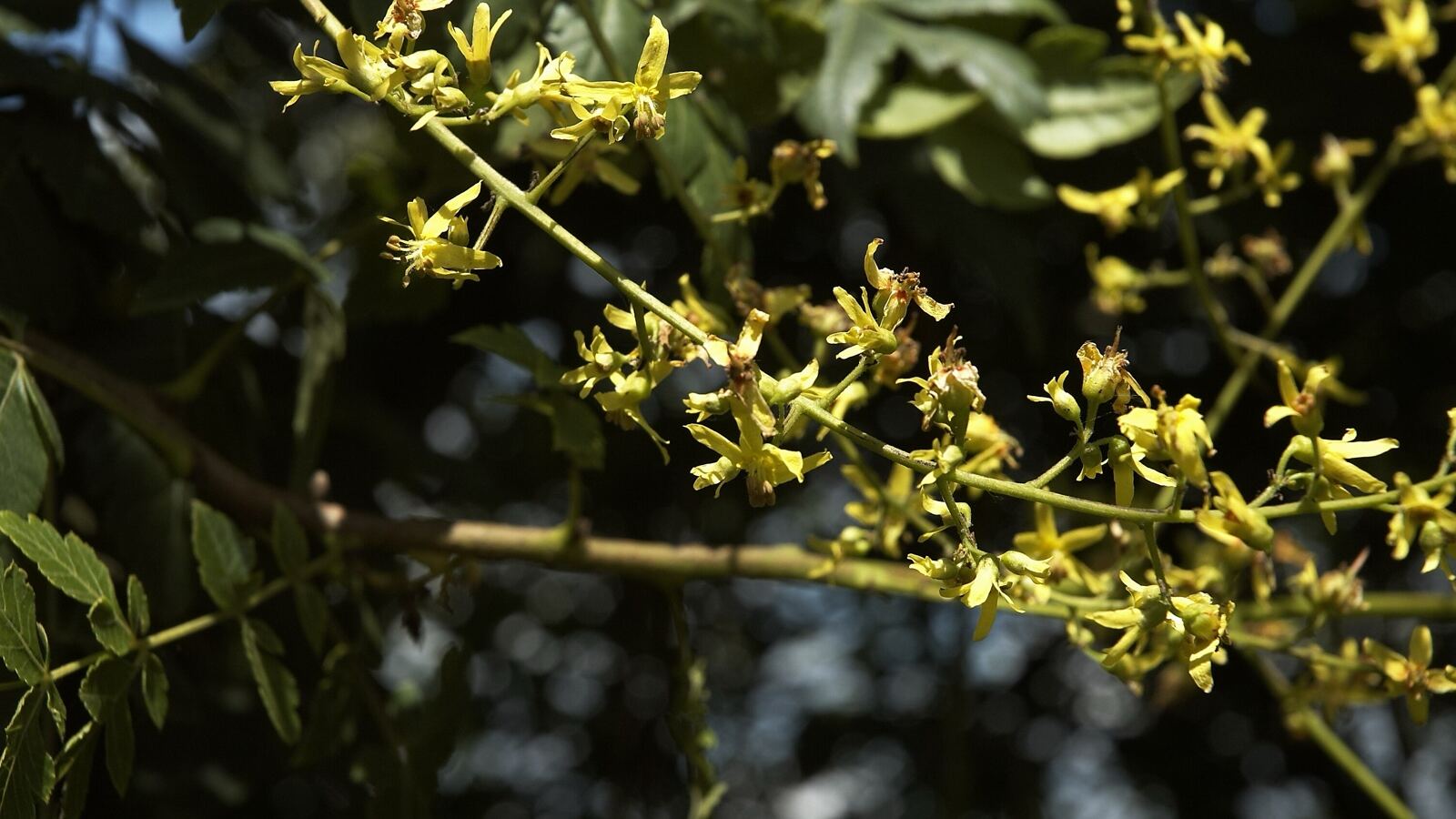
Summer flowers. In mid-to-late summer — a season when almost no other tree is flowering — it produces large, upright, branching panicles of small bright yellow flowers, held above the foliage so the whole crown seems dusted with gold, and dropping to lay a yellow carpet beneath (the "golden rain"). Coming when it does, this is a genuinely valuable late-season nectar and pollen source, and the tree hums with bees when in bloom — one of the better trees for feeding pollinators in the late-summer gap. See native bees.
Autumn lanterns. The flowers give way to the tree's other charm: inflated, papery, three-sided seed capsules that look like little Chinese lanterns, ripening through green to gold to a warm pink or bronze and hanging in showy clusters well into autumn, when the foliage also turns yellow. The lanterns are decorative on the tree and in dried arrangements, each holding hard black seeds once used as beads.
Tough for hard places
The golden rain tree's popularity as a street and city tree rests on its toughness. It tolerates drought, heat, wind, cold, pollution, poor and compacted soil, and a range of pH from acid to alkaline — close to the full list of urban stresses — and it stays a manageable size with a broad, rounded, shade-giving crown, so it fits the constrained conditions of a street where larger trees will not. It is fast when young, then moderate, and comes into flower at a young age. It sits alongside the other tough, adaptable urban species like the hackberry and honey locust as a diversifier of the city canopy. See urban forestry.
The invasive side
The usual caution attaches to a tough, free-seeding, adaptable tree. The golden rain tree — and especially its relative the flamegold (Koelreuteria elegans / bipinnata) — seeds prolifically, and the seedlings come up readily, so it has become an invasive species in parts of the southeastern United States and elsewhere, escaping gardens to colonise roadsides, fields, and disturbed ground. It is a moderate rather than catastrophic invader, but enough that it is discouraged in some regions, and the recurring lesson applies: the very heavy seeding that fills the pretty lanterns also fills the surrounding land with seedlings. Check local status, and deadhead or choose less fertile forms where it is a concern.
Growing it
Full sun and almost any well-drained soil; extremely tough and adaptable once established, and drought-tolerant.
A good small tree for a garden or street, 8 to 12 m, with an attractive rounded form. It flowers young and needs little care beyond formative pruning to build a strong framework (like the yellowwood, it can make weak forks if left untrained). Largely free of serious pests and diseases. Grown very easily from seed (which is part of the invasive issue — collect or deadhead the capsules where escape is a worry) and from root cuttings. See propagation.
See also
- Maples the soapberry-family relatives
- Lychee and Longan fellow Sapindaceae, on the fruiting side
- Urban Forestry golden rain tree as a tough street tree
- Invasive Species its free-seeding habit abroad
- Pollinator Habitat the valuable late-summer nectar
- Laburnum the "golden chain" tree it is often confused with
- Soap Nut
- Yellowhorn