What it is
Gleditsia triacanthos, the honey locust, a legume of the central United States and one of the more heavily armed trees of the temperate world.
It shares the "locust" name with the unrelated black locust, and the two are often confused, but they are different genera and differ in almost every important respect — thorns, pods, flowers, and, as it turns out, nitrogen.
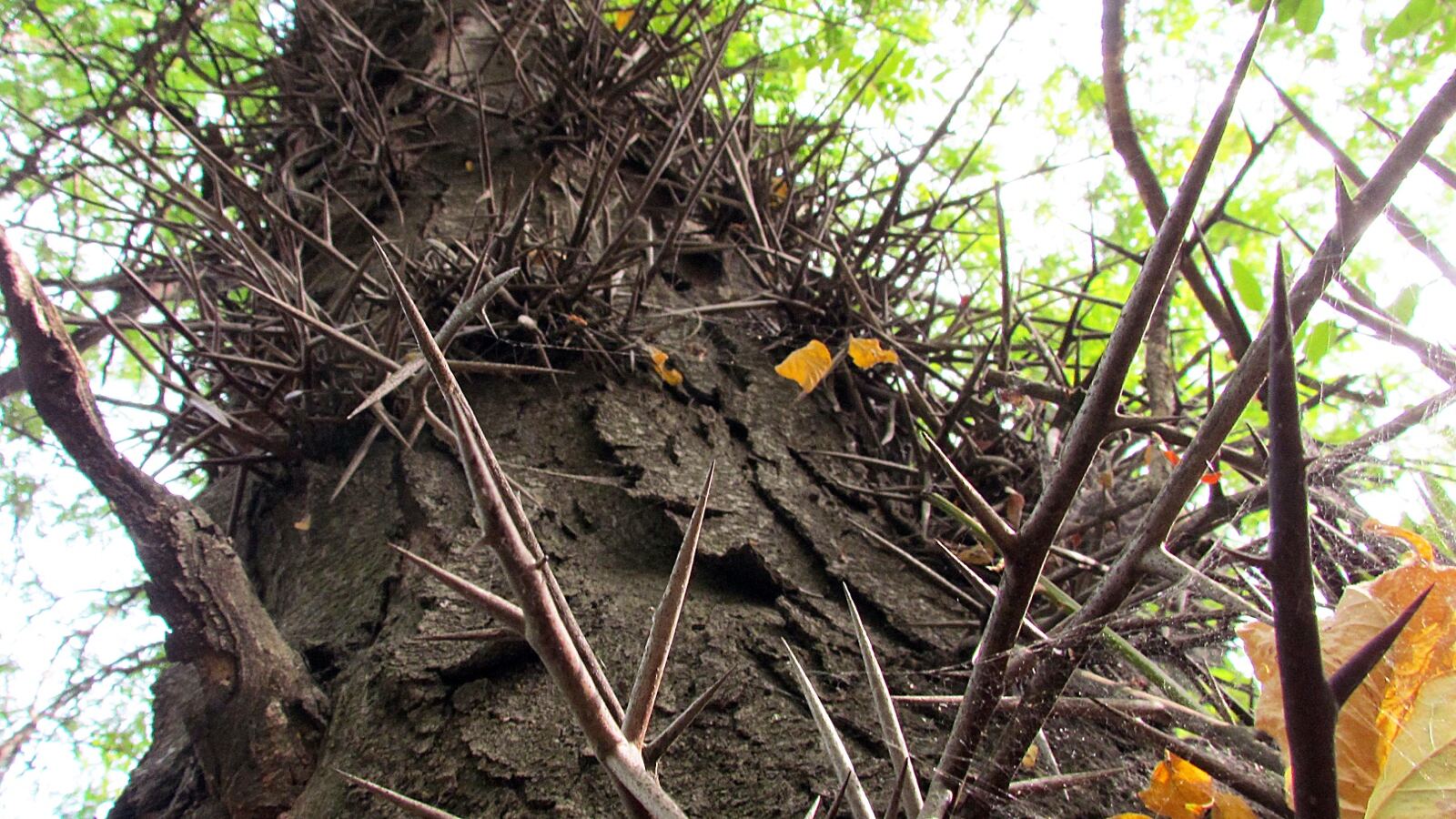
The wild tree is unmistakable: the trunk and lower branches are armoured with large, branched, needle-sharp thorns up to 20 cm long, growing in clusters straight out of the bark, tough enough to puncture a tractor tyre. The delicate, ferny, doubly-compound leaves give a light dappled shade quite unlike the armament below.
The pods and the megafauna ghost
Honey locust produces long, flat, twisted, leathery pods up to 40 cm, filled with hard seeds set in a sweet, sticky pulp — the "honey" of the name. The pulp is genuinely sugary, was eaten and brewed by Native Americans, and is readily taken by livestock and wildlife.
And here is the puzzle: the pods are large, sugary, and full of hard seeds, but in the modern American landscape almost nothing disperses them. They mostly fall and rot beneath the parent tree.
The widely-argued explanation is that honey locust is an evolutionary anachronism — its fruit evolved to be eaten by the large mammals of Pleistocene North America (mastodons, giant ground sloths, native horses and camels), which would swallow the pods, digest the pulp, and pass the scarified seeds far away. Those animals went extinct around 13,000 years ago, and the tree is left with fruit adapted to disperser that no longer exists. The huge thorns, on this reading, were defence against those same browsing giants. The same argument is made for osage orange and the kentucky coffeetree, which grow in the same region and have the same orphaned-fruit problem, and for the pawpaw. Cattle now do, imperfectly, the job the megafauna once did.
The nitrogen surprise
Honey locust is a legume, and almost everyone assumes it fixes nitrogen — it is repeatedly listed as a nitrogen fixer in permaculture and agroforestry writing.
It does not. Honey locust forms no root nodules and hosts no nitrogen-fixing bacteria, one of the exceptions among the legume family. This matters because it is often planted specifically as a fertility tree in alley cropping and food forest systems on the assumption that it is enriching the soil, which it is not. Its real merits are the light shade, the fodder pods, and the toughness. For actual fixation, use the genuine fixers set out in nitrogen fixers and nitrogen-fixing food trees.
Silvopasture and fodder
The pods are the reason honey locust keeps being promoted for silvopasture.
They are high in sugar and reasonably nutritious, drop in autumn when other feed is short, and are eaten readily by cattle, sheep, pigs, and deer — a tree crop that feeds livestock with no harvesting, in the tradition of the carob and the acorn-fattened pig. Selected heavy-cropping, thornless cultivars were trialled extensively for exactly this, and the light shade the ferny canopy casts lets pasture grow beneath, which is precisely what silvopasture needs. The concept remains sound and underused.
The urban tree
Most honey locusts planted today are thornless, podless cultivars (G. t. f. inermis — Sunburst, Shademaster, Skyline, and others), selected to remove the two things that make the wild tree difficult.
These have become extremely popular street and city trees, because honey locust tolerates drought, heat, salt, compaction, pollution, and poor soil, and the small leaflets cast light shade and need no raking — they blow away. It is a standard tough urban species alongside hackberry and plane. See urban forestry.
The over-planting has had the usual consequence: where honey locust became a dominant street tree, pests and diseases (honeylocust plant bug, mimosa webworm, cankers) built up, the standard argument for diversity in the urban canopy. And in parts of Australia, Argentina, and South Africa the wild thorny form has become an aggressive invasive, forming impenetrable thorny thickets along watercourses.
Growing it
Full sun and almost any soil; exceptionally tough once established.
Fast-growing, reaching 20 to 30 m in the wild, less in cultivars, with an open airy crown. Plant thornless podless cultivars near people and paths — the wild thorns are a serious hazard, and podless forms avoid the litter.
Grows easily from seed (scarified), which is how the wild thorny form returns; cultivars are grafted or budded. See propagation and grafting.
See also
- Black Locust the unrelated tree it is confused with — and a real nitrogen fixer
- Kentucky Coffeetree the same region, the same orphaned-fruit puzzle
- Osage Orange another megafaunal anachronism
- Silvopasture the fodder-pod system
- Nitrogen Fixers what honey locust is wrongly assumed to be
- Urban Forestry the thornless cultivars as street trees
- Avocado
- Yellowwood